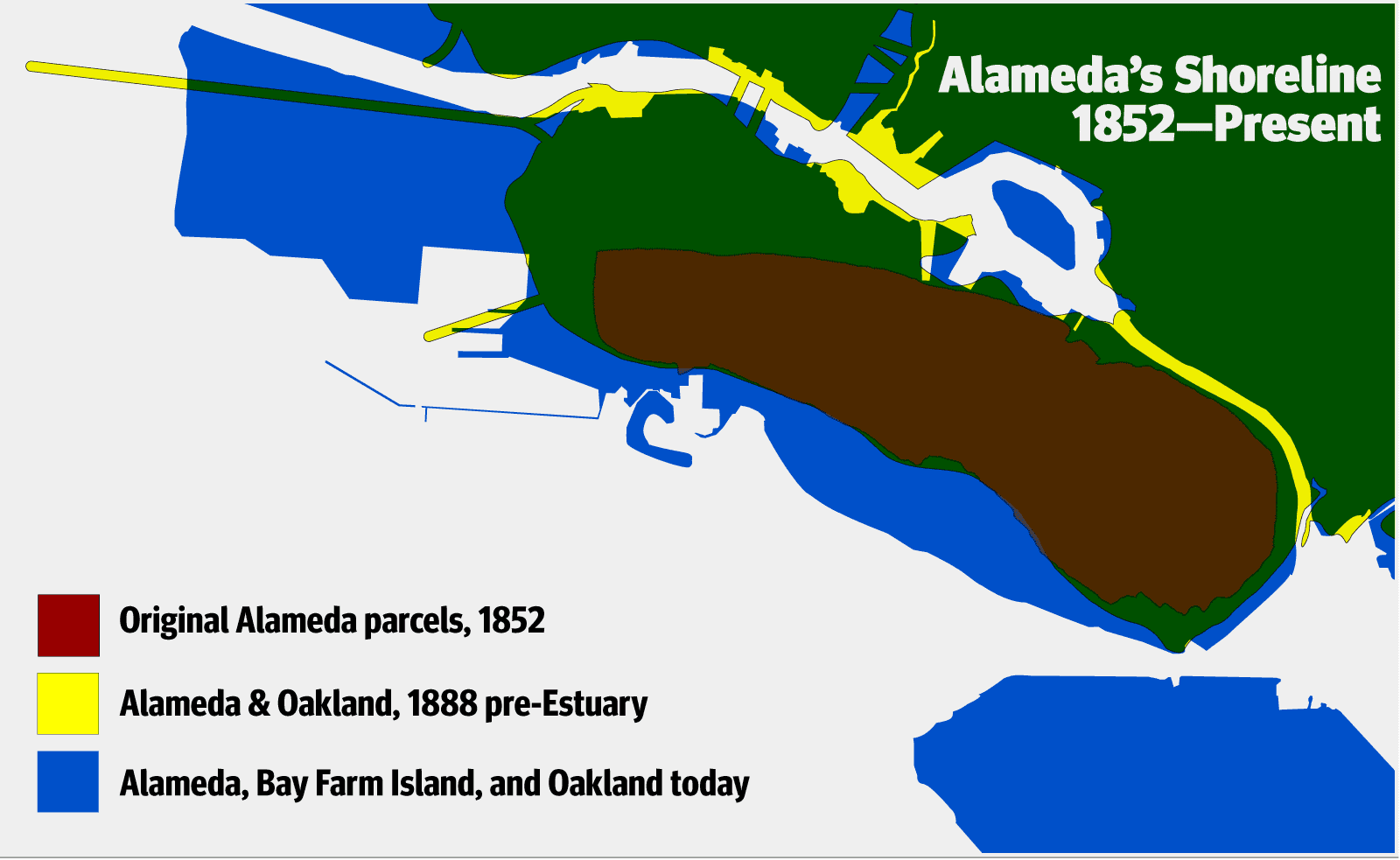
Utah Construction’s dredge Franciscan arrived off Alameda’s San Francisco Bay shoreline on November 7, 1955. By the end of the following year, the dredge had created the land we know today as South Shore. The Franciscan did not finish its Alameda tasks with the South Shore project, however. On New Year’s Eve 1968, the company informed its shareholders that its “hydraulic electric dredge has placed 22 million yards of fill at Bay Farm Island for a reclamation district.” We know that district as Harbor Bay Isle.

How all this was allowed to happen is a story that begins with two parties: a 19th-century family on Bay Farm Island and a pair who invested their money in the tidelands along today’s South Shore.
We can trace the expansion of Bay Farm Island to include Harbor Bay Isle to Amos Mecartney, for whom Mecartney Road is named. Amos attempted to bring this property under cultivation in the 1870s. He hired some 500 Chinese workers to help him accomplish the task. However, Amos died in 1903 without finishing this large undertaking.

After his death, Mecartney’s widow Dolly moved to Berkeley. In 1914, she sold most of the family’s Bay Farm property to A. M. (Arthur Mervil) Parsons. Parsons had pioneered the idea of transforming seemingly worthless marshland into housing subdivisions. In 1906 he converted the marshes along Alamitos Bay in Long Beach into a development called Naples. Perhaps he had the same plan in mind for Bay Farm when he purchased the property?
Parsons changed his mind—apparently—and, in 1917, sold the land to Roy Pike, C. A. Beardsley, and P. R. Thompson. These gentlemen incorporated their business as The Alameda City Land Company. They announced plans to create “Alameda Acres,” but their corporate papers told another story. Poor’s Publishing Company quoted the papers as saying that these men created this company “to engage in farming,” something hardly feasible in the marsh that Mecartney had failed to tame.

A careful look at Alameda City Land Company’s board of directors reveals an interesting name: A. C. (Arthur Cline) Parsons, who was A. M. Parsons’ son. The elder Parsons may have sold his property, but he made certain that his family remained involved. Alameda City Land Development chose to create an artificial seawall on the western edge of their property. They did this by sinking six stripped-down World War I destroyers on the western edge of their property along what became Aughinbaugh Way.
Join the Alameda Post’s Adam Gillitt and Dennis Evanosky as they untangle the tales that brought an out-of-state giant to town—and how that colossus transformed Alameda. The Post will offer a Zoom presentation for ticketholders about Utah Construction’s role in creating South Shore and Harbor Bay Isle at 7 p.m., Thursday, April 11. You can join them at 1 p.m., Saturday, April 13 (Note – later start time for this one tour) or 10 a.m., Sunday, April 21 to explore South Shore, or meet at 10 a.m. on either Sunday, April 14 or Saturday, April 20 to visit Harbor Bay Isle. Tickets are $20 each.
The May 5, 1921, edition of the Oakland Tribune heralded the opening of “Alameda Acres.” Pike, Beardsley, and Thompson pinned their fortunes to a paper naval base. The Tribune described their property as “the farm-home tract close to the site of the $100 million United States naval base.” According to the Tribune, the trio also promised “a harbor front lined with shipping, warehouses, factories, and other activities.” The Navy changed its mind; “Alameda Acres” withered and died. By 1954, the property belonged to Utah Construction.
The story of the development of Alameda’s South Shore begins in the 1920s, when Stanley Hiller and Joseph J. Coney began buying all the available Alameda tidelands from private parties. Hiller Highland’s bears the family name. The family once lived there, and Stanley, Jr. began crafting a vehicle we know the family best for today, the helicopter.


Although not as well known, Joseph Coney began his career as a naval architect for Consolidated Steel. For many years, he partnered with Stanley Hiller Sr. in the Hillcone Steamship Company. Hillcone operated oil tankers and owned gold dredging operations from California to Alaska. They also invested in real estate.
By 1954, Hiller and Coney had managed to purchase all the tidelands along Alameda’s San Francisco Bay shoreline defined roughly today by Otis and Westline drive and the northern shore of the lagoons that stretch east to Waterton Street. The pair created Alameda South Shore Land Development Company and proposed something that startled most Island City dwellers.
Hiller and Coney announced that they wanted to build 1,500 homes along with a six-lane freeway about 2,000 feet offshore that would connect with a new Bay Bridge dubbed the Southern Crossing. Faced with strong opposition from Alameda residents, the developers withdrew their plan and sold their property to the Utah Construction Company.
Coney and Hiller sold their South Shore tidelands to Utah Construction in 1950. Utah was negotiating with Alameda City Land Development for the Bay Farm property at the time. Utah put that real estate in its portfolio in 1954.
Utah had grand plans, many of which the City of Alameda scaled back. The City sorely needed to recover the tax base it had lost. The end of World War II brought an end to most of the shipbuilding here and scaled back the Navy’s presence at Naval Air Station.
Next week’s article will look at how the voters allowed Utah to bring its dredge Franciscan into play both at Alameda’s South Shore and at the Promised Land of “Alameda Acres.”
The Post would like to thank Michael Colbruno for his information about Stanley Hiller and Joseph J. Coney.
Dennis Evanosky is the award-winning Historian of the Alameda Post. Reach him at [email protected]. His writing is collected at AlamedaPost.com/Dennis-Evanosky.
