On May 27, the Planning Board held a workshop to guide staff in drafting updates to the inclusionary housing ordinance, focusing on addressing housing affordability and legal issues. A key issue precipitating an update is that rental units designated for moderate-income renters frequently sit vacant because they offer little to no discount over market-rate units. In the meantime, homeownership opportunities for moderate-income households are inadequate.

Background
Inclusionary policies aim to integrate residents from various income levels, fostering socio-economic diversity. Alameda’s inclusionary ordinance requires that 15% of units in residential projects with five or more units be made affordable to very low-income (4%), low-income (4%), and moderate-income (7%) households. The ordinance applies to all residential projects; those located on Alameda Point are subject to a higher threshold of 25%.
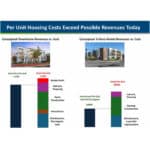
A key issue spurring the need for an update is that “moderate-income” rental units, intended to make housing more affordable for middle-income residents, effectively function as market-rate units. As post-pandemic rents in Alameda have softened, market-rate apartments are now priced comparably to moderate-income units. Yet, moderate-income renters prefer market-rate apartments, which aren’t burdened with the restrictions and paperwork of the specially designated apartments.
Consequently, as reported in other news outlets, including the San Jose Mercury News, units designated for moderate-income renters earning between 80% and 120% of the area median income (AMI) frequently sit vacant. Still, landlords have been reluctant to lower rates, fearing that renters could pay at that level for years due to rent control restrictions. In the long run, they need rents to be high enough to pay back their loans.
Conversely, whereas there is good demand among moderate-income households for housing ownership opportunities, it has been challenging to find qualified very low- and low-income buyers who can provide the necessary down payment and meet the ongoing costs of ownership.
Another issue spurring the update is the disparity in the costs of inclusionary requirements for ownership versus rental housing. Finally, the current ordinance lacks an in-lieu fee for larger developments, as required by state law. Developers can pay in-lieu fees instead of building on-site affordable housing. Cities use the fees to fund affordable housing developments off-site.
Planning staff recommended updates to address these issues.



Recommended changes
City of Alameda Planning Services Manager Steve Buckley and Street Level Advisors consultant Kearstin Dischinger led the workshop. Their recommendations included:
- For rental projects, require that 10% of units in projects with five or more units be made affordable to very low-income (4%) and low-income (6%) households, increasing the percentage of units for low-income households but eliminating moderate-income units, which are too similar to market rate units to provide benefits.
- For homeownership projects, require that 20% of homes be made affordable to moderate-income households, significantly increasing ownership opportunities for middle-income households but eliminating opportunities for low- and very-low-income households, which have generally had difficulty providing the necessary down payment and meeting ongoing ownership costs.
- Expand in-lieu fees to all project sizes and increase existing fees to incentivize on-site inclusionary housing.
- Improve cluster agreements, wherein developers partner with a nonprofit or housing authority to develop affordable units on a separate parcel, by formalizing criteria and oversight to ensure any donated land is viable for development and doesn’t burden city resources.
- Extend the term of affordability from 59 years to 99 years or the life of the building, aligning with regional best practices.
Board feedback
Most Boardmembers supported the overall direction of the consultant’s recommendations, expressing support for shifting away from moderate-income rental units toward more units affordable for those at 50-80% of the Area Median Income. Boardmember Hanson Hom noted “the huge need for very low and low-income units.” Conversely, Boardmembers supported increasing the percentage of ownership homes for middle-income households.
Hom expressed interest in exploring shared equity models for affordable ownership units. He argued that this type of homeownership could help residents build wealth and enable upward mobility while preserving long-term affordability.
Both Hom and Board President Xiomara Cisneros supported having a provision allowing developers to lower rent on middle-income units when the market is low, so the units don’t sit vacant, and allowing the developer to increase the rents to what would be affordable to households in the 80 to 120% AMI when the market recovers.
Boardmember Asheshh Saheba emphasized the need for ongoing dialogue with the development community to understand what is working, analyze economic triggers, and align policy with what would restart stalled pipeline projects.
Next Steps
Planning Services Manager Buckley indicated that the next steps will include outreach to the residential development community and other stakeholders, drafting a revised ordinance incorporating Board feedback, and returning for review.
Contributing writer Karin K. Jensen covers boards and commissions for the Alameda Post. Contact her via [email protected]. Her writing is collected at https://linktr.ee/karinkjensen and https://alamedapost.com/Karin-K-Jensen.
