Number of parking spaces debated
On July 1, City Council approved a revised Aquatic Center design with project funding of $35.5 million. Project costs increased by $5.5 million over the original $30 million budget due to a convergence of economic and site-specific challenges, including liquefaction risk and high groundwater levels. Parking was a significant issue of debate, and Council will revisit the issue of how much parking to construct in October.
Council also appointed new members to the Commission on Persons with Disabilities and the Historical Advisory Board and reappointed members to the Library Board, Planning Board, and Public Utilities Board.

Revised design and costs
Recreation and Parks Director Justin Long presented the final design and funding plan for the Alameda Aquatic Center, seeking approval for a revised $35.5 million budget and project design. The project aims to increase access to aquatic facilities, provide consistent year-round programming, and improve water safety education. It also supports city sustainability goals by electrifying the facility, thereby eliminating the use of natural gas.
Initially approved in 2023 with a $30 million budget, the project’s cost rose to $42 million due to inflation, rising material costs, and site-specific challenges, including liquefaction risk and high groundwater levels. In response, the city undertook a value engineering process to reduce costs while maintaining essential elements, particularly the full-size competition and activity pools, while also addressing geotechnical issues critical to ensuring long-term stability and avoiding costly repairs.
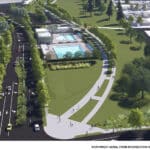
Significant design changes include removing the outdoor pavilion, reducing the parking lot size, condensing the administration building by 1,000 square feet, reorienting the activity pool to reduce its deck size, and utilizing more cost-effective materials. The updated plan preserves the core elements: a 30-meter competition pool, activity pool, shaded seating, locker and mechanical rooms, and enhanced bicycle facilities, including expanded bike parking and secure lockers.
Parking was reduced from 93 to 67 on-site spaces. However, a shared-use agreement with a neighboring property associated with the College of Alameda and Blue Rise Ventures adds 126 additional parking spots during evenings and weekends. The center is situated near bike trails and transit routes, and the Recreation and Parks Department plans to encourage biking, ride-sharing, and transit use through incentives and education.
The final design integrates with the surrounding Jean Sweeney Open Space Park, preserving existing trees and utilizing natural colors and materials to blend with the landscape. Economic uncertainty and rising construction costs are included in the revised project cost. The facility is projected to open by January 2028.

Public comment
Public speakers supported the Aquatic Center but differed sharply on how much parking to provide. Some advocated for ample parking, focusing on the facility’s regional draw and logistical needs. Others advocated for reducing parking and charging for it to encourage the use of public transit and active transportation.
Marla Koss of Alameda Backyard Growers, Swim Coach Amelia McDonald, and Chris, a self-described “water polo superdad,” stressed the need for sufficient parking to ensure accessibility. Koss, representing the planned Jean Sweeney community garden that will be adjacent to the Aquatic Center, emphasized the need for parking so gardeners can bring supplies to the garden.
Chris supported increased parking plus an overflow agreement with the College of Alameda, arguing that tournaments generate economic benefits—“Without ample parking, we’ll lose these events to better-equipped cities.” McDonald added that not everyone can bike, especially families, older adults, those carrying equipment, and those with tight schedules, adding, “These are the people that I want in the water.”
Several speakers, including Christy Cannon of Community Action for a Sustainable Alameda, Mitchell Ball, Cyndy Johnson of Bike Walk Alameda, and Thushan Amarasiriwardena, argued that the proposed parking lot was too large and conflicted with the City’s climate goals. Cannon called the proposed parking “shocking,” stressing that Alameda’s Climate Action and Resiliency Plan encourages reducing car use.



Ball criticized the City’s planning assumption that over 90% of users would drive, calling it “unrealistic.” Johnson urged leveraging the facility’s access to bike lanes and transit, as well as reducing parking, to preserve open space. Amarasiriwardena added that current trends show a reduction in driving per capita and called for prioritizing sustainability.
Speakers appreciated the addition of bike lockers, a planned drop-off zone, and transit proximity, though Amarasiriwardena criticized plans to charge for bike lockers while offering free parking for cars.

Council debate
Vice Mayor Michele Pryor supported the plan as is but urged planning overflow parking for tournaments. She added, “We should absolutely consider charging for parking,” while suggesting provision of a “permit parking program” for community garden users.
Councilmember Tracy Jensen emphasized the importance of reducing reliance on cars, saying, “We have prioritized parking in Alameda for far too long.” She called for looking at disincentives to driving, including charging for parking. Still, she encouraged the shared-use agreement with the College of Alameda to provide parking along Atlantic Avenue.
Mayor Marilyn Ezzy Ashcraft opposed automatically building 67 spaces, citing climate and heat island concerns. “Adding a parking lot right off the bat, with 67 spaces, is adding more asphalt at a time when we’re seeing our (temperatures) rise and rise,” she said. The mayor also noted that other cities, like Piedmont, host tournaments with minimal parking, stating, “Somehow people get there.”
Councilmember Tony Daysog proposed a flexible approach: “Give authority to staff to build up to 67 parking spaces,” allowing adjustments if needed. He noted that the Aquatic Center would be an ideal destination for bicyclists using the Cross Alameda Trail. Still, he acknowledged the need for a “robust parking program” to accommodate regional meets.
Councilmember Greg Boller called for flexible, tech-driven approaches to manage parking equitably. He suggested that a modern parking system could differentiate between users, such as people with disabilities, carpools, electric vehicles, short-term drop-offs, and deliveries by using “dynamic technological” tools and clear policy priorities. He supported shared-use agreements with nearby business parks and the College of Alameda, echoing concerns about the environmental impacts of adding excessive asphalt.
Council vote
Council voted 4–1 to approve the revised City Aquatic Center Project at a cost of $35.5 million. The Council voted to proceed with 67 parking spaces for permitting and bidding purposes, but included a 50-space alternative. Council plans to revisit the parking decision in October based on costs, CEQA implications, and further transportation demand analysis. Council also directed staff to continue negotiating shared parking agreements with nearby businesses and the College of Alameda.
Mayor Ashcraft, the lone “no” vote, argued for a more robust shared parking program and to study what would be the minimum parking needed, saying, “If you build it, they will come,” indicating that if the City builds more parking, more people will drive, rather than choose alternative methods of transportation. She called on her fellow elected officials to “take a stand and say, ‘You know what, we can make a difference.’”
Commission and Board appointments
In other business, City Council appointed Julie Lyons as a Member of the Commission on Persons with Disabilities and David Crotty as a member of the Historical Advisory Board, and reappointed Dimple Kanji and Sara Stricker as Members of the Library Board, Xiomara Cisneros and Andy Wang as Members of the Planning Board, and Christina McKenna as a Member of the Public Utilities Board.
Contributing writer Karin K. Jensen covers boards and commissions for the Alameda Post. Contact her via [email protected]. Her writing is collected at https://linktr.ee/karinkjensen and https://alamedapost.com/Karin-K-Jensen.
