We need to talk about e-bikes and e-scooters. The City of Alameda encourages active transportation—walking, biking, and using public transportation—to reduce greenhouse gas emissions (GHGs) that cause global warming and sea level rise, and for health benefits.
Transportation, primarily on-road travel, is the single largest source of GHGs in California, according to the California Air Resources Board. The City’s ambitious Climate Action Resiliency Plan (CARP) has set targets, in line with the State and scientific community, to reduce GHGs 50% below 2005 levels by 2030, and become carbon neutral by 2045. We support these objectives by building more bicycle infrastructure every year, including the recently completed Clement Avenue cycle track and improvements currently underway on Central Avenue.
I often urge parents to let their children—especially high school and middle school students—get themselves to school by walking, riding a bike or scooter, or taking public transportation. Lately, I’ve heard from parents, including those who ride their bikes to school with their elementary school children, that close encounters with e-bikes and e-scooters have made their bicycle commutes feel unsafe.
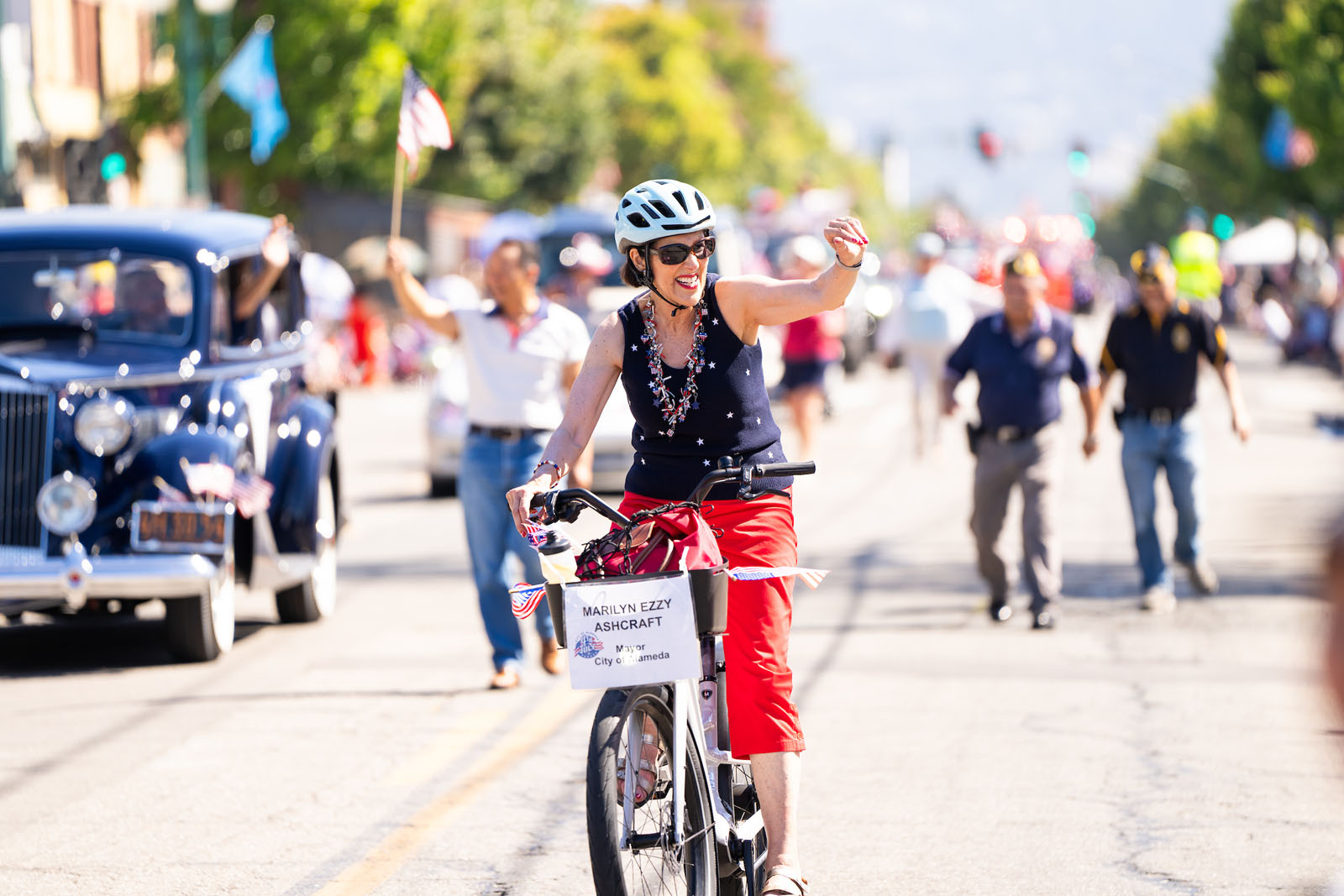
As a longtime cyclist who has ridden a borrowed e-bike in the last three 4th of July Parades (thank you, Alameda Bicycle!), I have enjoyed the extra boost an e-bike can provide. E-bikes also provide active mobility for those who find pedaling a standard bike challenging. However, the growth in popularity of e-bikes and e-scooters has outpaced education and understanding about their safe operation, so I asked the Alameda Police Department (APD) for safety tips. Huge thanks to Captain Jeff Emmitt and Sergeant Frank Petersen for the following input!
First, APD wants to remind you that e-bikes must follow the same traffic laws as other vehicles and traditional bicycles.
Jared Sanchez, California Bicycle Coalition Policy Director, notes that, according to California state law, “the term ‘e-bike’ only applies to pedaled bicycles whose motor support is limited to either 20 or 28 mph, depending upon its class. The state classifies e-bikes as Class 1, 2, or 3.”
- Class 1 is a low-speed pedal-assisted e-bike equipped with a motor that provides assistance only when the rider is pedaling and stops providing assistance when the bicycle reaches 20 mph.
- Class 2 is a low-speed electric bicycle with pedal-assist and throttle modes that has a top assisted speed of 20 mph.
- Class 3 is a pedal-assisted electric bicycle that provides assistance only when the rider is pedaling and stops providing assistance when the bicycle reaches 28 mph.
The operator of a Class 3 electric bicycle:
- Must be 16 years old or older.
- Must wear a bicycle safety helmet.
- Must not transport passengers.
- May ride an electric bicycle in a bicycle lane if authorized by local authority or ordinance.
NOTE: The Alameda Municipal Code does not authorize Class 3 electric bikes to ride in a bike lane.
APD emphasizes that e-motos (electric motorcycles) are not e-bikes. There are big differences between the two, and e-motos are not allowed in bike lanes. They are considered vehicles and are subject to the same requirements as a motor vehicle.
Don’t drink and ride. Drivers can still be arrested for DUI, regardless of e-bike class or moped/e-moto/scooter driven.
Do not alter manufacturer speed governors. Tampering with e-bikes to increase speed is illegal. (CA Vehicle Code (CVC) section 24016(d))




Motorized scooter info—CVC section 21235 covers the operation of motorized scooters, including, but not limited to the following:
The operator of a motorized scooter shall not:
- Operate a motorized scooter without wearing a properly fitted and fastened bicycle helmet … if the operator is under 18 years of age.
- Operate a motorized scooter without a valid driver’s license or instruction permit.
- Operate a motorized scooter with any passengers in addition to the operator.
- Operate a motorized scooter upon a sidewalk, except as may be necessary to enter or leave adjacent property.
- Leave a motorized scooter lying on its side on any sidewalk, or park a motorized scooter on a sidewalk in any other position, so that there is not an adequate path for pedestrian traffic.
APD encourages e-bike, e-scooter, and electric motorcycle riders, and parents of minor riders, to educate themselves about the applicable laws governing these means of transport.
“Best practices” for e-bike/e-scooter operators include maintaining a high visual horizon while constantly scanning ahead when riding and giving yourself enough space to slow down or stop. With electric motors providing supplemental power, it is easy for riders to travel at speeds which are too fast for the conditions, e.g. approaching intersections, riding around vehicles, etc.
Bicyclists, like drivers, should refrain from using a cell phone while riding—it is a potentially dangerous distraction.
When bicyclists are on the roads, they must obey the same laws as vehicles. That means no riding bicycles through crosswalks. If a bicyclist chooses to use a crosswalk, they should dismount and walk their bicycle so they are considered pedestrians and have the right-of-way.
And, if passing another rider or a pedestrian, bicyclists should be courteous and call out, “Bicycle on your left,” etc., or ring your bell to let them know.
Let’s embrace all forms of active transportation safely and with respect for our fellow roadway users.
Stay Alameda Strong, and Active!
Marilyn Ezzy Ashcraft is the Mayor of the City of Alameda. Reach her at [email protected].
