Western bluebirds are among the most beautiful birds in Alameda. The male is intensely blue with bronze highlights and the female is equally beautiful, with more subtle coloration. Western bluebirds are now quite common in open-space areas of the city, but that was not always the case. Before 2010 they were rarely seen here, and for a few years after that they were seen only in winter around Crown Beach, traveling elsewhere to nest during spring.

Bluebirds often live in suburban environments, and their populations have been fairly steady overall in the Western United States for decades. So why has their population exploded in recent years in Alameda? To answer that mystery, it is important to understand their habitat needs, how humans caused their demise in Alameda and elsewhere, usually not on purpose, and how humans have helped bring them back.
Bluebirds need open space like grasslands to hunt invertebrates, and they also need trees or open forest for nesting, roosting, and hunting. The Crab Cove area of Crown Beach is prime bluebird habitat for food, but not for nesting. Bluebirds nest in holes in trees, called cavities. They do not make the holes—woodpeckers usually do. Sometimes the holes form when branches fall out of trees. If the woodpeckers make more cavities than they need, if they abandon them, or if they die, the nests become available for other species. Although woodpeckers will build cavities in many kinds of trees, they almost always use dead wood because it is much easier to excavate than living wood.

In Alameda and other cities, park staff and homeowners usually cut down dead trees and large, dead branches so that they will not fall on buildings or endanger humans. By protecting people and property, we also take away potential nesting habitat for bluebirds.
Despite this general lack of dead wood in Alameda, in Spring 2013, a pair of bluebirds nested in a hole in a tree in Washington Park, the first known nest in the city since records have been kept. Unfortunately, the nest was not successful, but it inspired Francis Mendoza, a former naturalist with the East Bay Regional Park District (EBRPD), to improve nesting habitat for bluebirds at Crown Beach.
Mendoza teamed up with teachers and middle school students at Nea Community Learning Center to research where the bluebirds were hunting in the Crab Cove area, and to help decide the best locations to install bluebird nest boxes. The students then built six wood nesting boxes, some covered with creative paint jobs. In the winter of 2013/2014, the boxes were installed.

In the spring of 2014, bluebirds successfully nested in one of the boxes. One year later, four of the six boxes had successful bluebird nests. Bluebirds were here year-round and, for many years since then, most of the nest boxes have had nests. Bluebirds, now on the search for more opportunities, have successfully nested in a few tree cavities and even in an abandoned utility pole in less developed parts of Alameda, further increasing the population.
Connor Nitsos is a Park Ranger at Crown Memorial State Beach, which is managed by EBRPD. He loves bluebirds. In the winter of 2022/23, he built and installed four nest boxes in the Crab Cove area. Inspired that they were used that spring, he built and installed eight more in the winter of 2023/2024. In mid-June of this year, at least 10 out of 18 nest boxes in the Crab Cove area were being used by bluebirds, and two by tree swallows. It is possible that others had been used earlier in the spring. This is a high rate of occupancy and a huge success! If bluebirds could thank both Francis and Connor, they certainly would.

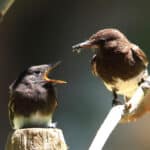


Bluebirds are easy to see as they hunt, which makes them fun to watch. Sometimes they hover in the air above potential prey, and often they pounce onto the ground to catch their meal. Sometimes they catch insects in the air or pick caterpillars off shrubs and trees. In the spring and summer, they eat mostly insects, spiders, and other invertebrates. In the fall and winter, they switch over to eating mostly berries and seeds. In the fall, a large toyon bush outside of the Doug Siden Visitor Center at Crab Cove brings much joy to human observers as beautiful bluebirds eat the bright red toyon berries.
Now that bluebirds are so plentiful in Alameda, they help control populations of some insects. Tree swallows that have used some of the nest boxes are insectivores, and they help control mosquitoes

Bluebirds nest April through July. When the babies are small, the mother or father bluebird goes all the way into the box or cavity to feed their noisy chicks. When the babies are bigger and can reach up to the entrance hole, the parent can quickly deliver a meal without going inside. Between the Crown Beach main parking lot and the Glory of the Seas Building at Crab Cove, there are currently 18 nest boxes, and more may be added. If you come to watch bluebirds and the nesting season has finished, you can still find them hunting all over the area. Ask a park ranger, naturalist, or interpretive student aide where to look.
Remember, we humans cut down dead trees for safety, but that is bad for birds that are cavity nesters. Would you like to do something to improve nesting habitat? Consider installing nest boxes around your home, school, or community center.

If you want to help a particular kind of bird, first research the location to find out if it’s the right habitat, and make sure you have the right-sized box with the right-sized hole. Bluebirds may sometimes come into the middle of neighborhoods, but they tend to nest only near open space. There are many places in Alameda that are appropriate for installing bluebird boxes. Other cavity-nesting birds like chickadees, Bewick’s wrens, nuthatches, and oak titmice will nest in the middle of neighborhoods if there is enough food nearby. You can increase healthy food for birds by planting a garden of California native plants and growing that garden organically.
We invite you to come to Crab Cove to watch Western bluebirds.
For more information about bluebirds, including directions on how to build nest boxes, visit the following websites: California Bluebird Recovery Program, North American Bluebird Society, and the Golden Gate Bird Alliance. You can also easily find nest boxes for bluebirds and other cavity nesters for purchase online.
Michael Charnofsky is a Naturalist with the East Bay Regional Park District, based at the Doug Siden Visitor Center at Crab Cove, Crown Memorial State Beach in Alameda. This article is part of a series from the Friends of the Alameda Wildlife Reserve (FAWR), a Conservation Committee of the Golden Gate Bird Alliance (GGBA, formerly Audubon). Learn more about FAWR at www.goldengatebirds.org.
