I visited Southie (South Boston) in 1977 for the annual St. Paddy’s Day Parade, the most Southie thing the people of Southie did and do each year. It was not a good time then for the neighborhood, due to the resisted efforts to integrate the public schools through busing, which had begun three years earlier. Lawsuits and protests gave way to riots and racial violence. Rocks were thrown at school buses and there were casualties from the many harsh altercations. Governor Michael Dukakis was booed ferociously along the parade route.

David Lindsay-Abaire, the playwright of Good People—now showing at the Altarena Playhouse—grew up there and was a kid during that ugly time. And while his remarkable play is not specifically about those events from that era, they are the context and the subtext. It’s not ridiculous to think he was at the very same parade I witnessed, for Good People are his people.
Margie is a single mom who loses her job at the Dollar Store and struggles to support herself and her disabled adult daughter. She did not finish high school, has limited work skills, relies on friends to hold her life together, and cannot find a new job. Like so many people we used to call the “working poor,” her world was built with flimsy sticks. Where the story begins, the merciless wind finally won. A friend suggests she reach out to someone she once dated while in high school, a local boy named Mike who left Southie, went to Penn, became a doctor and now lives in a wealthy suburb with his young African American wife and their daughter. Margie, desperate, does so and integrates herself briefly and uncomfortably into Mike’s life.

Russell Kaltschmidt’s direction of Good People is outstanding, and his casting and the dressing of the characters by costume designer Christine U’Ren are incredible. Alicia Rydman plays Margie while Nicole Naffaa is her best pal Jean. These two women, through their own physicality, voices, mannerisms, hairstyles, and clothing, are so perfectly authentic. Each creates the kind of person who’d entice you to offer to buy them a drink at a bar, but from whom you’d just as likely get a punch in the stomach as a dance in the dark.
Rydman’s Margie is especially moving and memorable. Upon finding out she’s about to be fired by her manager—the engaging and sweet Stevie played by Samuel Barksdale—Margie becomes Willy Loman from Death of a Salesman, literally begging for her job by offering to work for less, then less again, all to no avail. Her eyes break your heart. Naffaa’s Jean, wearing a Boston T-shirt in Act One (which probably should have been a Celtics jersey with Larry Bird’s number 33), is the tougher broad, and her love for Margie is most powerfully expressed when she cries out “F*** you!” in her friend’s defense.

Margie’s counterpart Mike, played by Daron Jennings, is a tall, handsome physician who rocks his lab coat like Doctor Kildare. The actor probably ends up playing a lot of doctors onstage, for his voice is deep and clear and his carriage regal. But as the play goes forward and we learn more about who he was before he became who he is, his inner Southie comes out. Tough may fade ,but it’s never really gone, and Jennings deftly shows Mike’s present and past selves. Rezan Asfaw plays his wife Kate and, in the same way Alicia Rydman’s Margie is spot on, Asfaw’s portrayal is equally believable. From her refined demeanor to her expertise with wine and cheese, she is so Georgetown, but she’s also endowed with integrity and grit. The one fully comical character, Margie’s landlord and friend Dottie, is a welcome contrast to the others. She’s got sand as they used to say, but speaks her mind, does not suffer fools, and is also pretty darn good at throwing F-bombs. Dottie could easily have been a neighbor of The Golden Girls.


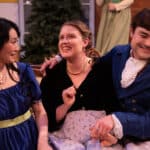

This is a play about class and privilege, capitalism and luck. Like Death of a Salesman, Good People puts on stage what might be called thrift-store or grocery-coupon people. Lindsay-Abaire gives them the poetry of the ordinary to speak and they join Willy, the Joads, and in some ways nearly all of August Wilson’s characters, as working class heroes. But this play, and those stories, are far more complex. They are Shakespeare’s mirror, for while we sit and watch them in our theater seats, these are the same people living on the street not far from High Street, the same people who bag our groceries, deliver our Grubhub orders, and fight in our wars. To borrow from Linda in Death of a Salesman, “Attention must be paid.”

Let me leave you with one small detail, among so many, that director Kaltschmidt got exactly right. Early on, Margie, Jean, and Dottie are having coffee in unmatched mugs, and instead of adding cream, they use Coffee Mate. Of course. Coffee Mate.
Good People is the kind of theater this reviewer craves every time he sees a play: a story of truth, written with craft, performed by amazing actors led by an insightful, sensitive director. Thank you Altarena Playhouse for your great work.
Good People runs from now through September 21; Fridays and Saturdays at 8 p.m. and Sundays at 2 p.m. More information is available online at the Altarena Playhouse website. Tickets may be purchased online.
Gene Kahane is the founder of the Foodbank Players, a lifelong teacher, and former Poet Laureate for the City of Alameda. Reach him at [email protected]. His writing is collected at AlamedaPost.com/Gene-Kahane.
