This month’s walk will take us through a family estate that Edwin and Lucretia Mastick’s children developed into a neighborhood. “Mastick Park” is an exception to an Alameda phenomenon, with estates becoming parks rather than neighborhoods. Chochenyo Park began life as the private grounds for A. A. Cohen’s Alameda Park Homestead. R. R. Thompson made his home in Lincoln Park. William Dingee owned a mansion in modern-day Washington Park. The Waymire family called today’s McKinley Park [1] home. Charles and Eliza Baum settled down in today’s Franklin Park [2].
 [3]
[3]The “Mastick Park” story begins with Edwin Baird Mastick, who was born in Burton, Ohio on March 22, 1824, to Benjamin and Elizabeth “Eliza” Tomlinson Mastick. He was the second of nine children. When Edwin was still an infant, his parents moved to Rockport, Ohio. Edwin attended law school in Cleveland and began to practice law there. When he was 24, he married Lucretia Mary Wood. They lived in Rockport, Ohio.
In 1851, Edwin set off for California. Just after his arrival, he obtained a clerkship at the California Supreme Court. Over the next 43 years he built a large law practice with offices at 520 Montgomery Street in San Francisco. He sat as a senior partner in the law firms of Mastick & Mastick; Mastick, Belcher & Mastick; and Mastick, Van Fleet & Mastick.
Edwin and Lucretia had five sons—George, Edwin Jr., Charles, Reuben, and Seabury. The couple had a daughter, Lucretia, affectionately known as “Lulu.” She married another prominent Alameda resident, Edwin’s law partner and future mayor Frank Otis.
Edwin lived in Alameda for 37 years, from 1864 until his death in 1901. He had a large estate bordered on the north and south by Pacific and Railroad avenues and on the east and west by Wood and Prospect streets. The city renamed Railroad Avenue to Lincoln Avenue in 1909. Wood Street was named for Lucretia’s family; Prospect Street is Eighth Street today.
 [4]
[4]Edwin sat on the board of directors of A.A. Cohen’s San Francisco & Alameda (SF&A) Railroad. Cohen named the railroad’s first locomotive “E B Mastick” for Edwin, and placed one of SF&A’s stations at Edwin’s doorstep on what today is Lincoln Avenue.
Edwin also served as a member of Alameda’s board of trustees (an entity comparable to today’s City Council) from 1878 to 1893. He served as the board’s president (the equivalent of today’s mayor) from 1883 to 1893.
It is sometimes incorrectly stated that Mastick was Alameda’s first mayor. That honor goes to Henry Haight, who had already served as California’s governor and lived on a large estate on the West End. The city of Alameda was incorporated in 1872 and was governed by a board of trustees. Haight served as president of that board, an office equivalent to today’s mayor.
Alameda didn’t have mayors as we now know them until it changed its charter to a mayor and city council form of government in 1916. The first mayor under the new charter was Edwin’s son-in-law Frank Otis.




 [5]
[5]Join Dennis for a walk through Mastick Park’s “bungalow heaven.” In 1864, Edwin Mastick settled here with his family in a gracious home along the San Francisco & Alameda’s railroad tracks on a street that become Lincoln Avenue. Prospect Street, today’s Eighth Street, bordered his property to the west. When Edwin passed way, his son George took down his parent’s home and subdivided the family’s 22-acre estate into 186 lots. He kept his own home intact on Pacific Avenue just outside the tract—we’ll take a look on the tour. George then hired C. C. Adams to develop “Mastick Park.” (We’ll meet Mr. Adams next month again when we tour Waterside Terrace.) Surveyors stretched Eighth and Ninth streets and Eagle Avenue through the estate and laid out Nason and Wood streets.
As we stroll through the development, Dennis will explain how American builders made the India-inspired, British-born bungalow—not a style, but a type of a home—their own. Click for more tour information.Tickets are $20 each. Get yours now! [6] Sunday, August 24 [7] or Saturday, August 30 [8]. [6]
Edwin died on February 17, 1901. His funeral took place at Mountain View Cemetery in Oakland. “Sacred music appropriate to the occasion was furnished by the Knickerbocker Quartet,” the Oakland Tribune reported. “The floral tributes were both numerous and beautiful.” The Tribune also informed its readers that, “A host of friends, among them some of California’s most distinguished public men, attended the funeral and paid their last respects to the departed.”
The Tribune went on to report that the city of Alameda owed a great deal of its prosperity to Mr. Mastick’s public-spiritedness. A large estate at the western end of the city was his, and Mastick Station, on the broad-gauge line, was named for him.
The demand for housing after the Great San Francisco Earthquake and Fire [9] convinced the Mastick children to lay out the 22-acre family estate—disused and vacant since their parents’ death—as a nine-block tract.
 [10]
[10]In 1907, work began on “Mastick Park,” which historian Woody Minor calls “Alameda’s oldest 20th century subdivision.” The new development was bounded by railroad tracks on the west (today’s Wilma Chan Way), with Wood Street on the east, Pacific Avenue on the south, and the proposed route of San Francisco, Alameda, and Eastern Electric Railway on the north. The latter became the Alameda Belt Line railroad yards, which today is Jean Sweeney Open Space Park.
The oldest of the Mastick children, George, engaged the Greater San Francisco Investment Company to finance the new development. He oversaw the development that featured an emerging type of house—the bungalow. Woody Minor tells us, “The influx of residents to the Island City in the aftermath of the earthquake assured brisk sales, and the tract was largely built by World War I.”
 [11]
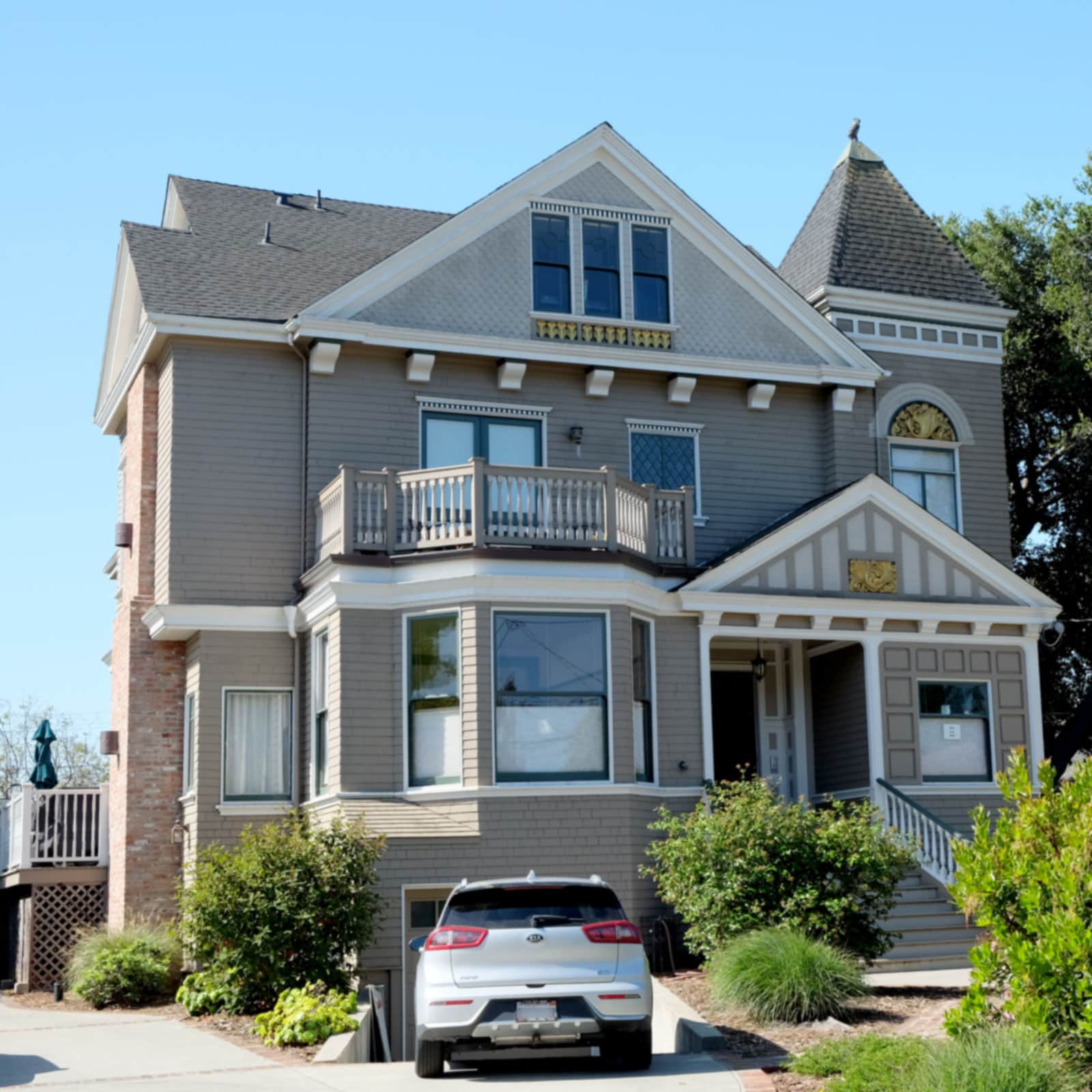
[11]We’ll start our investigation at George Mastick’s 1889 Queen Anne mansion, where he lived with his wife Lysbeth “Lizzie,” and their children Winifred, Spencer, and George Jr.
The development of Mastick Park began when bungalows were making their first appearance in Alameda. Although inspired by the British, who adopted a type of home from India, the bungalow took on a different life in the United States. American architects and builders dressed them in styles that had emerged from designs borrowed largely from the Craftsman and Colonial Revival styles. Stucco clads many of these homes with their wide porches featuring “Elephantine” columns that taper toward the top. These columns, which borrow their name from an island in the Nile River, became one of the trademarks of the bungalow.
Walking through the neighborhood will allow us to compare these 20th-century homes with those built nearby during the Victorian era.
Dennis Evanosky is the award-winning Historian of the Alameda Post [12]. Reach him at [email protected] [13]. His writing is collected at AlamedaPost.com/Dennis-Evanosky [14].