Public safety and homelessness services took center stage at the February 17 City Council meeting, as Councilmembers reviewed detailed data from the Alameda Police Department and considered multi-year contracts to support the City’s homeless response system. Council examined rising police enforcement activity alongside stable misconduct findings and weighed expanded shelter and mental health services against questions of oversight and fiscal safeguards.
In other business, Council ratified revised salary schedules for the City Council appointed Positions of City Manager and City Attorney to ensure compliance with California Public Employee’s Retirement System (CalPERS) requirements.
 [1]
[1]Police Auditor report
Police Auditor Dr. Leigh Grossman provided a high-level overview of Alameda Police Department (APD) activity in 2025, highlighting increases in internal affairs investigations, arrests, traffic stops, and use-of-force incidents, while noting no corresponding increase in substantiated misconduct.
Internal Affairs cases rose approximately 70% compared to 2024, which Dr. Grossman attributed largely to supervisors taking a more proactive approach to documenting allegations and complying with state reporting requirements. Of 59 cases, 48 were closed, and nine included at least one sustained allegation involving issues such as firearm safety, unsatisfactory work product, conduct toward others, and body-worn camera activation; disciplinary actions ranged from counseling and training to suspension.
Use-of-force reporting showed a 67% decrease in weapon display incidents (e.g., pointing a firearm or Taser), but a 54% increase in low-level force, primarily control holds. Control holds accounted for 76% of all force incidents.
Traffic stops increased by 89% in 2025 due to the department’s emphasis on traffic enforcement, particularly moving violations such as speeding and red-light infractions. Roughly half of stops resulted in citations and half in warnings, with outcomes generally consistent across racial groups. Notably, only 36% of those receiving citations or warnings were Alameda residents.
Calls for service remained relatively stable, totaling about 68,000 in 2025. Felony arrests increased 56% and misdemeanor arrests rose 28%, driven largely by theft and shoplifting enforcement in business districts. Pursuits remained limited (12 in 2025), were generally short in duration, and resulted in no pursuit-related collisions. Department vehicle collisions increased slightly, with employees found at fault in 78% of cases.
Community satisfaction surveys showed generally strong ratings, around 4.5 out of 5, with improved dispatcher satisfaction but a slight decline in officer professionalism ratings. Sworn staffing remains 25% below authorized levels and is currently frozen at 72 officers. Officers average about 100 hours of training annually.
Council discussion
Councilmembers expressed appreciation for the report’s transparency and the department’s efforts to track and publicly present detailed data. Councilmember Tracy Jensen [2] asked for clarification regarding the reported 25% sworn vacancy rate. Dr. Grossman explained that the percentage reflects the difference between the authorized staffing level of 88 officers and the current staffing level of approximately 69 to 72 officers, noting that although staffing is technically authorized at 88, there is currently a freeze at 72 positions.
Vice Mayor Michele Pryor [3] expressed gratitude that no collisions resulted from pursuits and emphasized the importance of carefully balancing public safety with enforcement decisions. She also praised the comprehensive tracking of all uses of force—including low-level incidents—highlighting that such reporting, combined with body-worn camera footage, strengthens accountability and community trust.
Councilmember Tony Daysog [4] thanked Dr. Grossman for contextualizing traffic stop data, particularly the impact of non-resident drivers on enforcement statistics. Councilmember Greg Boller commended the Alameda Police Department for enhanced transparency measures, increased enforcement in business districts to address property crimes, and attention to traffic safety concerns, such as speeding. Councilmember Boller also highlighted officer training as a strength, noting the substantial hours of training officers complete annually.
While expressing overall support, Mayor Marilyn Ezzy Ashcraft [5] expressed concern about sworn staffing levels remaining below the authorized number. She encouraged future efforts to increase staffing: “The numbers, the staffing, troubles me. We do need to get those numbers up to where they’re authorized.”
Council unanimously accepted the informational presentation.
 [6]
[6]Homeless shelter services
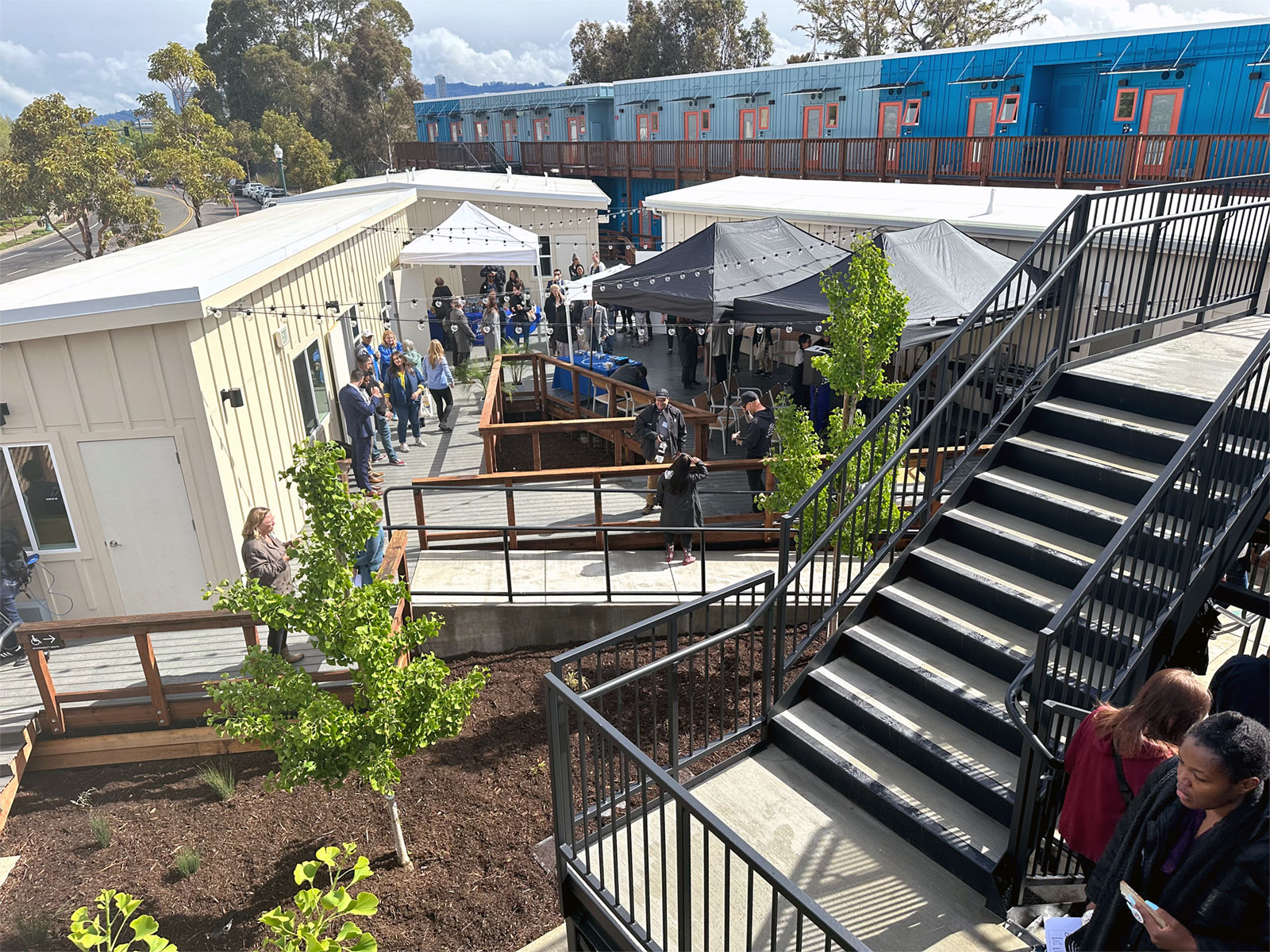
Housing and Human Services Manager C’mone Falls presented three related contract approvals aimed at continuing and strengthening Alameda’s homeless services system. The contracts address mental health services, emergency supportive housing operations, and day center/safe parking program management.
The first would authorize an agreement with Alameda Family Services [7] (AFS) to continue providing on-site therapeutic services at Dignity Village [8], the Emergency Supportive Housing (ESH) program, and the Day Center/Safe Parking Program. AFS currently provides crisis intervention, individual therapy, and connections to outside mental health, substance abuse, and housing resources. Falls emphasized that mental health and substance use challenges are increasingly complex among unhoused residents, making integrated clinical support critical within shelter settings.




The second and third contracts reflected the outcome of a competitive Request for Proposals (RFP) process for shelter operations. The City used a two-step review process—written proposals reviewed by partner jurisdictions, followed by oral panel interviews with Housing and Human Services staff and regional partners—to select the most qualified providers.
For Emergency Supportive Housing, staff recommended Ruby’s Place, doing business as Restorative Pathways [9], an organization with more than 55 years of experience serving families, single adults, and transitional-age youth and operating contracts with Alameda County and the City of Hayward.
For the Day Center, Safe Parking, and overnight emergency shelter, staff recommended Urban Alchemy [10], which has experience operating low-barrier programs, including safe parking, tiny home sites, and emergency shelters, in Alameda County and other jurisdictions.
Falls noted continued high demand for services, with the winter warming shelter currently over capacity. She reported that Alameda’s approach includes an integrated homeless services response system, with bi-monthly coordinated outreach meetings where providers review client cases by name to improve housing outcomes.
Public comment
Ian Clark-Johnson of Urban Alchemy expressed strong support for their proposed contract, describing the organization’s model as rooted in “love and respect” and built around staff with lived experience, including formerly incarcerated individuals and people who have experienced homelessness. He emphasized their 24-hour wraparound services, including a day center with showers and service access, safe parking to provide stability for vehicle dwellers, and overnight beds during cold weather.
A second speaker, who had received services at Dignity Village, raised concerns about the structure, accountability, and transparency of homelessness services, questioning the vetting process for providers and requesting greater public access to data, accreditation standards, and oversight mechanisms. Similarly, another commenter called for broader audits and oversight under the Sunshine Act and questioned funding, grant processes, and interagency coordination related to homelessness programs.
Finally, Karin Zeltzer of Alameda Family Services spoke in support of continuing mental health services, noting the benefits of having on-site therapists available for crisis intervention, de-escalation, individual therapy, staff consultation, and therapeutic group activities. She emphasized that housing and mental health services must operate in partnership to achieve long-term stabilization.
Council discussion and vote
Council discussion focused on contract oversight, renewal authority, and accountability. Falls clarified that contract extensions are contingent on program monitoring and outcome performance. The City Attorney further clarified that Council had delegated extension authority to the City Manager but could direct staff to provide updates to Council before renewals. Council agreed to amend the agreements to require that any extension be “approved by the City Council in an open and public meeting,” ensuring annual public review.
Councilmember Jensen asked about program oversight. Falls clarified that not all Emergency Supportive Housing sites have 24-hour on-site staff. For instance, family homes do not have overnight staffing. Oversight includes weekly provider meetings, coordinated outreach meetings twice monthly, and random site visits.
Jensen asked for clarification about a scope-of-work provision in the Restorative Pathways contract stating that the provider would “collect and save 30% of clients’ income and render the funds upon discharge.”
Falls explained that the 30% amount is based on a client’s ability to contribute and is not a strict requirement. She clarified that this is a flexible practice intended to support clients’ financial stability and savings needed for a successful transition into stable housing.
Councilmember Jensen questioned the vetting of Urban Alchemy, expressing concern about lawsuits, including a class-action lawsuit alleging labor violations. Mayor Ashcraft also brought up media reports of alleged budget overspending in San Francisco. City staff and Urban Alchemy’s CFO, Melek Totah, responded that overspending reports were incorrect, that Urban Alchemy had worked with the San Francisco Chronicle to correct reporting that resulted from being asked to add guests at a shelter for which they did not initially receive commensurate funding. Eventually, they did receive the funding and Totah affirmed that they did not exceed their budget. In addition, one lawsuit was dismissed and another settled, with internal controls relating to payroll and timekeeping greatly strengthened.
Mayor Ashcraft expressed satisfaction with Urban Alchemy’s explanation, noting that “there’s no one out there doing work that hasn’t run into difficulties, but we also give people credit for correcting them.” She added that annual public renewal of contracts would provide continued transparency and oversight.
The Alameda Family Services and Restorative Pathways contracts passed unanimously. The Urban Alchemy contract passed 4–1, with Councilmember Jensen voting no.
Contributing writer Karin K. Jensen covers boards and commissions for the Alameda Post [11]. Contact her via [email protected] [12]. Her writing is collected at https://linktr.ee/karinkjensen [13] and https://alamedapost.com/Karin-K-Jensen [14].