For three years, the Alameda Police Department has implemented the community beat program to offer a space for community members to directly speak to officers. The program divides the island into 12 beats, with a different officer assigned to each one, and holds meetings for each beat twice a year.
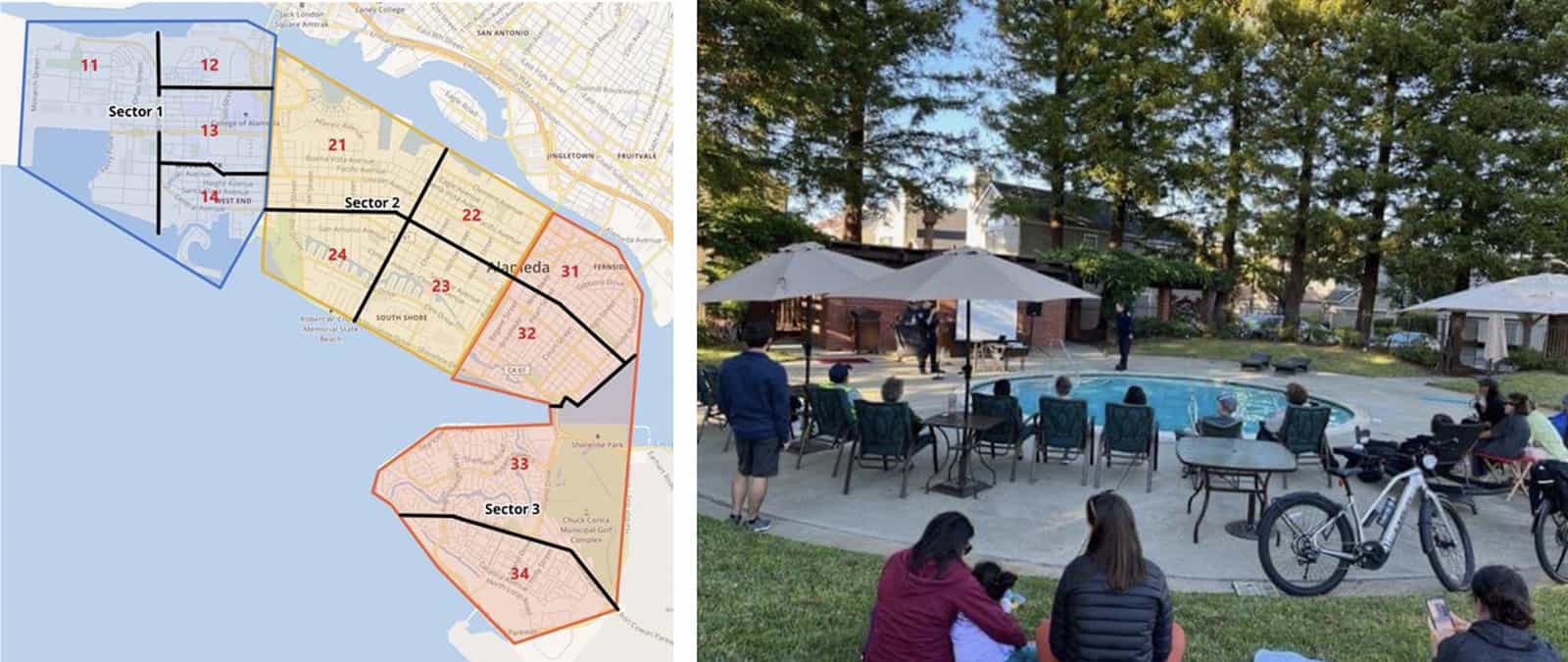
The meetings were conceptualized in 2022 when Chief Nishant Joshi first joined the Alameda Police Department (APD), according to Public Information Officer Michealia Parker.
“It gives community members a chance to sit and say, ‘These are the things we’ve been dealing with the last six months, how can we best address that?’” Parker said in an interview with the Alameda Post.
Beats 21 and 22 held their fall meeting on September 9 with Sergeant Michael Ortega. Thirteen community members gathered at Mastick Senior Center to hear preliminary crime statistics from Ortega and direct their questions to him.
Traffic was the primary issue, as is the case for all the beats, according to Parker. Residents questioned a new no-right-turn signal arrow with low-visibility at Atlantic Avenue and Wilma Chan Way. Ortega said the APD has no say in where signals are placed but said he would forward the feedback. Parker passed the message along.
“I e-mailed the city and let them know, ‘This is some feedback we received, can you guys send out either an AC alert or some kind of educational piece so people are aware of this new signal?’” Parker said. “We aren’t always informed when new infrastructure goes in, we just are there and have to enforce it.”
The meetings help APD to communicate the breadth of the department’s purview and fight misinformation, Parker said. During the September 9 meeting, Ortega addressed concerns with the Flock license plate tracking system used for stolen vehicles, which he said does not share information with ICE. Another resident posed the question of how many officers are typically assigned to a call, and Ortega said some protocols, such as domestic violence or suspicious person calls, call for two officers to be sent, while others, such as child or elder abuse, require a supervisor in addition to two officers, and major crime calls are usually all hands on deck.
“If you have to take someone in custody or take statements from witnesses, you might need additional resources,” Ortega said at the meeting. “There’s no perfect answer for each call, it just depends.”



Ortega asked several residents who brought up neighborly disputes and concerns of suspicious activity to speak with him separately. Parker said having more one-on-one interactions with community members is a major goal of the meetings that has been largely achieved.
“We are finding that we are building stronger relationships with community members, where officers know more people on a first-name basis,” Parker said.
Still, some residents at the September 9 meeting voiced issues with APD outreach and accessibility. Several people said they reached out and never received a follow-up. Another said the email list was faulty, and another said that finding out about the community beat meetings themselves was difficult.
Parker said that attendance usually fluctuates in accordance with major events. Last year’s homicide garnered higher attendance at beat meetings, Parker said. Regular attendance is around the 15- to 20-person mark, but she said increasing this number is key in improving APD efficiency.
“If we can increase attendance and get more of our community members to be involved in these meetings, the better we can work together to address concerns,” Parker said.
APD holds community beat meetings in the spring and fall, and dates can be viewed on the City’s Upcoming Community Meetings webpage.
Sindhu Ananthavel is a contributing writer to the Alameda Post. Contact her via [email protected]. Her writing is collected at AlamedaPost.com/Sindhu-Ananthavel.
