Alameda has been dealing with a structurally inadequate shoreline along its south shore ever since a developer pumped in sand from the Bay to create more land for homes and a shopping center in the mid-1950s. The developer left Alameda with an embankment that didn’t hold up well.

In 1976, barely 15 years after the development was completed, the City and the East Bay Regional Park District (EBRPD) asked the federal government to fund a major Army Corps of Engineers study of alternatives to deal with erosion threatening the street. The City and EBRPD chose the beach alternative that created today’s Alameda Beach in the early 1980s.
The existing remedy of a beach is now facing more extreme weather events causing major erosion and sea level rise. As part of its planning efforts for both immediate and long-term adaptation of the shoreline, the City recently submitted a grant application to the San Francisco Bay Restoration Authority to pay for designing new adaptation measures along the shoreline. State law now requires that all communities around the Bay have sea level rise shoreline adaptation plans by 2034.


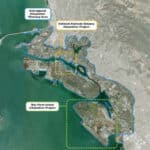
Called the Alameda South Shore Adaptation Project – Concept Design, its goal is not to produce construction drawings but rather overall concepts that will meet the new state requirements for shoreline adaptation. The study will be broken down into four concepts: (1) Bird Sanctuary and Bay Trail Concept; (2) Mudflat and Eelgrass Concept; (3) Stormwater and Lagoon Concept; and (4) Beach Nourishment Concept.
Bird Sanctuary and Bay Trail Concept
The Elsie Roemer Bird Sanctuary is at risk of being lost under water and will be evaluated for potential measures to enhance the existing salt marsh intertidal habitat through elevation changes and space for it to migrate as sea level rises. It will also seek to bolster the Bay Trail for sea level rise adaptation and ADA accessibility from the Bay Farm Bridge to the bird sanctuary.

Mudflat and Eelgrass Concept
The mudflat and eelgrass concept will explore opportunities to expand mudflats and the sizable offshore eelgrass bed. “The existing patch of eelgrass adjacent to Alameda’s south shore is about 340 acres,” states the grant application. “Nevertheless, rising water levels and rising temperatures are likely to reduce the suitability of this area for eelgrass in the future, making proactive efforts necessary to protect and expand this eelgrass patch.”
Eelgrass is considered a keystone subtidal species that enhances biodiversity, reduces sediment loss and improves sand management activities. The slender blades of grass are a favored habitat for fish, such as herring, to deposit their eggs.
“Mudflats are an essential habitat type and provide value for feeding birds since mud is a rich source of benthic organisms like snails, crabs and worms,” states the application.
Stormwater and Lagoon Concept
This concept will identify opportunities for green infrastructure, improvements in the piping system, the stormwater pump station and outfalls, as well as dredging the lagoons north of Otis Drive so as to retain more stormwater.


Beach Nourishment Concept
This concept will include “a feasibility analysis and concept for Alameda Beach centered around strengthening the dunes, stabilizing the beach and raising the shoreline to reduce the risk of flooding the beach, the Bay Trail, Shoreline Drive and inland neighborhoods,” states the application. Alternatives that will be evaluated for limiting erosion of the shoreline include constructing a barrier out in the Bay to dampen the force of the waves.


Cool historical fact
One of those wave barrier options, a jetty, was constructed during the last century to protect another popular Alameda shoreline—Neptune Beach. The arc of land extending out from the Crab Cove Visitor Center is constructed out of concrete debris. But where did the concrete come from and why? It didn’t take long for Alameda Post historian Dennis Evanosky to provide the answers.
“When I saw those concrete columns in Richard’s photo with the old-style steel rebar, I knew they came from the old borax plant for two reasons,” said Evanosky. “First, I found a January 1, 1931, statement in the Alameda Times-Star that Robert Strehlow, president of Alameda Park Co., the owner of Neptune Beach, was remodeling the resort’s west seawall.”
Secondly, Evanosky said he discovered an October 19, 1931, Alameda Times-Star news story that reported on the demolition, two days earlier, of the four-story borax plant built in 1893. It was one of the first steel-reinforced concrete buildings in the country. The walls featured vertical concrete columns as in the photo from Crab Cove. It was located on what was then the western shoreline of Alameda next to today’s Main Street soccer field at Alameda Point. Then over time, Alameda’s southern shoreline faced more extreme weather events causing major erosion and sea level rise. The story concludes by saying, “The great mass of concrete [from the borax plant] is to be used by the Alameda Park Co. for fill along the shore of Neptune Beach.”


The wide and relatively flat jetty soon became more than just new geography to protect human habitat. It has become a regular resting and food foraging area for birds, with marsh vegetation growing on the muddy landscape.
Grant to be awarded in 2026
The Restoration Authority will announce grant recipients by June 2026. The City of Alameda is asking for $1.6 million. If the study is funded next summer, the City expects to have draft alternatives for public review by April 1, 2027, with final overall design concept to be considered for approval by City Council in January 2028.
Related news
The City has already started a geomorphology (soils, impacts of tides and currents, etc.) and ecology study of the shoreline area, expected to be completed by June 2026. This data will help determine the placement of additional marsh, mudflat, beach, and eelgrass protections in the project concept.
Contributing writer Richard Bangert posts stories and photos about environmental issues on his blog Alameda Point Environmental Report. His writing is collected at AlamedaPost.com/Richard-Bangert.
