Sunnier skies are now in the forecast, but concerns over this past weekend’s king tides have yet to recede with the waters.

A series of back-to-back storms, combined with exceptionally high tides, led to flooding along many low-lying areas of the Bay Area. These highest tides of the year, commonly known as “king tides,” typically occur in the late fall or early winter when the Earth is closest to both the sun and the moon, and when all three celestial bodies are aligned, creating stronger gravitational pull that raises tides.

In response, the National Weather Service (NWS) issued a Coastal Flood Warning over the weekend and into Monday afternoon, sounding the alarm that the combination of king tides and storm surge could bring water levels up to 2.5 feet above normal high tide—a level not seen since 1998.

Several locations across Alameda—particularly those near the bay or estuary shorelines—were inundated, making for a wet surprise for those passing through. Near the Harbor Bay Club, pedestrians had to sidestep the flooded trail and utilize the adjacent wooden boardwalk. At the Grand Street Marina, vessels docked in the estuary floated at the same level as solid ground as water overtopped the parking lot. And on Alameda Point, inches of stagnant water made drivers nervous as they tried to exit the former Navy base through the Main Gate.


“This is a preview of the future,” said Zoe Siegel, Senior Director of Climate Resilience at Greenbelt Alliance, a nonprofit organization that serves on the steering committee for the Oakland-Alameda Adaptation Committee (OAAC). “While many people are familiar with the concept of sea level rise, king tides are a helpful way to raise the issue, making it much more tangible than a faraway climate threat,” Siegal noted.
The OAAC is a coalition between the cities of Alameda and Oakland along with key stakeholders, working together to develop an action plan to address sea level rise adaptation along the Oakland Estuary and in Bay Farm Island. Most recently, City of Alameda Sustainability and Resilience Manager Danielle Mieler provided an overview of urgent adaptation needs, long-term planning efforts, and potential strategies by neighborhood during a City Council meeting in early December.


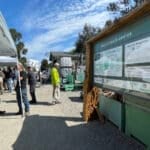

Siegel said the City and OAAC are working hard to raise awareness about the threat of sea level rise and have developed concepts plans for these strategies, ranging from physical barriers at the shoreline (such as seawalls and levees) to managed retreat, in order to address projected sea level rise anywhere from two to five feet by the year 2100. But securing funding for such extensive projects is expected to be challenging, especially as the federal government has recently rescinded grant funding for such work.
“With limited funding, it’s important that we prioritize nature-based solutions,” added Siegel, who suggested that investments in natural interventions, such as the installation of biofiltration swales or restoration of oyster beds, could have the greatest short-term impact.

Meanwhile, City crews have been busy lowering lagoons, pumping flooded areas, and clearing debris. In a post to social media, the City reminded residents to never drive or walk through flooded waters, and to call 510-337-8340 to report flooding and urgent maintenance issues.
As people continue to marvel and capture snapshots of this year’s aquatic anomaly, Siegel suggests using all those photos for good by submitting them to the California King Tides Project, which is crowdsourcing information to help visualize future sea level rise and recording changes to our coast and estuaries. More information is available on the project website.
Ken Der is a contributing writer for the Alameda Post. Contact him via [email protected]. His writing is collected at AlamedaPost.com/Ken-Der.
