On January 20, City Council reviewed and provided feedback on the Disposition Strategy for Leasing and Sale of Properties within the Reuse Area at Alameda Point, addressing how land sales and leases fund backbone infrastructure. Since 2020, estimated costs to complete the remaining Alameda Point infrastructure have soared from $700 million to $900 million. In the meantime, land values have softened and aging buildings are becoming more expensive to maintain.
Council also approved the 2025 Zero Waste Implementation Plan Update, which emphasizes four new priority programs to target multifamily housing, illegal dumping, and low-income waste services.
Council approved new leases at Alameda Point, including two with Kai Concepts, LLC, a blue technology research and development company, and another to relocate the Alameda Fire Department (AFD) administration to Marina Village Parkway. Council also approved Yatin Shastri as a Member of the Golf Commission.
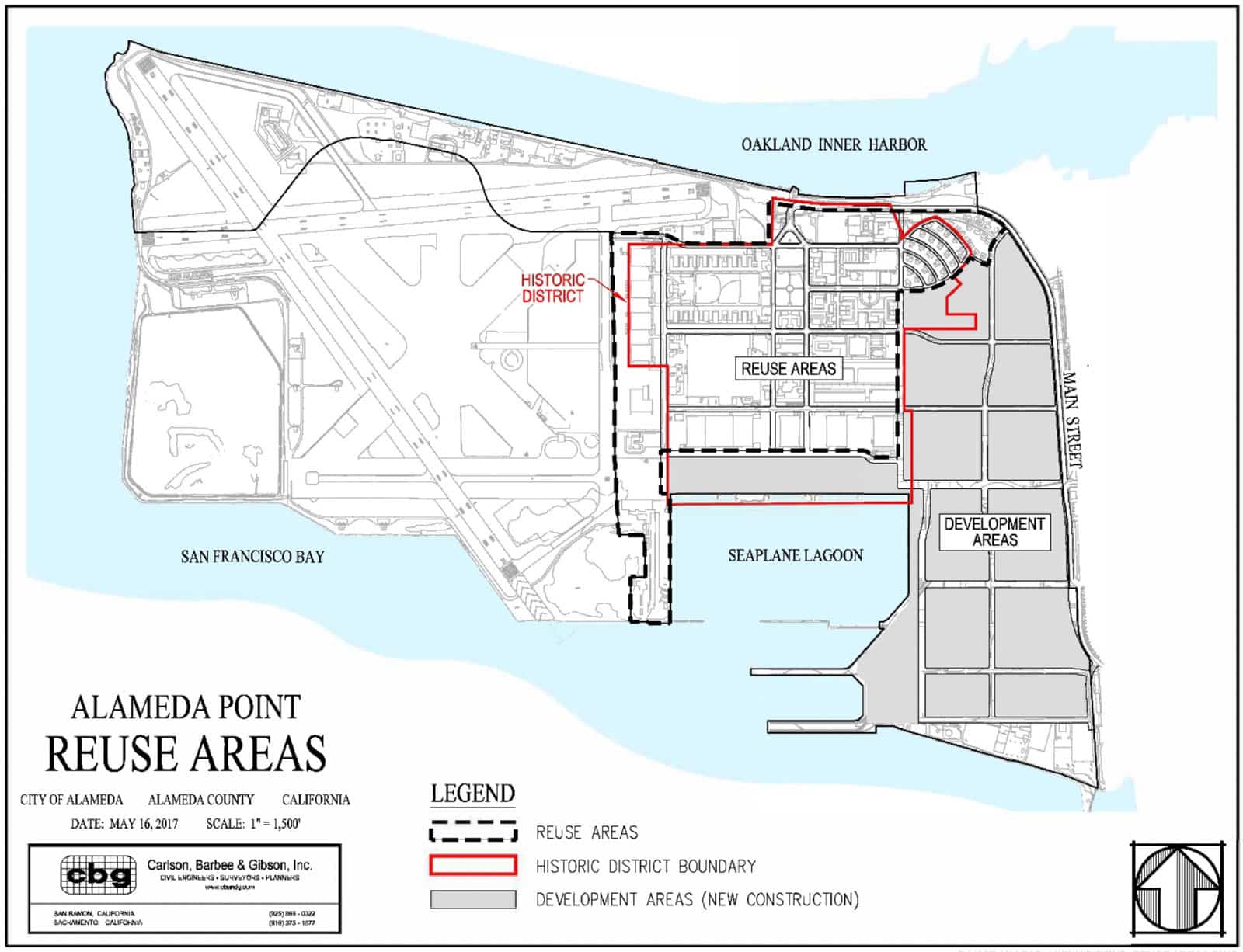
Alameda Point property disposition strategy
Base Reuse and Economic Development Department Head Abby Thorne-Lyman updated the Council on the City’s strategy to lease and sell properties in the Alameda Point Reuse Area. The strategy’s goal is to fund infrastructure improvements and advance economic redevelopment. Since 2020, estimated costs for completing the remaining infrastructure have soared from $700 million to $900 million, primarily due to inflation.
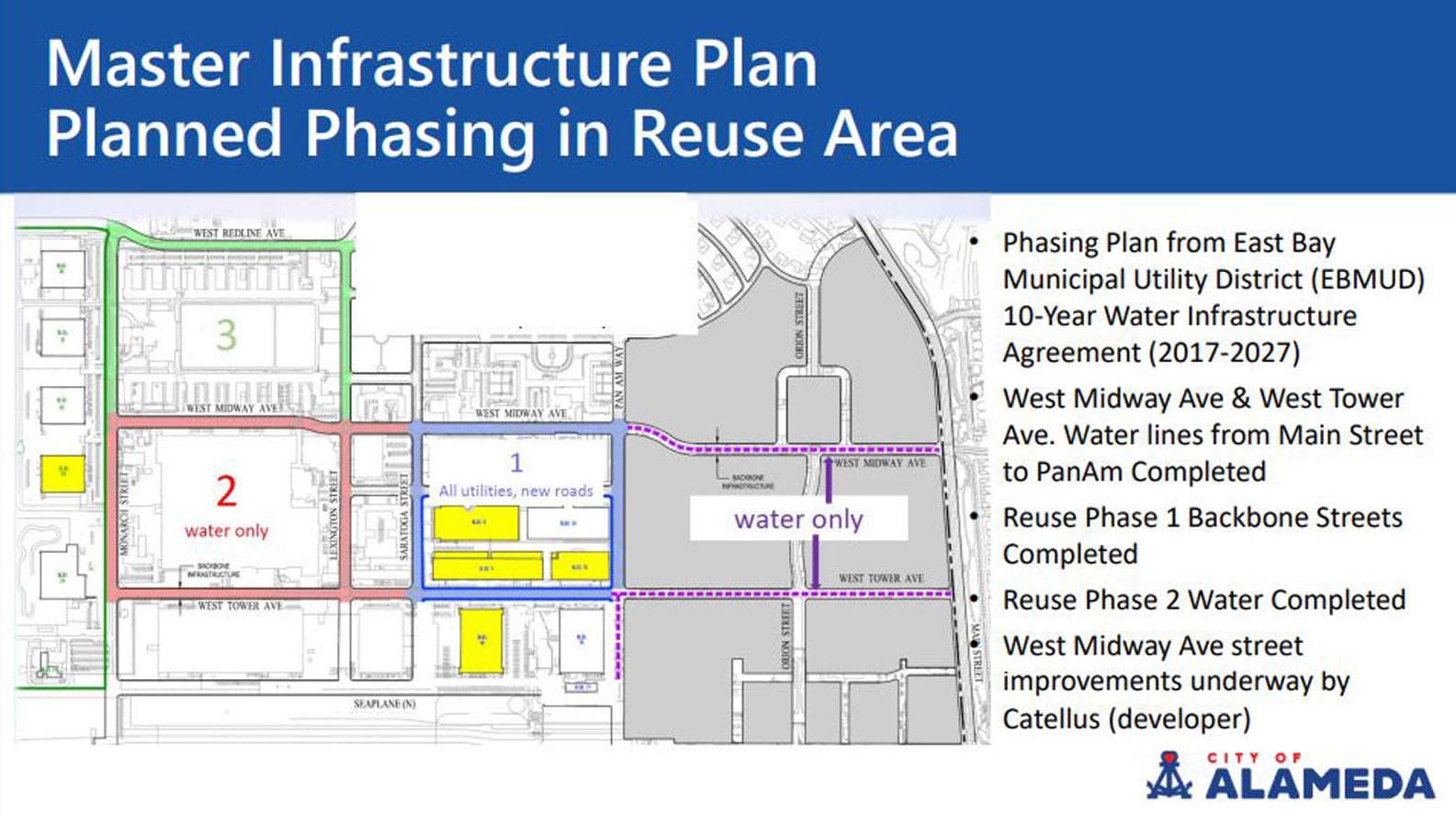
In the Reuse Area, unlike in the development areas where private master developers deliver infrastructure, the City must finance and build the infrastructure itself. This work is phased around three infrastructure loops, coordinated with EBMUD water service requirements. Phase One infrastructure is complete, and Phase Two water infrastructure is in place; the City now needs to generate funds to complete $43 million in Phase Two backbone infrastructure.
Thorne-Lyman recommended continuing to prioritize sales of properties connected to completed Phase One infrastructure, where land values are higher and the City can recapture value created by public investment. At the same time, she cautioned against selling all high-value leasing assets too quickly, as this could leave the City with aging, historic buildings in the Phase 3 area with high operating costs and insufficient lease revenue to support them.
Thorne-Lyman highlighted three key properties for focused attention:
- Building 41: Proposed for a long-term lease with option to purchase, despite still being Navy-owned, due to its high value and Phase One infrastructure access.
- Building 11/400/12 Complex: Considered for long-term lease and sale due to high rehabilitation costs (including a $12 million roof replacement) and the belief that a private developer could more efficiently redevelop the space.
- Bachelor Enlisted Quarters (BEQ): Identified as a significant long-term burden, with staff seeking creative disposition and adaptive reuse options, including potential residential uses.
Thorne-Lyman emphasized that land sales alone are unlikely to fully fund the $900 million in infrastructure needs, noting that an average price of roughly $2.55 million per acre across all remaining land would be required—an unrealistic expectation under current market conditions. Thorne-Lyman stressed the growing importance of grants and external funding sources to supplement land sale revenues.
Council discussion
A substantial portion of the Council’s discussion focused on how to fund infrastructure beyond land sales. Thorne-Lyman reiterated the need to pursue external funding, including grants for sea-level rise adaptation and port infrastructure. She cited the federal Port Infrastructure Development Program as a potential source to address costly pier and waterfront improvements.
Councilmember Greg Boller raised the idea of alternative financing strategies, including revenue bonds. Thorne-Lyman confirmed that revenue bonds were previously analyzed but not pursued, as the City’s strategy has primarily relied on land sales. She expressed openness to pursuing that strategy if directed by Council to do so.
Mayor Marilyn Ezzy Ashcraft highlighted her concerns about the City’s fiscal neutrality policy for Alameda Point. Fiscal neutrality means that Alameda Point is expected to pay for its own infrastructure and services solely with revenue generated on-site. She argued that treating the area as financially separate from the rest of Alameda reinforces an “us versus them” dynamic and no longer reflects how the site functions as an integrated part of the city.
The mayor emphasized that Alameda Point serves citywide purposes—including the ferry terminal, transitional and supportive housing, nonprofit activities, and employment—and suggested that the City should reconsider how rigidly it limits funding for improvement there. At the same time, the mayor acknowledged the need to balance any shift in thinking against broader City budget constraints.
Despite the scale of the challenge, Councilmembers expressed confidence in staff’s strategic approach. Mayor Ashcraft said, “I think the strategy that you’ve laid out is sound.”
Zero Waste Implementation Plan Update
City Council voted to adopt the 2025 Zero Waste Implementation Plan (ZWIP) Update, which continues the City’s effort to reduce landfill waste and meet state environmental requirements.


Alameda first adopted a Zero Waste plan in 2010, intending to achieve zero waste by 2020, defined as 89% diversion from landfills or no more than 1.2 pounds of landfill waste per person per day. As of 2024, Alameda has reached approximately 81% diversion, showing substantial progress but falling short of the target. The 2025 update removes a fixed deadline and instead commits the City to ongoing, long-term waste reduction, with annual reporting to City Council.
Public Works Coordinator Liz Acord reported that the plan was shaped by an equity-focused community engagement process. Feedback highlighted strong community support for zero waste goals, but also widespread confusion about proper sorting, barriers to participation (especially for multifamily residents), and a need for more education, incentives, and enforcement.
The 2025 ZWIP Update proposes 12 programs organized around four focus areas: behavior change, waste reduction, reuse, and construction and demolition debris diversion. Together, these programs are estimated to increase diversion by 4.46% at maturity, helping to close—though not eliminate—the gap to the 89% goal.
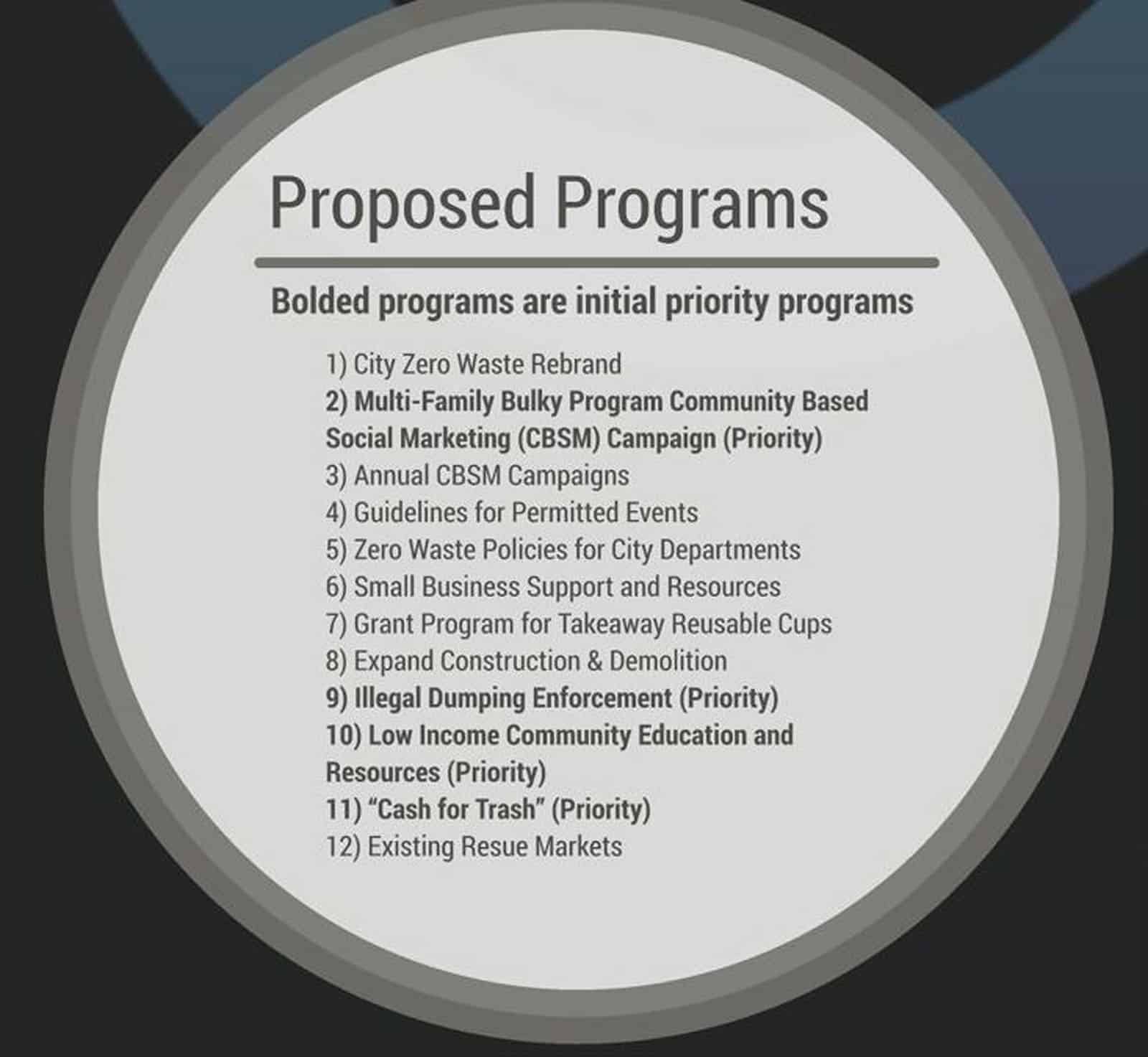
Four programs were identified as priority actions: increased multifamily participation in bulky-item pickup, enforcement against illegal dumping, and pilot programs to support low-income and unhoused residents, including a “Cash for Trash” incentive program. Modeled on a similar program in San Jose, Cash for Trash would provide a direct monetary incentive to unhoused participants who collect and dispose of litter and debris.
Priority ZWIP Programs and Estimated Diversion Gains
| Program | Focus Areas | Estimated Diversion | Notes |
|---|---|---|---|
| Multifamily Bulky Collection Participation Campaign | Behavior change, reuse | 0.96% | Targets low participation among multifamily residents |
| Illegal Dumping Enforcement Program | Waste reduction, enforcement | 0.34% | Adds enforcement to existing reporting/abatement |
| Low-Income & Unhoused Waste Services Pilot | Equity, waste reduction | Pilot – TBD | Addresses access barriers for vulnerable populations |
| “Cash for Trash” Pilot Program | Equity, litter reduction | Pilot – TBD | Modeled on the San Jose incentive program |
Council discussion
Councilmember Tracy Jensen emphasized the need for stronger tenant education and landlord accountability, noting that renters often lack information on waste sorting. She suggested exploring an approach where landlords would be required to include waste-sorting requirements in lease agreements. She also highlighted the burden on staff to enforce signage and sorting compliance in multifamily buildings and suggested future policy referrals to address this gap.
Upon questioning, staff explained that reusable foodware programs, such as Okapi reusable cups, have had limited uptake beyond a small group of enthusiastic users. Residential survey results show that two-thirds of residents prefer compostable foodware to reusable.

Councilmembers expressed support for increased outreach, education, and collaboration with community partners, including Community Action for a Sustainable Alameda (CASA). They emphasized that measures to address illegal dumping are needed and that overall success will depend on improved communication, incentives, and enforcement, particularly in multi-unit housing settings.
Council unanimously approved the 2025 Zero Waste Implementation Plan Update, with the understanding that funding proposals will return during the budget process.
Kai Concepts lease
Council unanimously approved two five-year leases with Kai Concepts, LLC, for portions of Building 168 and Pier One at Alameda Point. Kai Concepts, a long-standing tenant, conducts blue-technology research and development, including marine propulsion and watercraft testing, with Building 168 providing fabrication space and Pier One supporting on-water testing.
The leases generate more than $1.7 million in revenue over five years. The agreements retain City flexibility through termination and relocation rights while keeping buildings occupied and maintained, supporting economic development goals and reducing security concerns at Alameda Point.
AFD Administration lease
Council also approved a five-year lease for a new Alameda Fire Department administrative facility at 1001 Marina Village Parkway, allowing Fire Administration staff to consolidate into a single, modern location while remaining within the department’s existing budget. Fire Chief Nicholas Luby explained that the lease would improve operational efficiency, staff safety, and customer service by bringing together divisions currently spread across five locations, while also freeing up space at Fire Station One to address long-standing deficiencies.
Contributing writer Karin K. Jensen covers boards and commissions for the Alameda Post. Contact her via [email protected]. Her writing is collected at https://linktr.ee/karinkjensen and https://alamedapost.com/Karin-K-Jensen.
