The novelist Michael Cunningham once observed that everyone’s life is worthy of being a story, told well, with passion, craft and care. Karin K. Jensen, the author of the recently republished The Strength of Water, does exactly that, telling her mother’s heroic tale in rich, warm detail. The subtitle of the book is, “An Asian American Coming of Age Memoir” and suggests singularity. Yet her very personal narrative has an expansive quality and belongs on the shelf amid all great immigrant stories, fiction and non-fiction: Willa Cather’s My Antonia, Enrique’s Journey by Sonia Nazario, and Exit West by Mohsin Hamid.
The Strength of Water also reverberates with me and the story of my immigrant father. He came from a different continent under different circumstances, but the universal characteristics of being a newcomer—learning a new language, myriad struggles, the degree to which one assimilates, and the commitment to working hard so the next generation can have it easier—is the subsoil of this nation, and the content of Karin’s mother’s story. 5Q4 Karin K. Jensen focuses on how the book came to be published again and how she wrote her mother’s memoir in her voice, a voice of true strength.
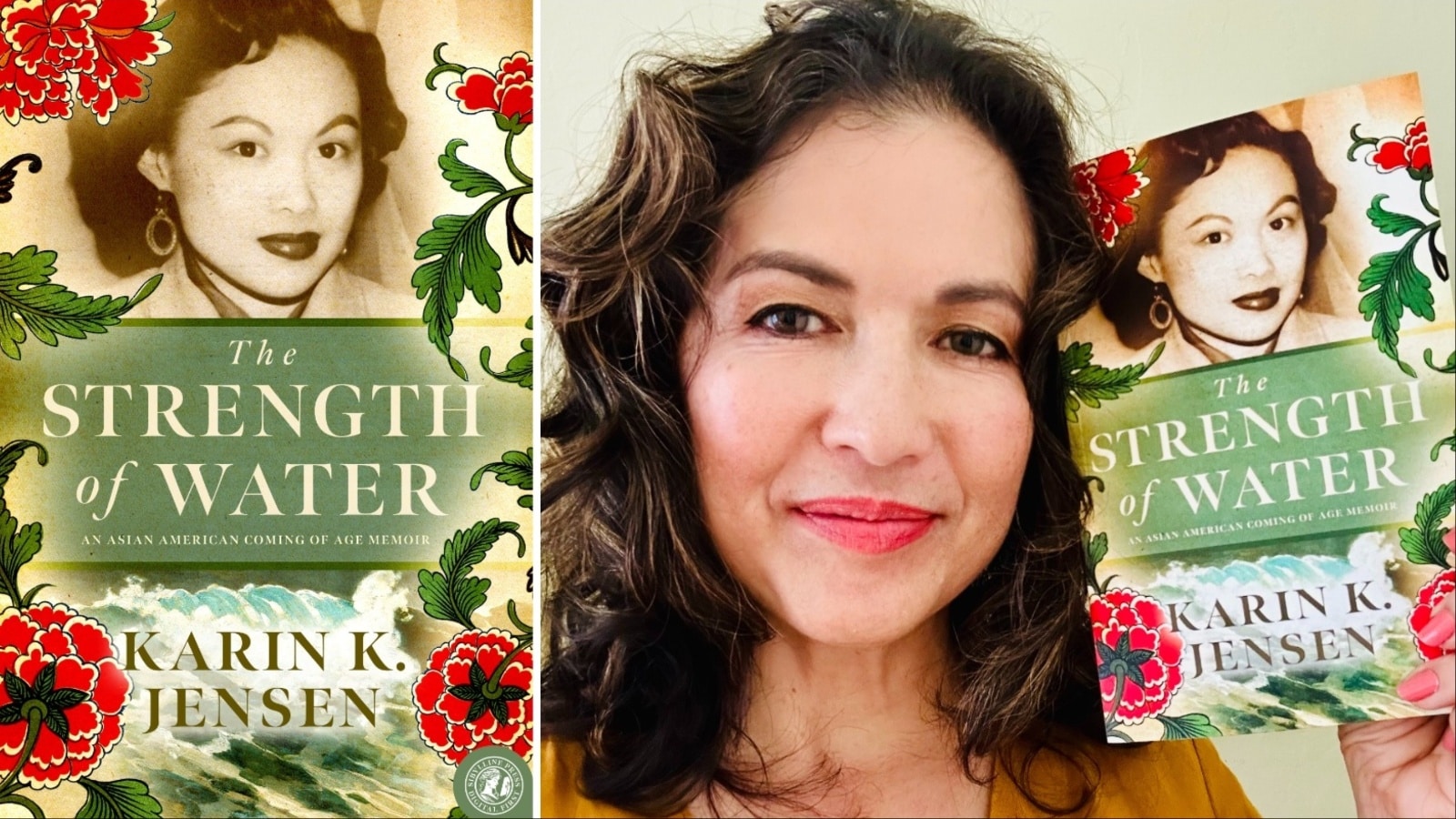
Let’s start with how you wrote The Strength of Water. It’s your mother’s story, you wrote it in her voice, and she is the narrator. How did you do that both practically and creatively? Were there interviews, did she read any of the copy, and did you try to make the language her language, the voice you heard for so many years?
Throughout my childhood, my mother told stories of growing up in her father’s Chinese laundry business during the infancy of the auto industry in Detroit, and later in a Cantonese village on the eve of the Sino-Japanese War. She also spoke of what it was like to survive as a live-in domestic worker and teen waitress in mid-century California.
There were tales, Dickensian in their pathos, of those who take advantage of the poor, of family addictions, painful racism, wartime privations, the perils of marrying too young, and then feeling trapped in marriage by social pressures. But there were also stories about the strength of family, the kindness of strangers, and the power, as she put it, of fighting for your little slice of happiness in this world before you pass on. Along the way, she revealed history from fascinating perspectives—a woman’s perspective, an immigrant daughter’s, and a life on the margins.
For me, the stories felt mythological, so far removed from my vanilla, comfortable, middle-class upbringing in the Bay Area. I grew up in Piedmont in a two-bedroom house next to a mansion so large that it extended from one street to the next, making me feel like Nick Carraway in The Great Gatsby. How had this transformation happened in a single generation, when my mother had not even had the chance to finish high school? This is what I wanted to record.
In 2002, my husband took work in New Zealand. While he was away, I had time to interview Mom, her siblings, my Dad, and my sister. When I took a sabbatical to join my husband, I began blogging, one rough draft chapter at a time. I could hear my mother’s voice so clearly that I wrote in the first person.
Practically speaking, the story blends her voice and mine because, although she was smart, she was not educated, so her English was often not grammatically correct. Still, I believe I captured her sentiments correctly.
Mom read those rough draft chapters and said, “I appreciate you writing down these stories. I mean who else would care?”
And I replied, “Oh, Mom, these stories are fascinating.”
Was there another story—biography, memoir, or fictionalized account of someone’s life—that served as a role model for your book, a source of inspiration beyond your mother herself?
Growing up, I loved the Little House on the Prairie series, which gave me a glimpse into how women and girls lived their everyday lives during pioneer days. These books inspired me to interview Mom and her siblings about the fine details of their childhoods and youth. What was it like doing laundry in the 1920s? What was school like? In the village, how did you care for babies without diapers or running water? How was Chinese clothing constructed? How did people get married? I had heard many of my mom’s and aunties’ stories at family gatherings, but during my interviews, I pressed them for fine details because I find them fascinating.
This is the second publication of The Strength of Water. Can you tell us how the book first came to be published, and the circumstances of this second publication by Sybilline Press? Additionally, what kind of editing and revising did you do?
With the arrival of my second daughter in 2005, I set aside my draft manuscript, 90% complete, with the dream of finishing and publishing it… someday. And then, between raising kids, caring for aging parents, and the grief of my mother’s passing, I didn’t finish the draft until 2018.
In 2020, the pandemic hit, and I lost my employment. I embarked on a months-long cycle of doom scrolling, puzzles, neighborhood walks, and too much baking. And then in the silence, I realized that someday had arrived, and it was time to work on my dream.
I didn’t know anything about publishing, but the universe nudged me. I met an author, Helen Harris, at church, who had just published her first novel in her 70s. Helen was my mother’s name! I got a little chill down my spine when I talked to her, asking her for advice. She recommended a developmental editor who would help me look at the big picture of my story.
With the editor’s help, I polished the manuscript and pitched it through a Twitter event. Twitter pitching events happen throughout the year. You can pick one in your genre. On the day of the event, you post a specified number of tweets pitching your book in 280 characters. If you get hearts on a tweet from an agent or small press, they are inviting you to send them a more detailed pitch.
As a result of #DVPit (Diverse Voices Pitching event), I received an offer from an American small press and almost made it to publication nearly a year later. Then that press went out of business due to pandemic stresses. When they informed me, I didn’t reply for three days because I was so bummed.
Then I dusted myself off and started querying agents and publishers. Query #42 got me an offer from a small press in London. I thought that would be fine since the world is online. But I soon realized that their marketing was based in Europe, and they relied on me to do publicity here in the U.S. I had no experience and no peer group to offer support. Sales floundered.
Still, the book won recognition, earning a spot on Kirkus Reviews’ annual Top 100 Indie Books list. In the meantime, two things happened: I started writing local news professionally, and I became aware of author Julia Park Tracey’s historical fiction, which I loved. I started following her on social media.


One day, when I was chatting with my boss, Adam Gillitt, publisher of the Alameda Post, I happened to lament my book not being published by a publisher like Julia’s, saying how much I admired her work and the experiences she was having.
“Well, why don’t you reach out to her and see what she thinks?” he asked.
It’s funny how powerful a little encouragement can be. I’m honestly not sure I would have done that without his prompting, but the rest is history. Besides being an author, Julia is the acquisitions editor for Sibylline Press. She encouraged me to submit a full manuscript, read it, said she loved it, and the next thing I knew, Sibylline was offering to republish it.
The difference in my experience has been like night and day. Sibylline is based here in California, is familiar with local opportunities, and represents numerous Bay Area authors, providing a supportive peer network. Their mentoring is outstanding.
As for editing, I am a more experienced writer than when I began this process. Republishing has allowed me to improve the book’s language, make its theme more intentional, and add new vignettes, thereby enriching the story. Sibylline’s book cover is beautiful, and they have improved the formatting by including photos throughout.
You received a Kirkus starred review for The Strength of Water and it was listed as one of their top 100 indie books. That’s remarkable, but what about the responses of individuals, friends, family, others with similar stories?
Family and friends have been wonderfully supportive. It’s hard to know how much of their enthusiasm is out of affection, but I was touched when a friend said that she brought the book on a trip to Germany, thinking she would read it for a couple of hours on the flight. Ten hours later, a little before touching down, she had finished it, saying she couldn’t put it down.
One of the most common comments from members of immigrant families is that they appreciate the level of detail my family was willing to share about the really hard experiences they encountered here in the U.S. and back in the village. Often, they say that their family members are not willing to be so forthcoming.
I experienced that with my in-laws, who lived through Nazi-occupied Denmark. Their memories were dark, and they didn’t want to discuss them. I understand, but I feel sad that those stories are now lost.
One thing that has changed since The Strength of Water first came out is the more aggressive effort by the current administration to enforce immigration laws all across the country. Your mother’s story—for this reader—seems to be a part of this longstanding conversation and battle over immigration in the United States. Do you have any thoughts on the larger topic, and what is happening now?
Each of us embarks on a journey to find a sense of belonging, a sense of where we fit into the world. When you’re an immigrant, or an immigrant daughter, that story is so much more challenging—sometimes epic.
My mother had the somewhat unique experience of starting life here in the U.S., and when her mother died, her father brought the family back to his village in China to get a new wife. In the village, they stepped back a hundred years in progress. They had lived poorly in America, but they had plumbing, electricity, a telephone, and access to a doctor. In my grandfather’s village, there were none of these. There were outhouses, oil-wick candles, communication by letter, and old wives’ tales in place of health care.
Moreover, there was no social safety net at all during a period rife with political and economic turmoil—no trusty food bank nor government benefits. In the middle of all this, the Sino-Japanese War broke out, with soldiers instructed to “live off the land,” pillaging their poor village, and “Zero” planes flying so low overhead that my mother could see the faces of the pilots.
In these situations, families make desperate decisions to survive—whether to send a family member to another country, possibly as an illegal immigrant in the hope they will send home some money, whether to sell daughters into servitude, or sometimes even whether to commit infanticide—decisions impossible to imagine in our first-world lives.
And yet, too often, immigrants are treated as second- or third-class citizens, and in the case of undocumented workers, as nothing more than lawbreakers and criminals. And so, we peel away their humanity. We learn not to care what happens to them. When we hear of an undocumented worker being mistreated, we shrug and say, “Well, that’s too bad, but what did they expect coming here illegally?”
Humanitarian issues aside, our economy, the fifth-largest in the world, depends on the labor of undocumented workers. The Bay Area Council Economic Institute reports that 8% of all workers in California are undocumented. (Nationally, it is 4.8%.) If their being here legally is so important, why don’t we make the process easier? They are essential to our prosperity. In addition, despite high-profile cases of immigrant crime, studies have shown that immigrants consistently have lower incarceration rates than U.S.-born individuals. In other words, immigrants are not the enemy.
And still, statistics rarely sway hearts. Stories do—stories in which we can get to know real people as complete human beings, not as stereotypes, not as caricatures. My hope is that more stories like The Strength of Water help tear down the walls we build around our hearts.
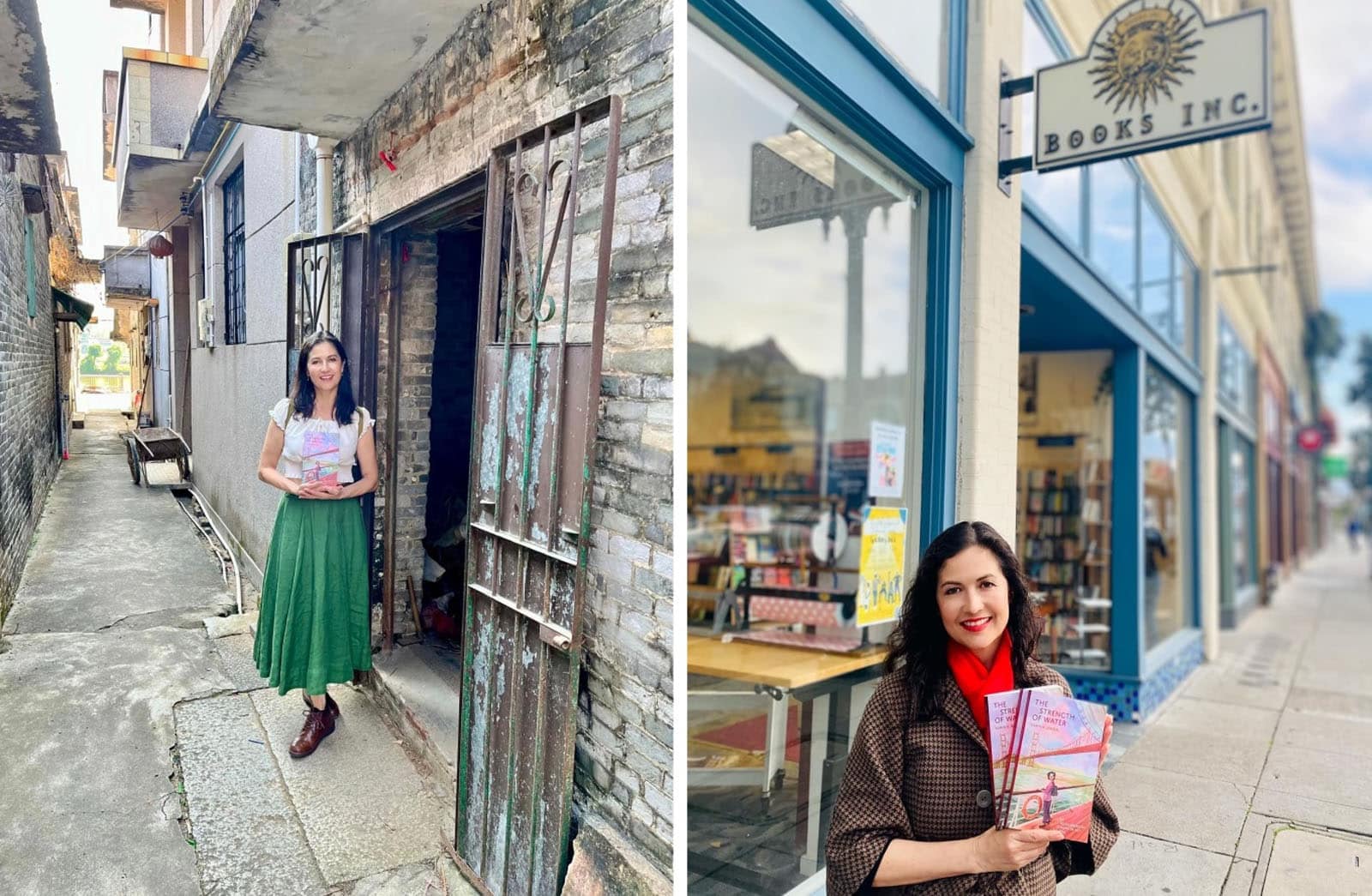
The Strength of Water will be available at Books Inc. on Park Street beginning November 7. Catch Karin’s book launch at Books Inc. on November 13, 5:30 – 6:30 p.m., which will feature a book discussion and signing.
Gene Kahane is the founder of the Foodbank Players, a lifelong teacher, and former Poet Laureate for the City of Alameda. Reach him at [email protected]. His writing is collected at AlamedaPost.com/Gene-Kahane.
