Waterside Terrace first of four neighborhoods to appear
In 1856, Alfred A. and Emilie Gibbons Cohen purchased the property that became today’s Fernside neighborhood. Two years later, Emilie’s father Henry Gibbons Sr., M.D., received title to the land on the east side of High Street north of the “old Farwell place.”
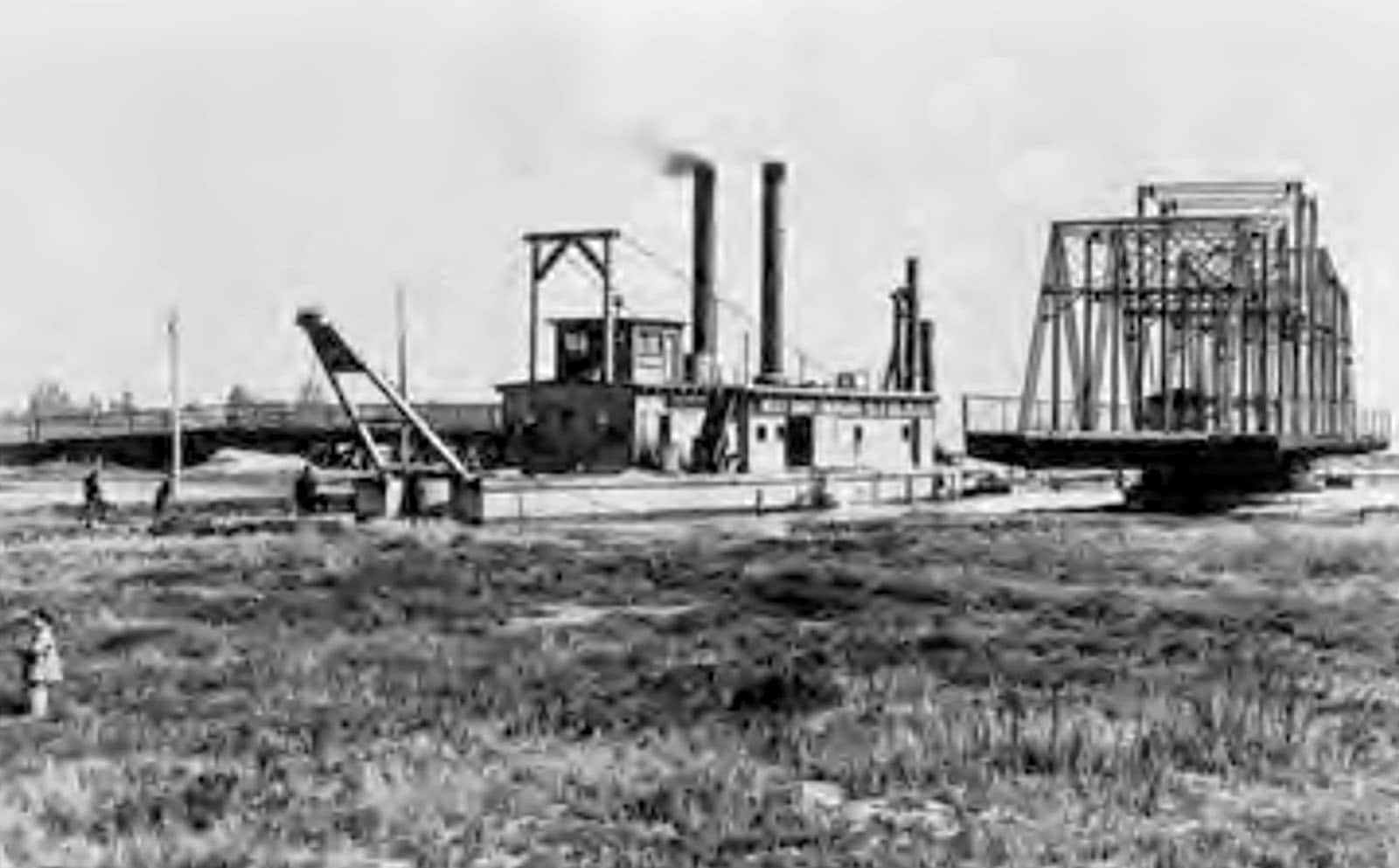
In 1901, the Corps of Engineers began shaping the Tidal Canal east of the Fruitvale Bridge. The dredge Olympian deposited some of the 200,000 cubic yards of material in its way onto Henry Gibbons’ property, creating “made land” where the marsh once stood. Workers removed some of this “deposit” to Lincoln Park to firm up newly created baseball fields. The Corps took much of this dirt to firm up projects along Oakland Harbor.
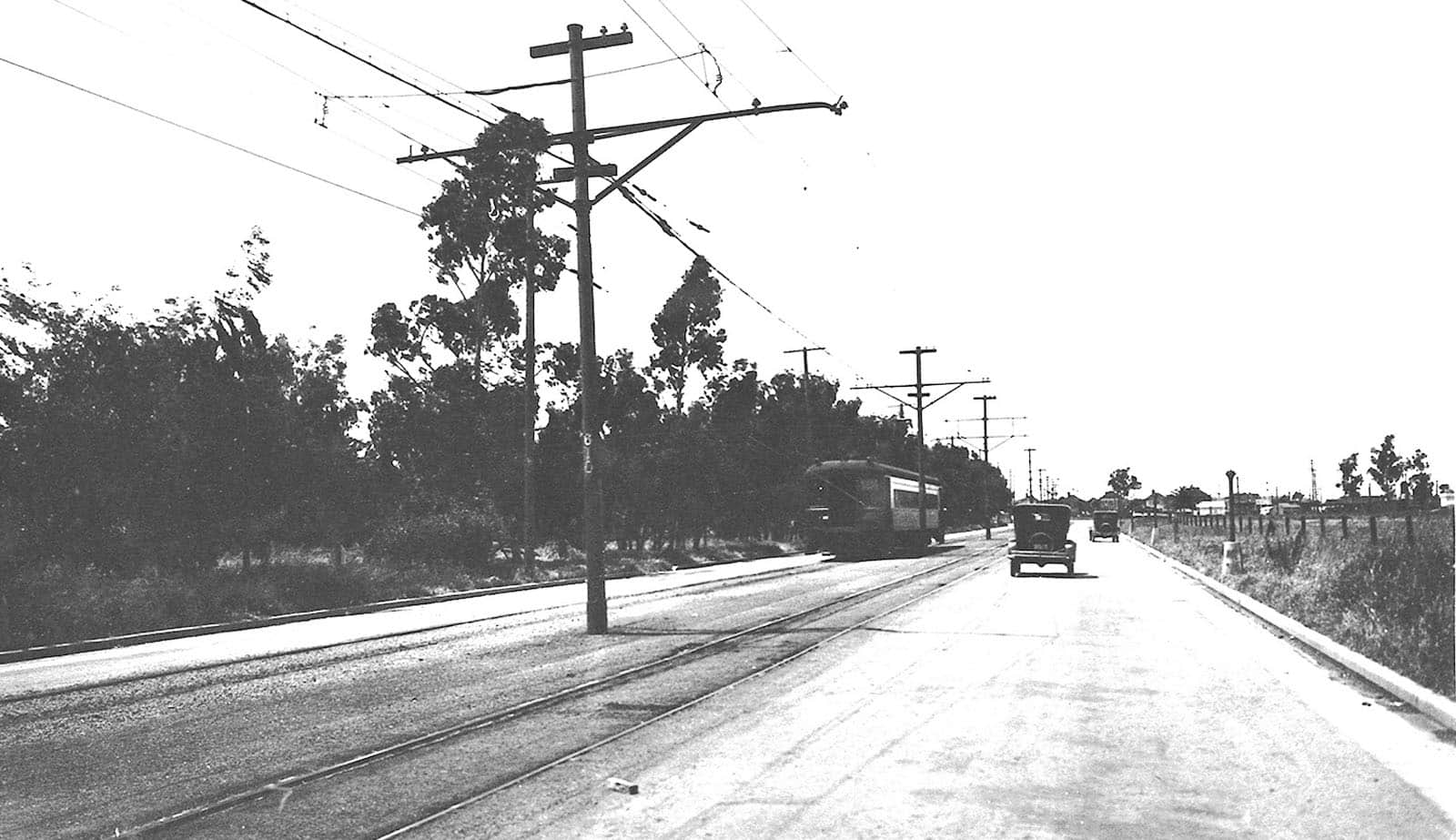
Beginning in 1909, the Southern Pacific Railroad stepped in and laid out the right-of-way that became Fernside Boulevard as a right-of-way for its new electric train system. The City gave its permission with the condition that Southern Pacific add a paved road for horse-drawn wagons and automobiles along the tracks. The trains began running on June 1, 1911. The arrival of the trains that locals dubbed “The Loop” and the new vehicle-friendly road attracted speculators with eyes on development.
The following year, speculator Stuart Hawley purchased the land—about 30 acres—from the Gibbons estate. He called in C. C. Adams (remember him from Mastick Park?) and Mark T. Cole to lay out “Waterside Terrace.” Adams and Cole presented Hawley with plans to build 160 homes on a fan-shaped tract that featured a pair of ideas new and radical in their day—terraced lots and curving streets. Historian Woody Minor tells us that “tons of canal dirt dumped on the marshy site” allowed the developers to form the neighborhood’s terraced parcels.
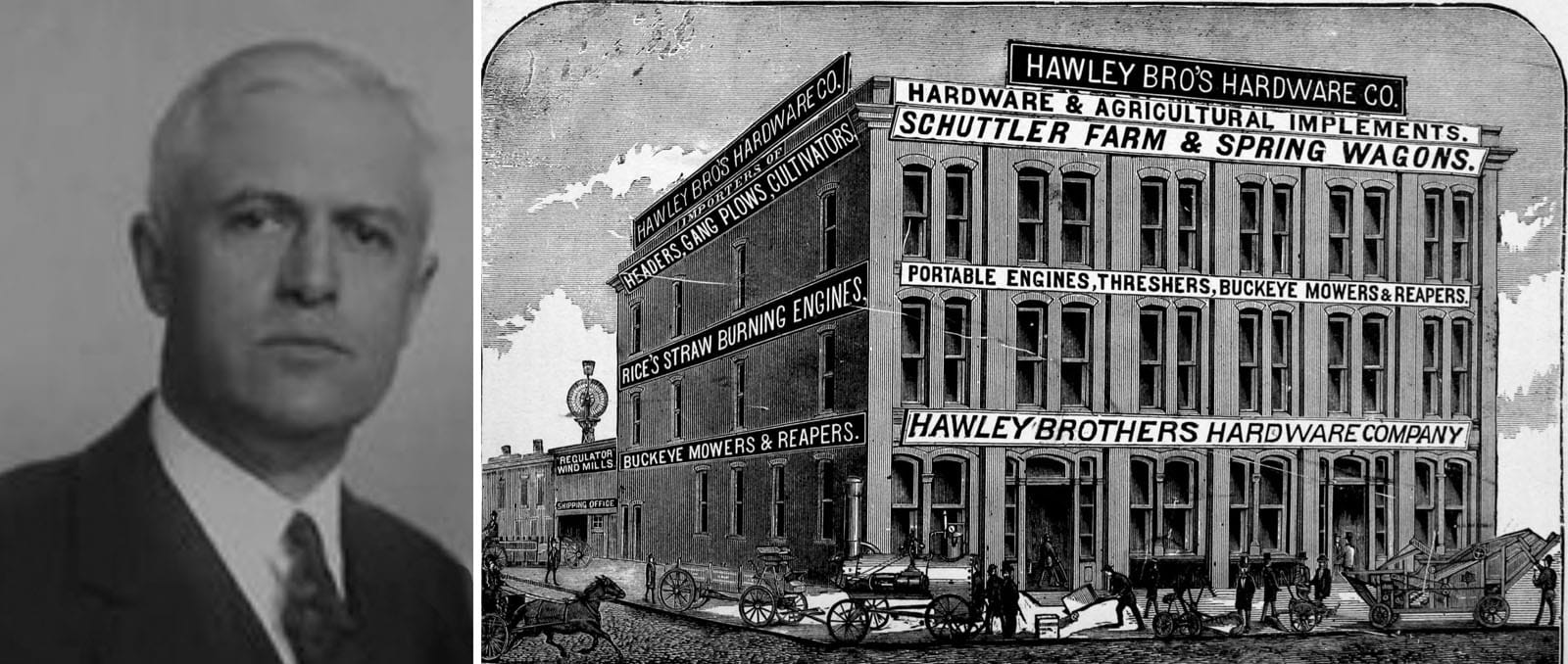
Did you know? Stuart Hawley purchased the Gibbons’ property that became Waterside Terrace in 1912. Stuart also owned the tract that became Mastick Park. His father and uncles operated a prosperous hardware store in San Francisco. In 1927 he sat as one of the first Port of Oakland commissioners.
Hawley approved, and Adams hired builders to put up homes in the impressive new Prairie style inspired by creations at Frank Lloyd Wright’s studio in Oak Park, Illinois. Look for the homes with those horizontal lines. As had been done in Mastick Park, F. N. and L. V. Strang were among the builders who signed on. The brothers had already built homes in the Bay Park Tract, today’s Burbank-Portola neighborhood. Adams also built bungalows in the new development along Bayo Vista, Monte Vista, Fairview, High Street, and Fernside Boulevard.
Adams and Cole added the three small parks to the development bounded by the estuary waters, High Street, and Fairview Avenue. The three parks are located on the east side of Fernside—the first about halfway between High Street and Monte Vista Avenue, the second at Monte Vista Avenue, and the third at Fairview Avenue.

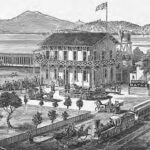

As was the case in nearly every early 20th-century development, the developers made it very clear that “those people” would never be living anywhere in Waterside Terrace. “There are restrictions against Japanese, Chinese, and Negroes…” states a 1913 advertisement for Waterside Terrace. According to the advertisement, “These restrictions are thrown about this property, as it is the intent of the owners to make this the modern high-class home place of the city.”
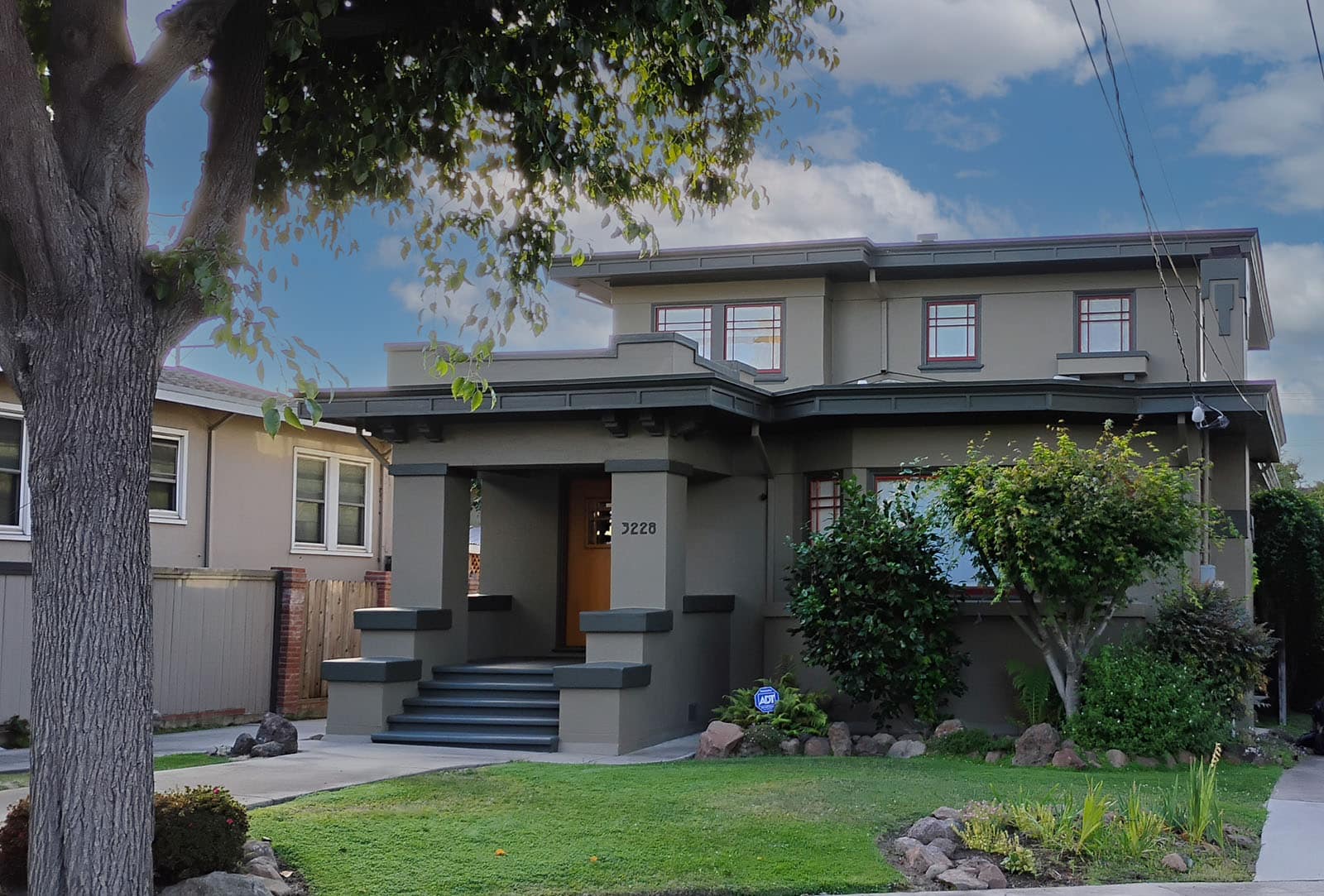
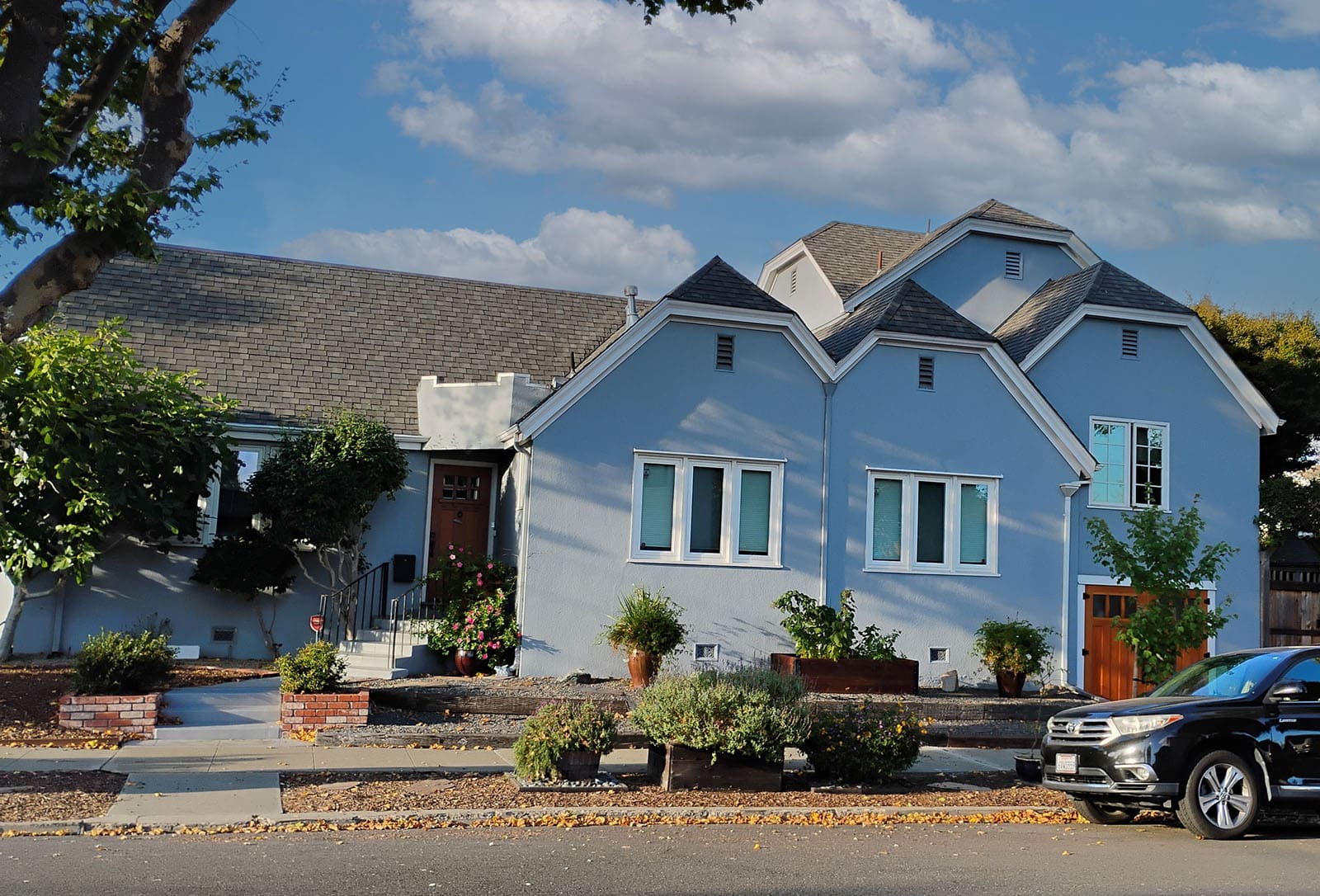
In 1858, Henry Gibbons Jr., M.D., purchased the property that became Waterside Terrace. The good doctor’s investment, defined roughly by today’s High Street, Fairview Avenue and Fernside Boulevard—was mostly marshland that bordered San Leandro Bay. In 1902, when the Corps of Engineers shaped the Tidal Canal, their dredges created “made land” here. Beginning in 1909, the Southern Pacific Railroad stepped in and built Fernside Boulevard as a right-of-way for its Big Red trains.
In 1912, developers stepped in with plans to build 160 homes on a tract that featured a pair of ideas new and radical in their day: terraced lots and curving streets. And the homes were amazing! C. C. Adams hired builders who put up homes in the impressive new Prairie-style inspired by creations at Frank Lloyd Wright’s studio in Oak Park, Illinois. On this walk we’ll learn to distinguish this new style from the bungalows in the neighborhood. It will be easy—just look for the homes with those horizontal lines. More tour information.
Join Dennis to explore this little-known Fernside neighborhood this weekend. Tickets are $20 each, get yours now! Saturday, September 13 or Sunday, September 14.
On our walk, we’ll discuss how Waterside Terrace’s street names—Monte Vista, Bayo Vista, and Fairview, a translation of Buena Vista—raise an interesting question. And I’ll show you how you can draw an (almost) straight line from Fairview at High Street to Buena Vista at Versailles Avenue.
The 1926 developer did run Fairview west from High Street, and he did something interesting: He ran Gibbons Drive (named for Emilie’s family) as a curve from Central Avenue to Fernside Boulevard. He nicely defined this curve and interrupted the flow of Fairview to Buena Vista with a pair of streets, an oval, at the center of Gibbons Drive. He named those streets “Northwood” and “Southwood.” His name? Fred Wood.
Had he not done this, I am certain that Fairview would have connected to Buena Vista and would have lost its name.
Dennis Evanosky is the award-winning Historian of the Alameda Post. Reach him at [email protected]. His writing is collected at AlamedaPost.com/Dennis-Evanosky.
