On December 8, the Planning Board approved the design, map, and new street names for Phase A of the West Midway housing development, a project that will include 284 new housing units at Alameda Point. The Board also approved the removal of 65 trees and the planting of 101 new trees related to the construction of the Clement Avenue/Tilden Way Improvements Project.
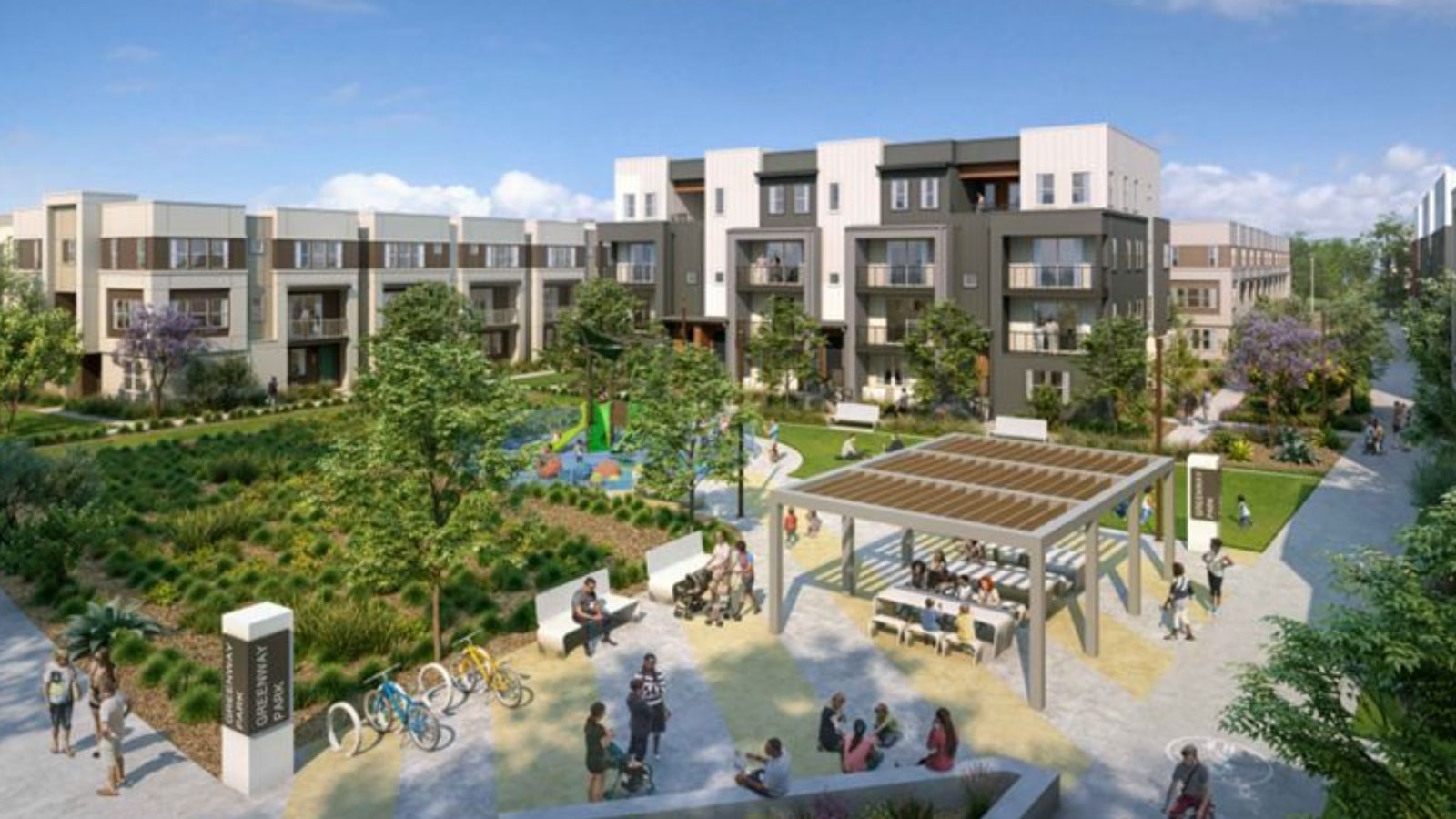
West Midway Phase A
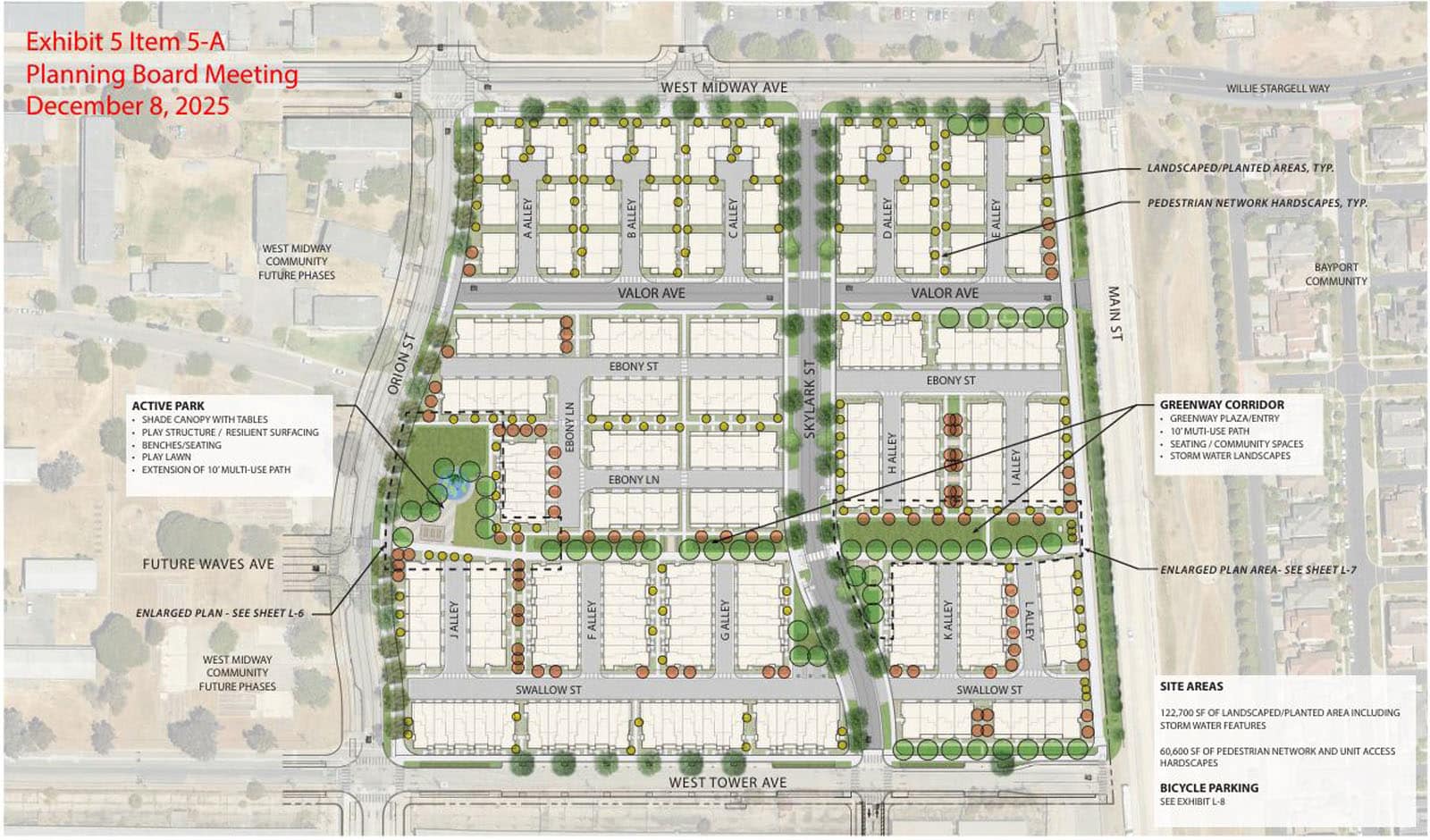
City Planner Henry Dong presented the West Midway Phase A design review, vesting tentative map, and street names application for developer Brookfield Residential. The proposal includes 62 new buildings containing 284 units. New streets will be named Ebony Street, Ebony Lane, and Swallow Street.
Dong emphasized that this development—together with RESHAP (Rebuilding Existing Supportive Housing at Alameda Point) and the broader West Midway project—forms a crucial part of Alameda’s housing strategy. Across both projects, the City anticipates 801 total units, including 201 replacement affordable units, 162 new affordable units, and 44 workforce units, all of which contribute to the Housing Element goal of producing 5,353 units by 2031.
Phase A includes most of the market-rate units, which will finance the infrastructure Brookfield must construct as part of the overall project, including streets, utilities, and public access. Dong noted that the Planning Board previously approved the West Midway development plan in May 2023. Since then, staff and the applicant have refined architectural requirements, landscaping plans, pedestrian and bicycle networks, and compliance with requirements, including affordability, public access, parking, and universal design.
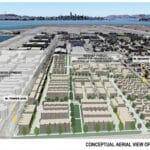
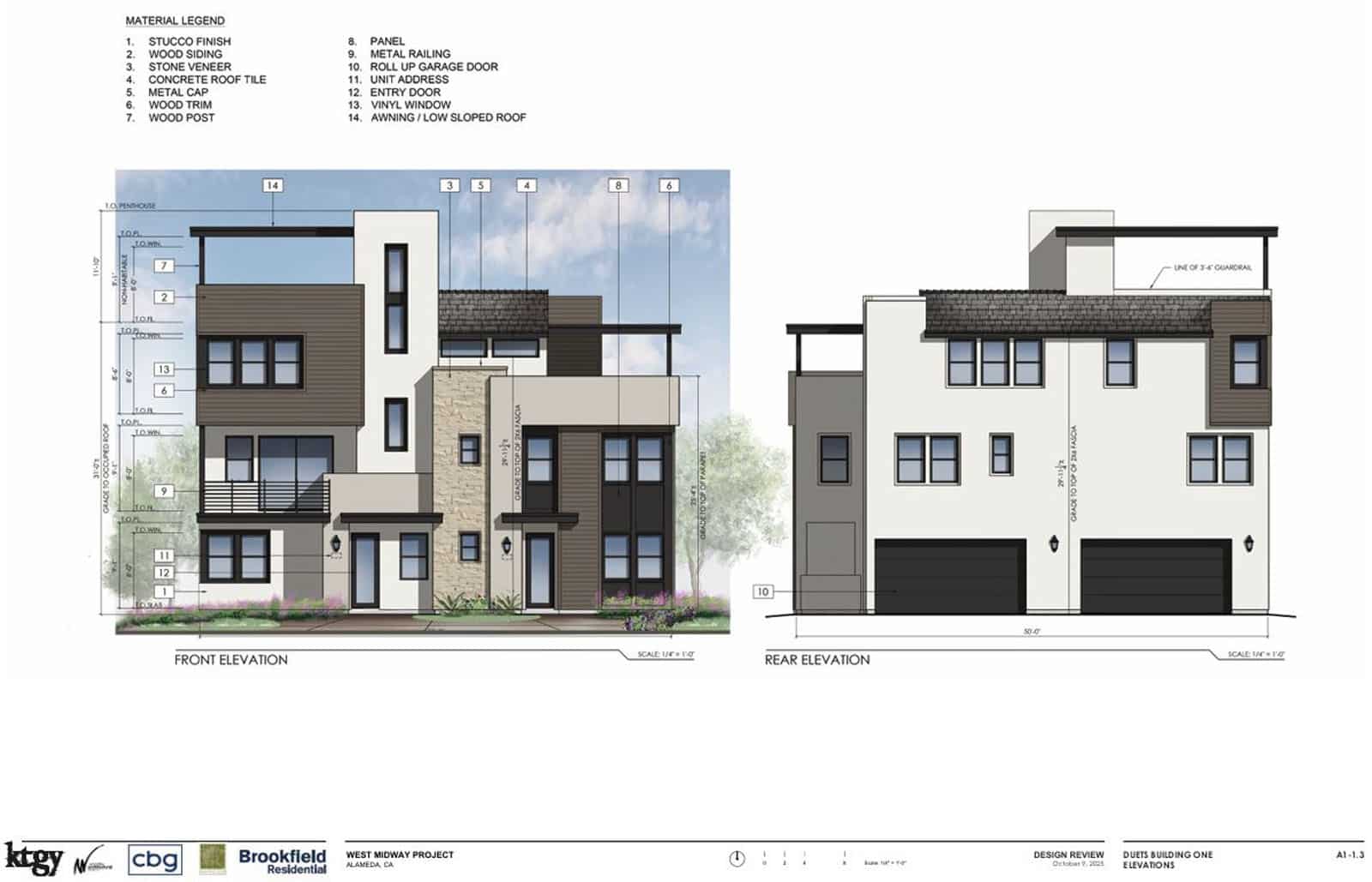
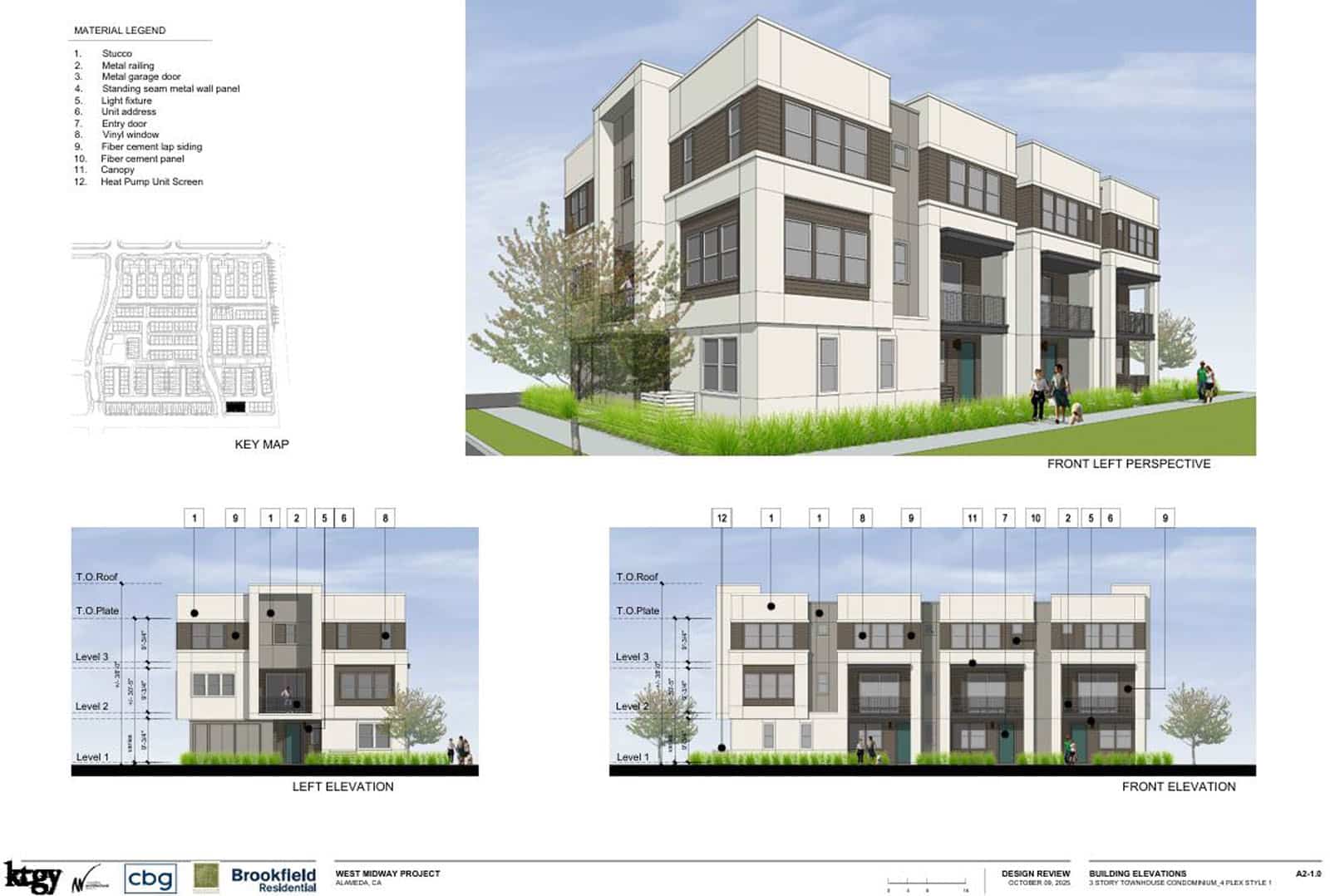
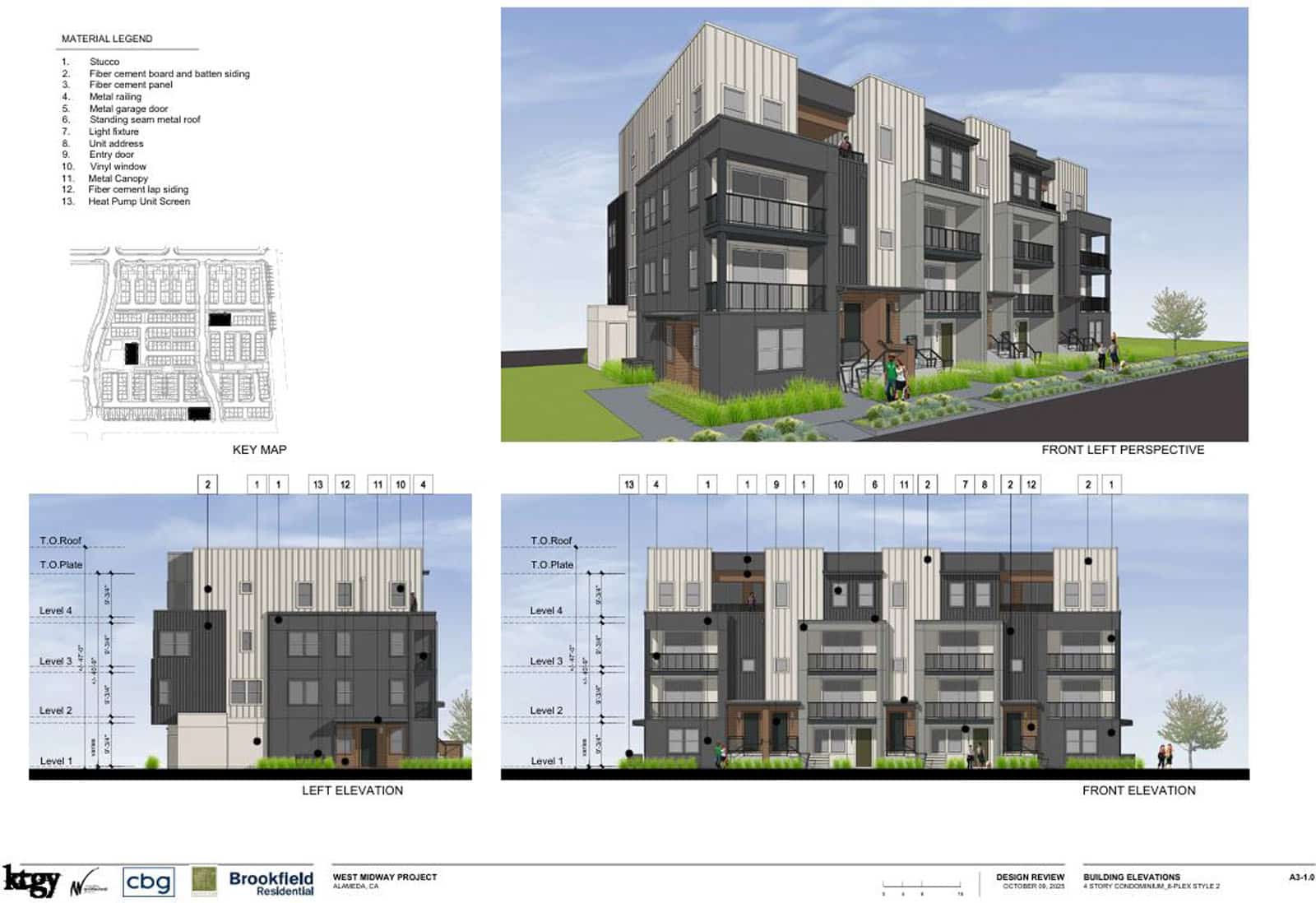
Brookfield’s representative, Alejandra Dominguez, outlined the site plan—Phase A covers 12.4 acres of the overall 22.8-acre project. The proposal features three distinct housing types interspersed to create variety, as well as a public-access greenway connecting Main and Orion Streets. Housing types include two- and three-story duets, three-story townhomes, and four-story condominiums, arranged around walkable blocks with pedestrian and bicycle connectivity. A privately maintained but publicly accessible Greenway Park will include play structures, turf, seating, and bike parking.
Architect David Burton detailed design strategies, such as protruding and receding elements and varied color blocking, intended to break up building massing. He also discussed strategies to ensure active frontages on all sides and to integrate Alameda Point’s historic architectural references.
Clarifying discussion
Board members questioned how workforce housing differs from market-rate units. Staff explained that workforce housing is “affordable by design,” meaning the units are smaller, simpler homes that are naturally less expensive. Workforce units must initially be sold to households in the 120-180% Area Median Income (AMI) range, but after the first sale, the units are no longer income-restricted. For Alameda County in 2025, the AMI for a four-person household is $159,800.
In today’s ownership market, a household would need an income closer to 300% of AMI to afford the average market-rate home in Alameda. Consequently, workforce units will be substantially less expensive than unrestricted market units.
By contrast, affordable homes are intended to ensure that lower- and moderate-income households can live in the community. Such homes are deed-restricted to ensure they remain affordable for future low- to moderate-income buyers. Low-income refers to households earning up to 80% of the AMI, while moderate-income refers to households earning 80-120% of the AMI.
Board members explored whether Phase A and Phase B would share the same types of housing. Staff explained that Phase A will include mostly larger, market-rate units, including two- and three-story duets, three-story townhomes, and four-story condominium buildings.
Phase B will also include townhouses and condominiums, but the architecture and scale will differ, reflecting different designers and unit goals. Phase B will contain the majority of affordable and workforce units. The applicant emphasized that Phases A and B will read as part of one community.
Staff also responded to a critical public comment, saying that the project does not exceed the Alameda Point unit cap, that it is outside the historic district so additional historic review is unnecessary, and that environmental impacts were already analyzed in the Alameda Point and General Plan Environmental Impact Reports.

Board comments and motion
Board members commended staff and the applicant for a complete and well-prepared design review package, noting that broad support for the project was expressed in public comments. Several members emphasized the importance of the 284-unit project for Alameda’s housing production goals.
Much of the design discussion centered on architectural cohesion across the three building types. Boardmember Asheshh Saheba felt that the duets appear aesthetically disconnected from the rest of the project and recommended greater consistency in materials to improve continuity. Boardmember Hanson Hom, while generally supportive of the project’s architectural diversity, also flagged the duets as the one design he was “not sure about,” pointing to a specific massing and elevation that looked “odd.”
Boardmember Andy Wang asked for improved clarity between attached units so it’s easy to see where one home ends and the next begins. Boardmember Saheba also asked the applicant to consider how residents experience the site from the street level, ensuring that wayfinding and front-door arrival are clear.
Boardmember Teresa Ruiz expressed concern about the likelihood that residents would follow the greenway corridor to Main Street, and jaywalk across it to reach Ruby Bridges School, rather than walk to the controlled intersection. She urged coordination with Public Works to avoid creating conditions that encourage jaywalking.
Ultimately, the Board voted to adopt the draft resolutions approving the design review and the vesting tentative map and recommending that City Council approve the street names for the West Midway Phase A development. Boardmembers expressed enthusiasm for the project’s pedestrian orientation, connection to RESHAP, proximity to ferry service, and the importance of advancing significant housing at Alameda Point.
Tilden-Clement tree replanting
Although City Council already approved the Tilden-Clement Roundabout and roadway redesign concept in 2023 and subsequently awarded a construction contract, staff belatedly realized that the City’s 2014 Tree Removal Policy requires a Planning Board review whenever a capital improvement project removes more than 5% of trees on a block. This step was not completed earlier, prompting this return to the Board for review before the City Council meeting scheduled for December 16.
Public Works engineer Ali Hatefi presented the project details. The Tilden–Clement improvements redesign the roadway at the northeastern gateway to Alameda, converting two signalized intersections into a roundabout, implementing a road diet on Tilden Way, and constructing the long-planned Clement Avenue extension to improve multimodal connectivity. The project also completes links to the Cross Alameda Trail and San Francisco Bay Trail, removes old railroad tracks and contaminated soil, upgrades bicycle and pedestrian facilities, and adds landscape improvements, including a new dog park at Tilden and Blanding.
Staff identified 65 trees for removal to accommodate the roundabout, trail connections, street redesign, and soil remediation. Four are Coast Live Oaks, a protected species requiring separate review by the Historical Advisory Board (HAB). One oak was approved for removal at the staff level due to safety risk, while the remaining three were approved for removal by HAB last week.
To offset removals, the project will plant 101 new trees—including eight Coast Live Oaks—all in 24-inch box sizes, irrigated and maintained for a one-year establishment period. Tree species were selected to fit infrastructure constraints and support the gateway landscape vision.
City staff requested the Planning Board’s concurrence and recommendation to the City Council to approve the removal of the 65 trees and the associated replanting plan.
Board comments and vote
Boardmember Saheba praised the plan, emphasizing that it will create a significant gateway into Alameda, reinforcing the corridor’s positive visual identity. Boardmember Hom noted that while removing mature trees is difficult, the project’s two-for-one replacement requirement represents a meaningful and positive mitigation. The Board voted to approve the proposed tree removal and planting plan.
Contributing writer Karin K. Jensen covers boards and commissions for the Alameda Post. Contact her via [email protected]. Her writing is collected at https://linktr.ee/karinkjensen and https://alamedapost.com/Karin-K-Jensen.
