In Part 1 of our story on 1724 Santa Clara Avenue, the Greenleaf House, we learned it was designed in 1891 by the respected British-born architect Ernest Coxhead (1863-1933), for the retired dentist and pharmacologist David Greenleaf (1827-1893). Coxhead had designed the nearby Christ Episcopal Church, at the corner of Grand Street and Santa Clara Avenue, and Greenleaf was so impressed by that structure that he sought out Coxhead to design his own home. Sadly, the original church burned down in an arson fire in 1960 and was replaced by the current church, which is still a grand structure, but it’s hard to match the Coxhead masterpiece that stood there from 1891 to 1960.
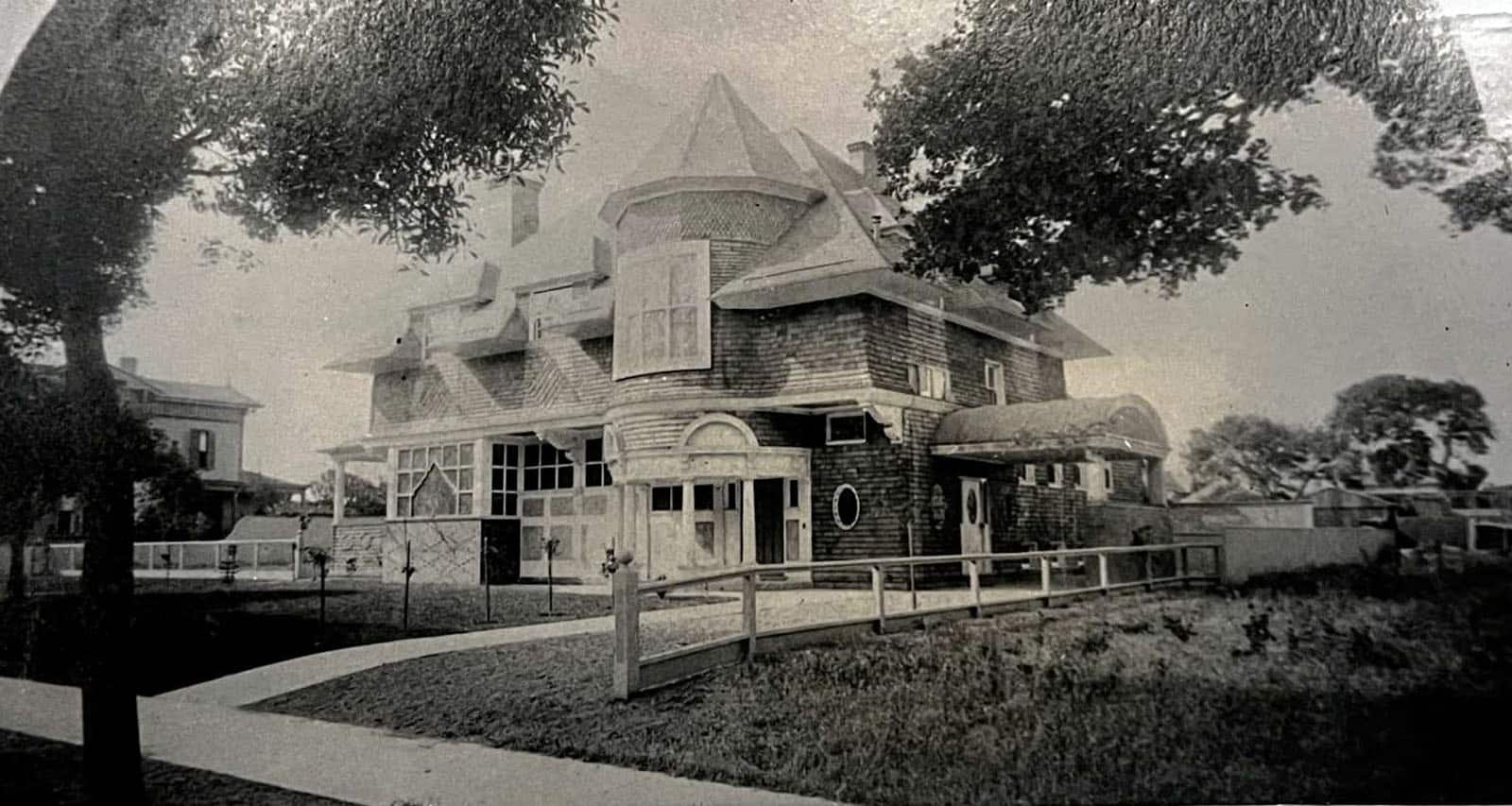
Death comes to 1724
As is always the case with these stories, death comes calling at some point in the narrative. While David Greenleaf had been looking forward to a comfortable retirement in his lovely Coxhead-designed home, he only got to live at 1724 Santa Clara Avenue for less than three years before he died on September 6, 1893. A handwritten letter obtained from the Alameda Museum, dated April 15, 1954, from David G. Martin (whose family owned the property from 1904 to 1942) describes original owner David Greenleaf as being “not well” in his later years, and suffering from diabetes. Perhaps with today’s better testing and treatment for the disease, Greenleaf could have lived longer than his 66 years and 7 months.
After Greenleaf’s death, his wife Helen Greenleaf remained living at the property with her son, 20-year-old David Greenleaf Jr. Her daughter Marianne was 38 years old at the time and lived elsewhere with her husband William Martin and their three children. One of those children, David Greenleaf Martin (1886-1955), the grandson of David Greenleaf, was the one who was quoted in the letter above, and who would live at 1724 Santa Clara Avenue with his wife Ruth from 1933-1942.
Shocked by electricity
An article in the Alameda Daily Encinal, dated December 10, 1901 carried the headline, “Shocked by Electricity,” along with the subheading, “David Greenleaf Has a Narrow Escape from Instant Death.” Helen’s son David Greenleaf Jr. was about 26 years old at the time, and was the assistant engineer of Alameda’s electric light plant. At 7:20 a.m., Greenleaf was turning off the power to the city’s all-night streetlights, when he incorrectly used both hands to throw the switch, instead of using the required one-handed method. As his hands came down, they made contact with screws on either side, which were fully charged with current. A piercing scream was heard throughout the plant, as 2,300 volts passed across his hands, momentarily locking him in place until he could throw himself free.
Greenleaf was immediately attended to by Dr. G.P. Reynolds, who fortunately was near at hand. Had Greenleaf’s hands been just a few inches apart, the current would have passed directly though his body, instead of just his hands, undoubtedly stopping his heart and causing instant death. The flesh on his hands was said to have been badly burned and split, and it would be weeks before he could work again. With his hands swathed in bandages, he said it was a “Fool’s burn,” and that he had just done the same thing he had always warned others not to do.
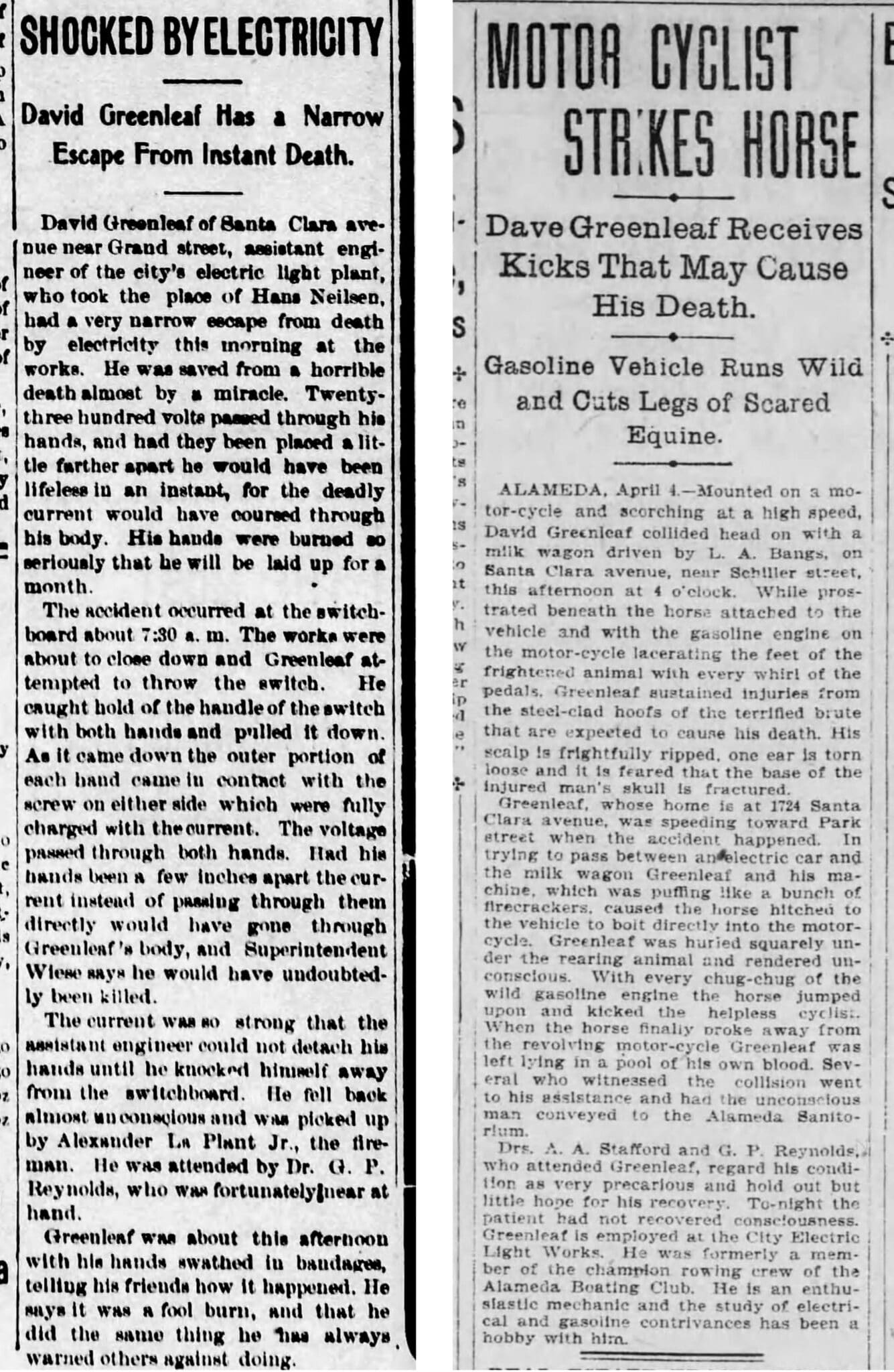
Motorcycle collides with horse cart
An even more serious incident occurred on April 5, 1903, when David Greenleaf Jr. was riding his motorcycle from his home on Santa Clara Avenue, near Schiller Street, at a high rate of speed and attempting to pass a dairy wagon. The noise from the cycle spooked the horse, causing it to turn and move directly into the path of Greenleaf’s machine, which went out of control and careened into the horse and wagon. Greenleaf was thrown beneath the horse, and as the spinning wheels of the cycle lacerated the legs of the frightened animal, it kicked wildly, its steel-clad hooves striking Greenleaf’s body and head repeatedly.
Little hope for recovery
Suffering from a fractured skull from the kicks, along with a torn ear, Greenleaf was rushed to the Alameda Sanitarium (today’s Alameda Hospital), where he was tended to by doctors A.A. Stafford and G.P. Reynolds, the latter being the same doctor who treated him for electricity burns to his hands just two years earlier. A newspaper article in the Alameda Times Star, dated April 6, 1903, reported that Greenleaf “was so severely injured late Saturday afternoon that it is feared that he cannot recover. He is at the Alameda Sanitarium and his condition is such that but little hope is entertained of his recovery.”
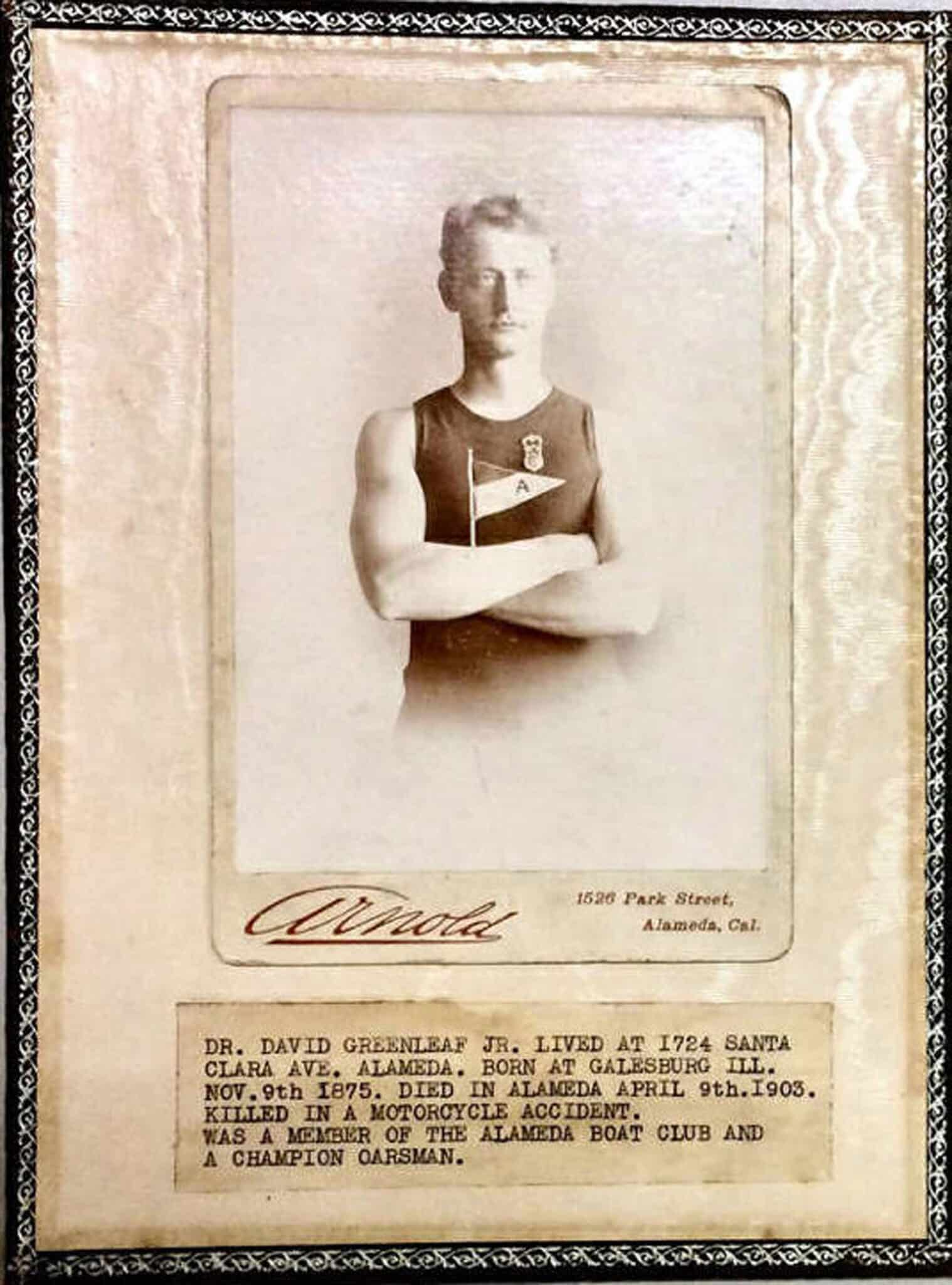
A life cut short
Although the young David Greenleaf Jr. held out for a few days at the hospital, with his mother Helen Greenleaf surely by his bedside, an announcement appeared in the Alameda Times Star on April 9, 1903 stating simply, “Died, In Alameda, David Greenleaf, beloved son of Mrs. Helen Greenleaf, and brother of Mrs. W.J. Martin. A native of Illinois, aged 28 years, 5 months. Funeral strictly private.” An article in the same newspaper came out the next day, April 10, 1903, announcing that “The funeral of the late David Greenleaf will take place at the home of the decedent’s mother, Mrs. Helen Greenleaf, on Santa Clara Avenue near Grand street. The services and interment will be strictly private.”
And so, within a period of 10 years, Helen Greenleaf had lost both her husband and her son. David Greenleaf Jr. must have been a very vital young man, as evidenced by his many medals awarded for excellence in rowing and boating, and by his enthusiasm for motorcycling. It was the latter hobby that would prove to be his undoing, and within a year Helen would sell the family home at 1724 Santa Clara Avenue to M.G. Martin for $10,000, perhaps to move in with her daughter Marianne. Helen died 13 years later, in 1917.

The Martin era
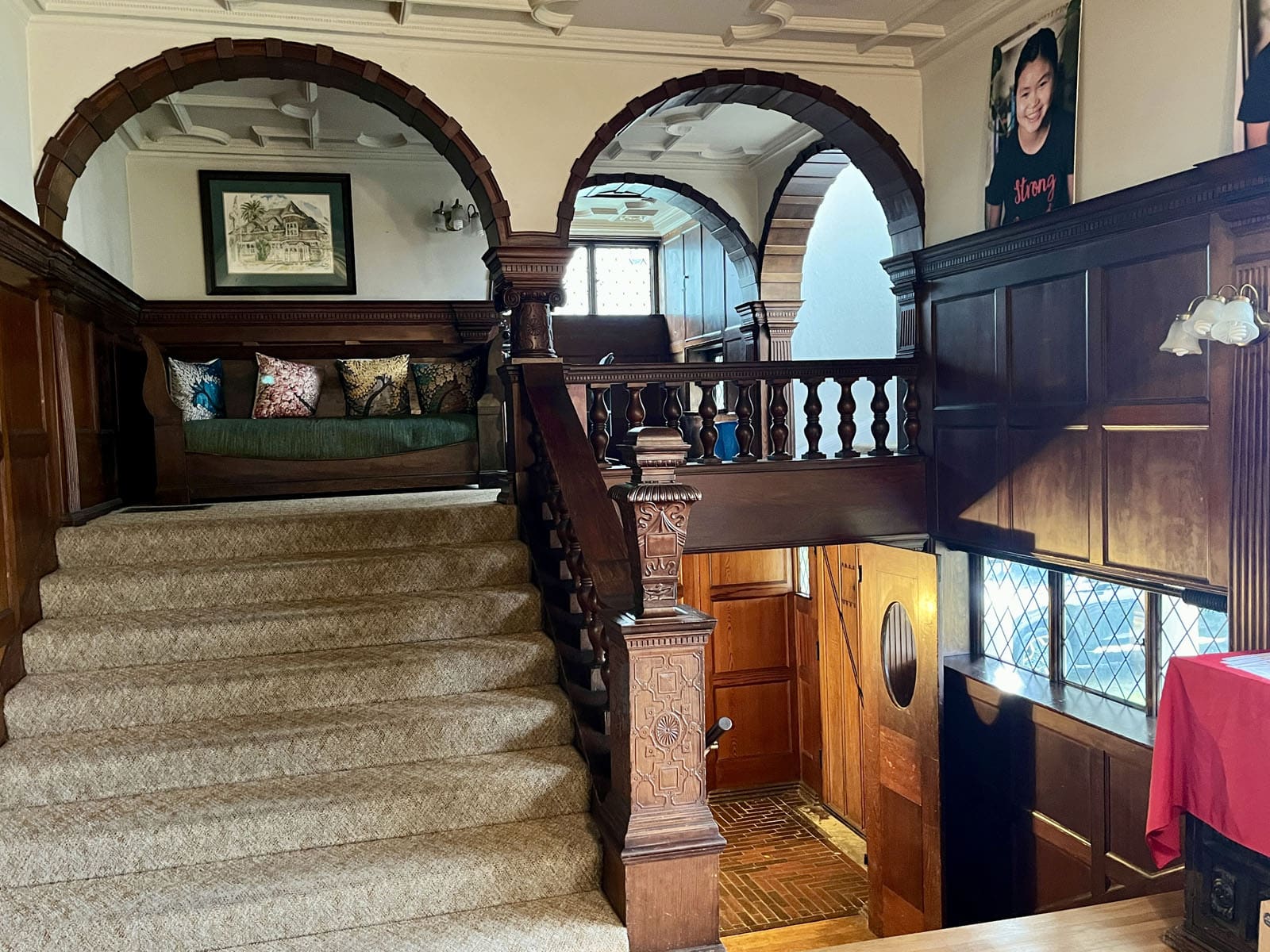
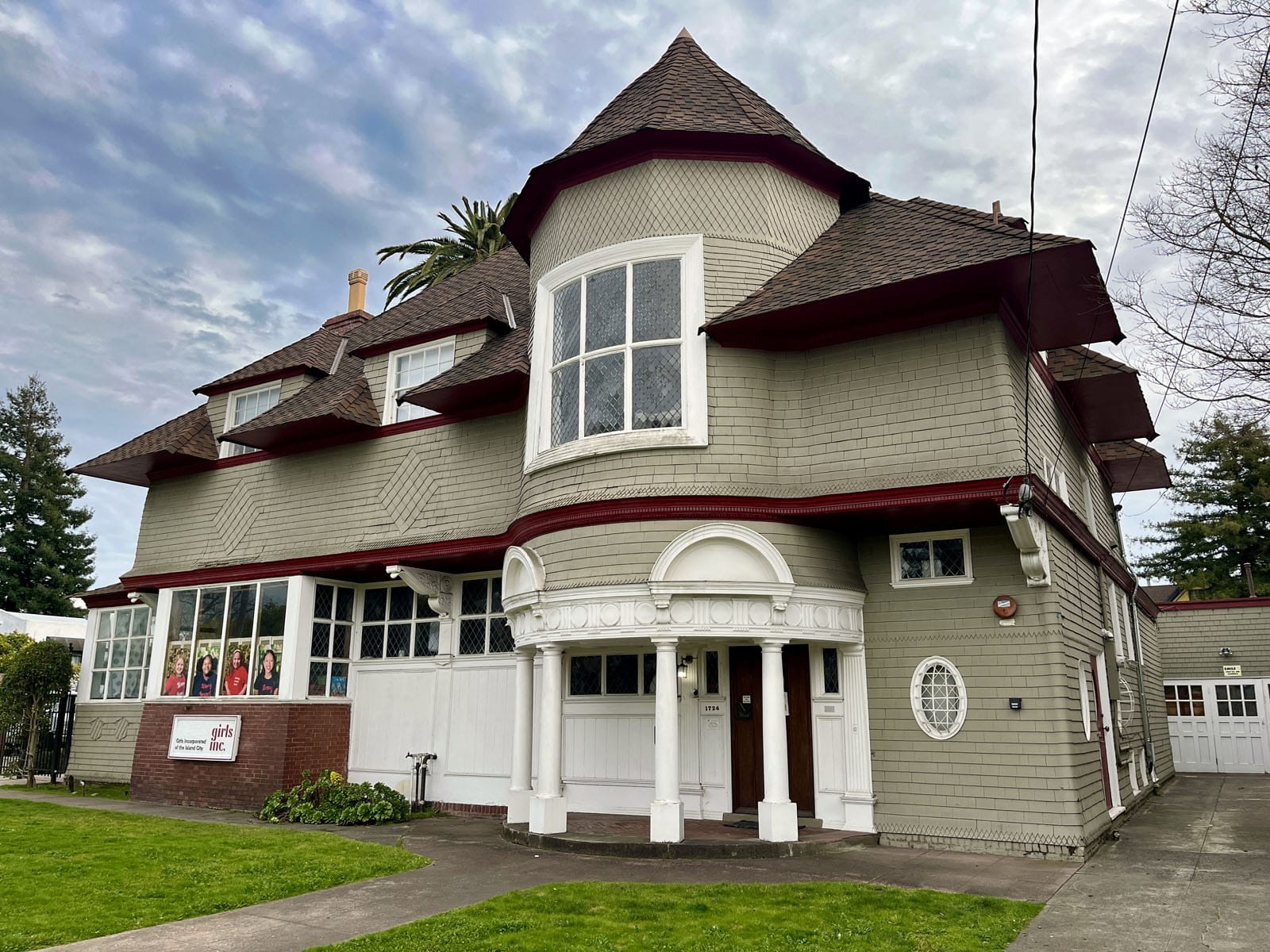
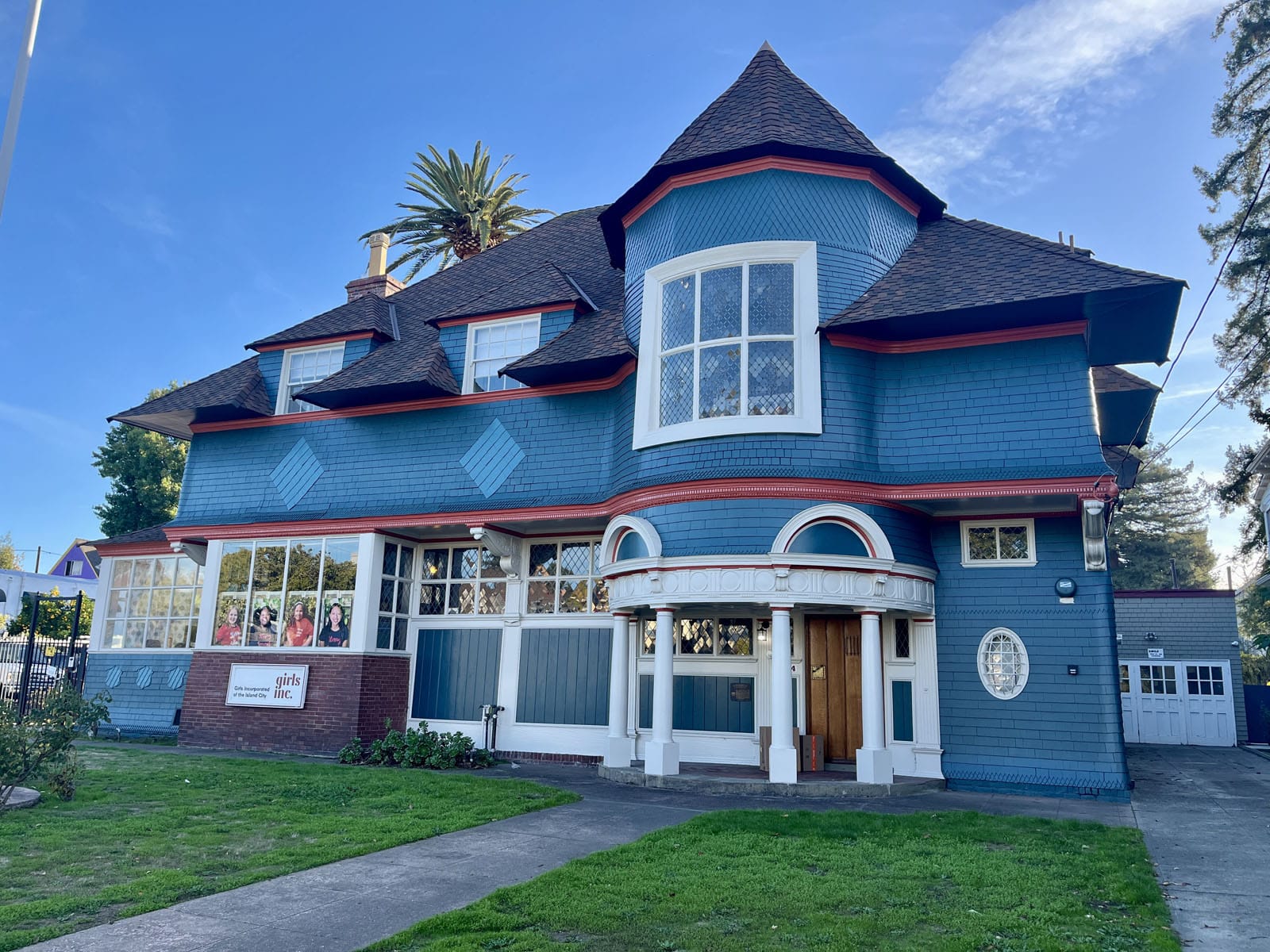
The historic ownership record for 1724 Santa Clara Avenue shows that the second owner was M.G. Martin, who purchased the property from Mrs. Greenleaf for $10,000 in 1904. There must have been some land held back at that initial sale though, because in 1914 there was an entry stating, “balance of land sold to Martin family.” Looking at the Girls, Inc. property today, one can see that it is a large plot of land, easily a double-wide lot by the standards of the neighborhood. Originally, though, it was even larger, and we’ll look into that in a future article. The lot that David Greenleaf purchased from the Morrill family in 1891 for $3,000 has seen many residents and uses over the decades, but one thing has held constant—the original home of David Greenleaf and family remains intact and standing tall, today used as offices for Girls, Inc.
A genealogical mystery
The historic record shows that M.G. Martin purchased the property from Mrs. Greenleaf in 1904, and then proceeded to rent it out to a number of tenants for decades until 1933, when the house was owned and occupied by David G. Martin and his wife Ruth. But who was M.G. Martin? My first guess would be that M.G. Martin was an elder relative of David G. Martin, and then the younger Martin inherited the property after his relative died. The mystery is that I can’t find an M.G. Martin in the genealogical record connected directly to David G. Martin. I see a William James Martin (his father), and a Thomas Beckett Martin (his grandfather), but no M.G. Martin.
Further genealogical digging finds Minnie Gertrude Martin (1857-1934), a resident of Alameda, married to David William Martin (1849-1931), and living on Park Avenue during the 1910 census. Minnie was an Associate Conductress of the Carita Chapter, Order of the Eastern Star (associated with the Masons). They had a son, David Chester Martin, who lived from 1883-1950. This almost makes perfect sense, in terms of M.G. Martin purchasing the property in 1904 and it being inherited by her son David in 1933, if only their son was listed as David G. Martin (1886-1955), not David C. Martin (1883-1950). But almost isn’t good enough when it comes to genealogy; the match has to be exact. How David G. Martin, who lived at 1724 Santa Clara Avenue from 1933 to 1942, is connected to Minnie G. Martin is still a mystery, but there must be a family connection there.
Family connections
Another interesting aspect of the ownership history of this home is the family connection between the first owners of this home, the Greenleafs, and the second owners, the Martins. In 1883, the Greenleafs’ daughter Marianne married William James Martin. They had three children, the oldest of whom was David G. Martin, whose full name was David Greenleaf Martin—the middle name honoring his grandfather, David Greenleaf Sr.
It might be a coincidence that the Greenleafs’ daughter just happened to marry someone with the same last name as the family who would buy her family home 21 years later, in 1904. But it seems a bit too much of a coincidence that their son David Greenleaf Martin would later inherit the house and live in it with his wife, before selling it in 1942. What seems most likely is that there was a longtime connection between the Greenleaf and Martin families, at least going back as far as 1883 when Marianne married William. Then, once Helen Greenleaf lost her husband in 1893, and her son in 1903, she sold her family home at 1724 Santa Clara Avenue to a relative of her in-laws, M.G. Martin, in 1904. To the best of our knowledge, that person was Minnie Gertrude Martin. At a time when it wasn’t common for women to own property, it is meaningful that the property changed hands from one woman owner to another woman owner—especially in light of the fact that the building would become home to the Girls Club (and eventually Girls Inc.) many years later.
Next up
When the story of the Greenleaf House continues, we’ll explore the complete timeline of all the different residents of the home over the years, including the Hazzard family, who established a private school there during the 1920s. Then, we’ll learn how the Boy Scout Council came to own the property, what led to the creation of a Girls Club in Alameda, and what brought them eventually to this house, and when their name changed to Girls Inc. Plus, there’s the sister-house to explore, a virtual twin of the Greenleaf House located in downtown Napa. All that, plus whatever new discoveries and historic photos that may come to light, when our story continues.
Special thanks to Beth Sibley and Myrna van Lunteren for additional historical information and photos for this series.
Contributing writer Steve Gorman has been a resident of Alameda since 2000, when he fell in love with the history and architecture of this unique town. Contact him via [email protected]. His writing is collected at AlamedaPost.com/Steve-Gorman.
