Last month, this series featured the “Peeps of Alameda,” four small similar sandpipers. Now we move on to somewhat larger sandpipers.
The peeps are all in one genus (the classification just above species), so they are closely related, and they all nest in the very far North. The medium-sized sandpipers discussed here are more diverse. They are all in the Scolopacidae order, the large group called “Sandpipers and allies.” Unlike the peeps, they belong to three different genuses, and breed in various places.

Like the peeps, these medium-sized sandpipers find what they need for the winter here on the Alameda bayshore—plentiful food, warmer weather, and a congenial spot to rest and fuel up for the trip back to the breeding grounds when spring arrives.
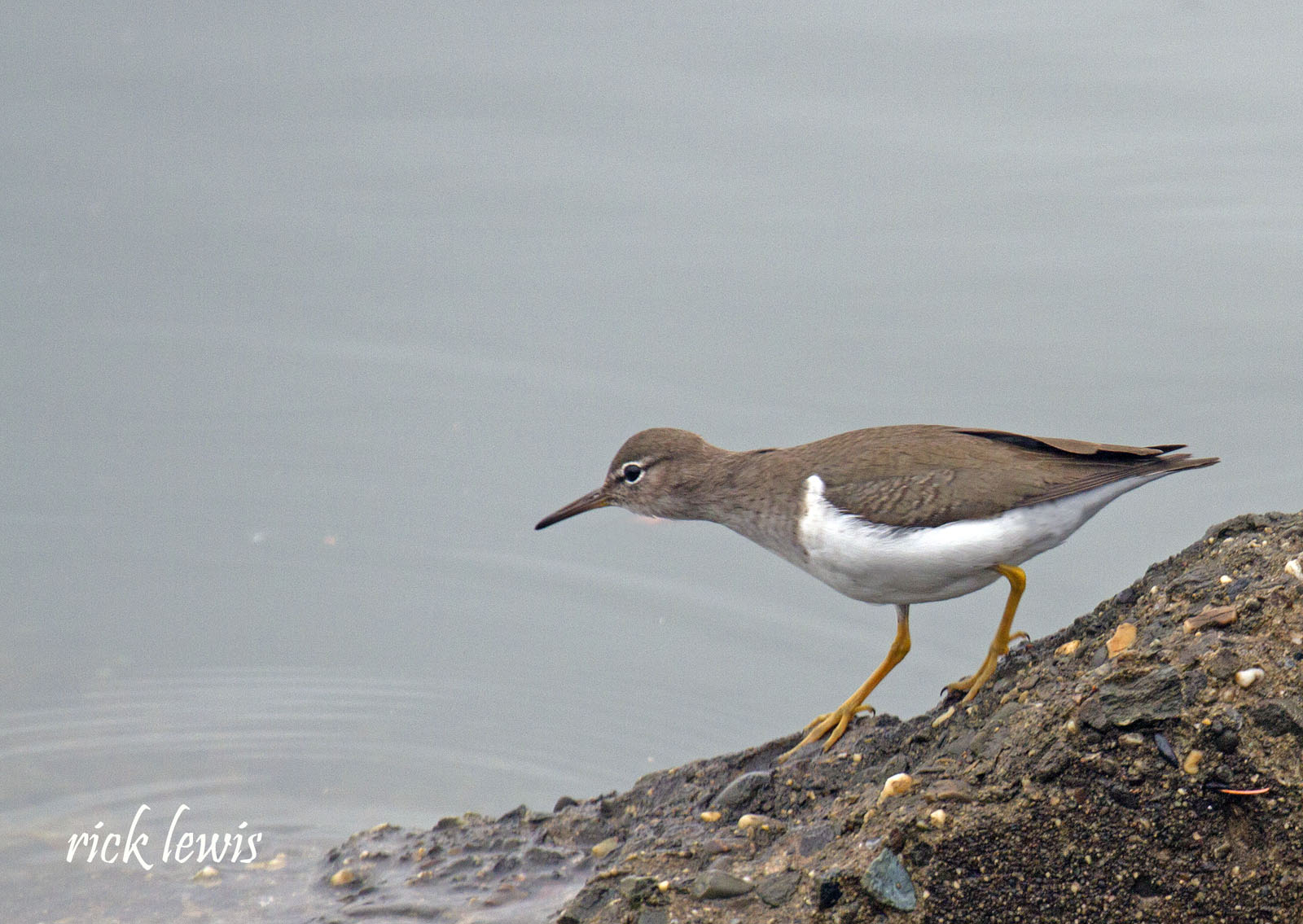
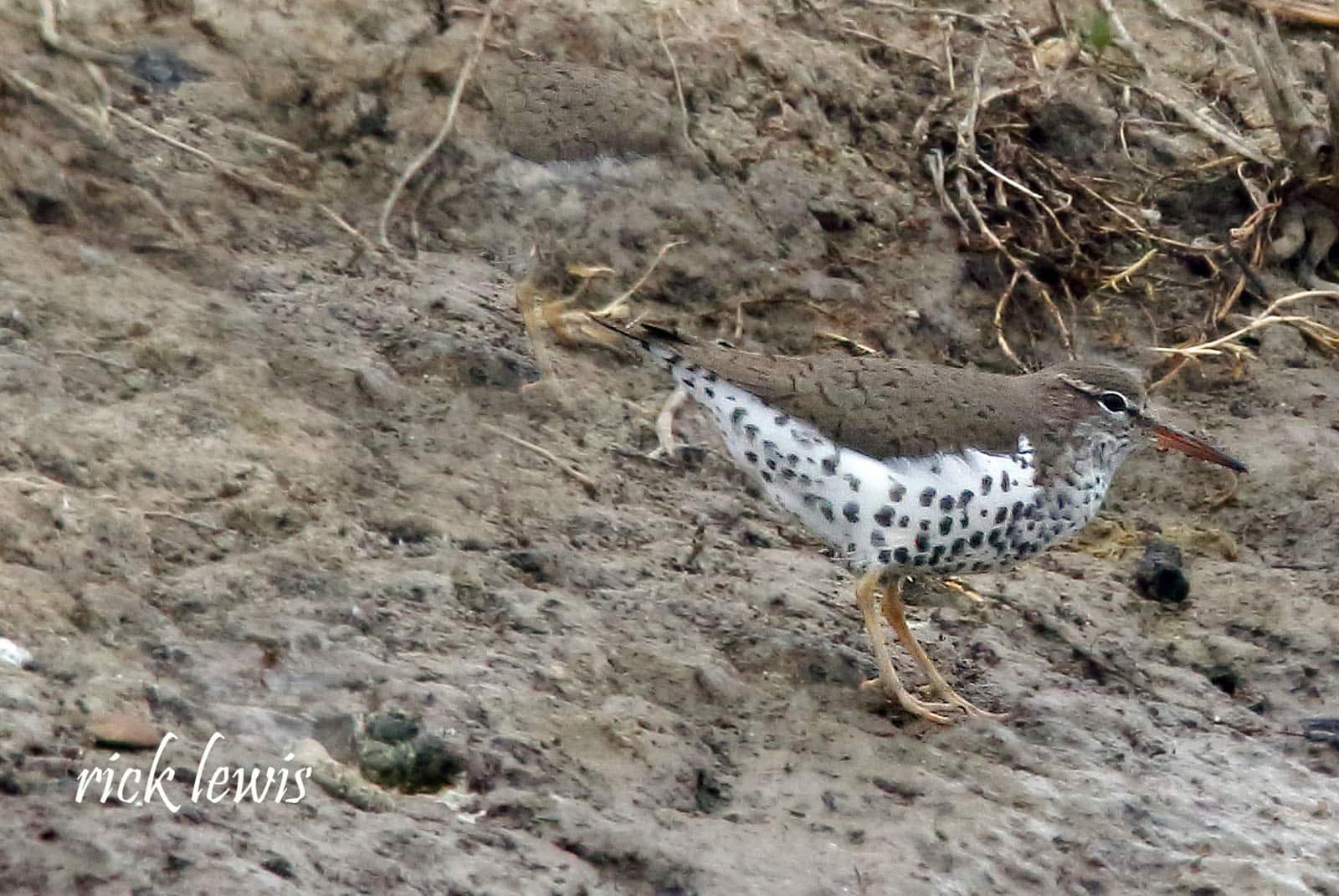
Spotted sandpiper (Actitis macularius)
Spotted sandpipers, at 7 to 7.9 inches long, are about the same size as dunlins, but their behavior is very different. Unlike the dunlin, spotted sandpipers (sometimes called “spotties”) have yellow legs. In the fall and winter when we see them, spotties have a black bill, grayish-brown back, a little light brown on their breast, and very light belly. So why are they named spotted sandpipers? In the breeding season, spotted sandpipers have bold dark spots that clearly distinguish them from the other sandpipers. In all seasons, they are distinguished by a characteristic teetering movement, so it looks like they are constantly bobbing their tails. In Alameda, spotties seem not to be as numerous as the peeps or some of other sandpipers, but they are seen climbing on and around rocks near water, such as at Crab Cove. Their flight is unique—low over the water and with stiff, shallow wing beats.
The spotted sandpiper has a very large breeding area—across all of North America, roughly above 36 to 37 degrees latitudes, with occasional dips down in parts of Arizona and New Mexico, but not including the Bay Area or nearby regions. Spotties can do this because they feed on a large variety of animal matter and can live in almost all habitats near water. They forage both by probing with their bills into sand and mud, visually sighting prey, and lunging at it in the air or picking it off surfaces.
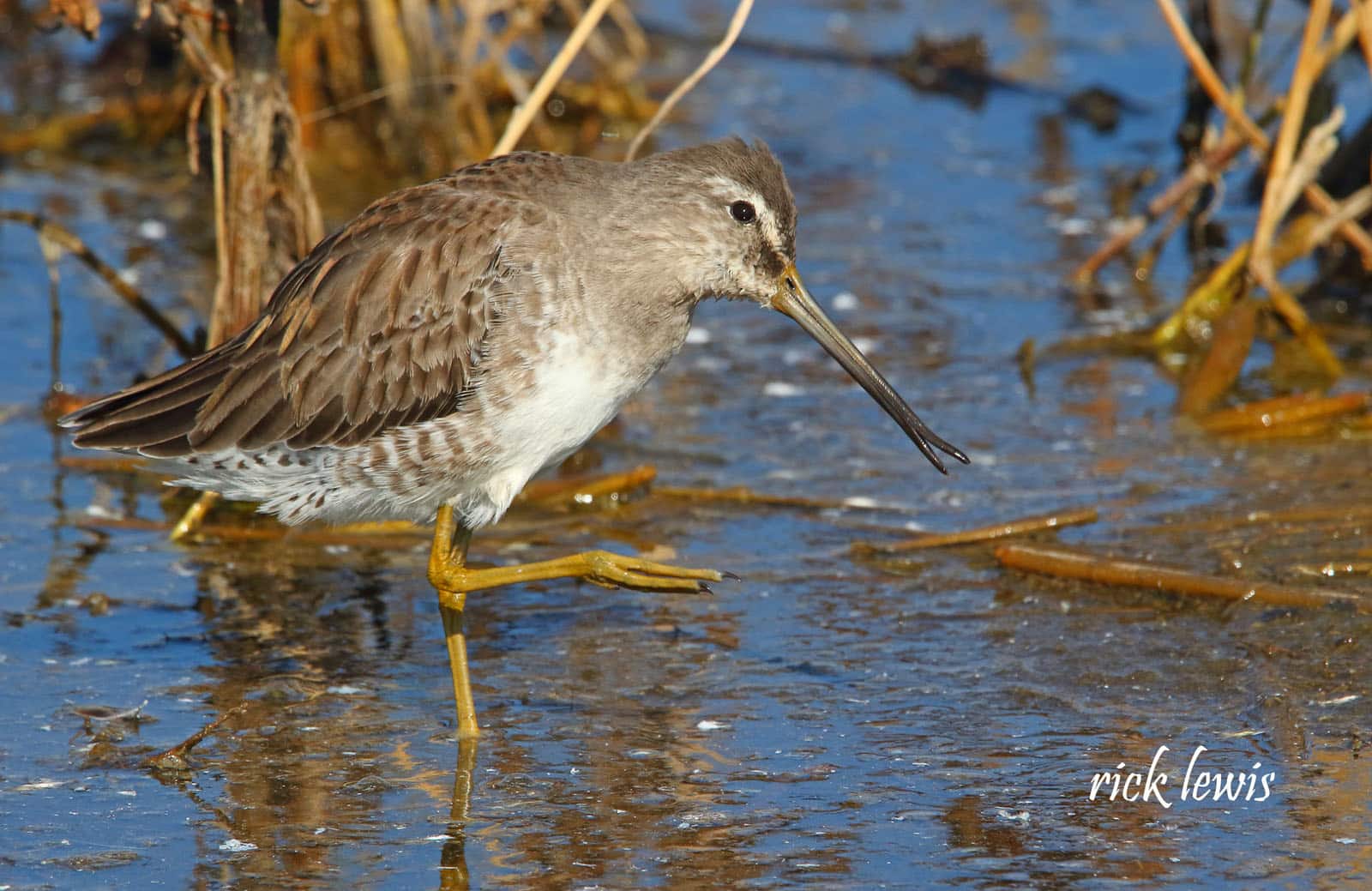
Dowitchers (Limnodromus scolopaceus and Limnodromus greseus)
Dowitchers are a step above spotties in length, measuring between 10 and 11.5 inches. There are two species of dowitchers—long-billed and short-billed. Differences between the two species are hard to detect in the winter when observing at a distance. While female long-billed dowitchers have longer bills than the short-billed species, the males often do not. If you hear them calling, the call of the short-billed is a “tu-tu-tu” while the long-billed has a “keek” call.
In winter, both dowitchers are grayish above and on the breast, and pale in the belly. They have long pale “eyebrows” and yellow legs. In flight, they have a distinctive white patch on the back between the wings near the rump.
Both dowitchers use their bills to probe into mud or sand in an up and down fashion, seeking food. The motion is reminiscent of a sewing machine needle. Both have special sensory receptors called Herbst corpuscles in their bills, so they can locate prey by touch.
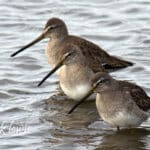
Both dowitchers breed in Northern climes. The long-billed breeds from northeastern Russia to northwestern Canada, on tundra. The short-billed breeds only in sub-arctic North America in patches almost coast to coast. Both tend to mostly arrive here somewhat later than the earliest shorebirds.
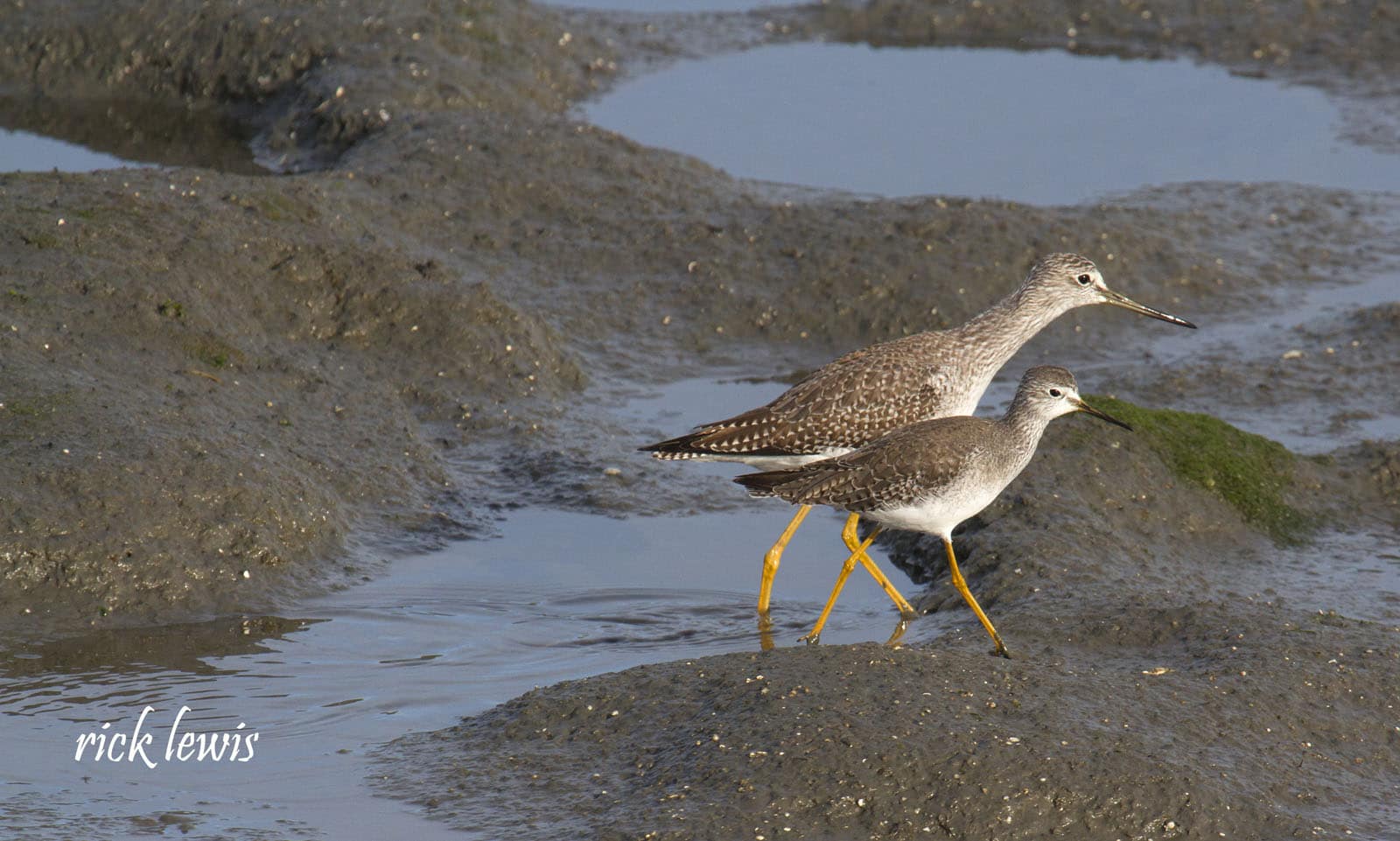
Greater yellowlegs (Tringa melanoleuca)
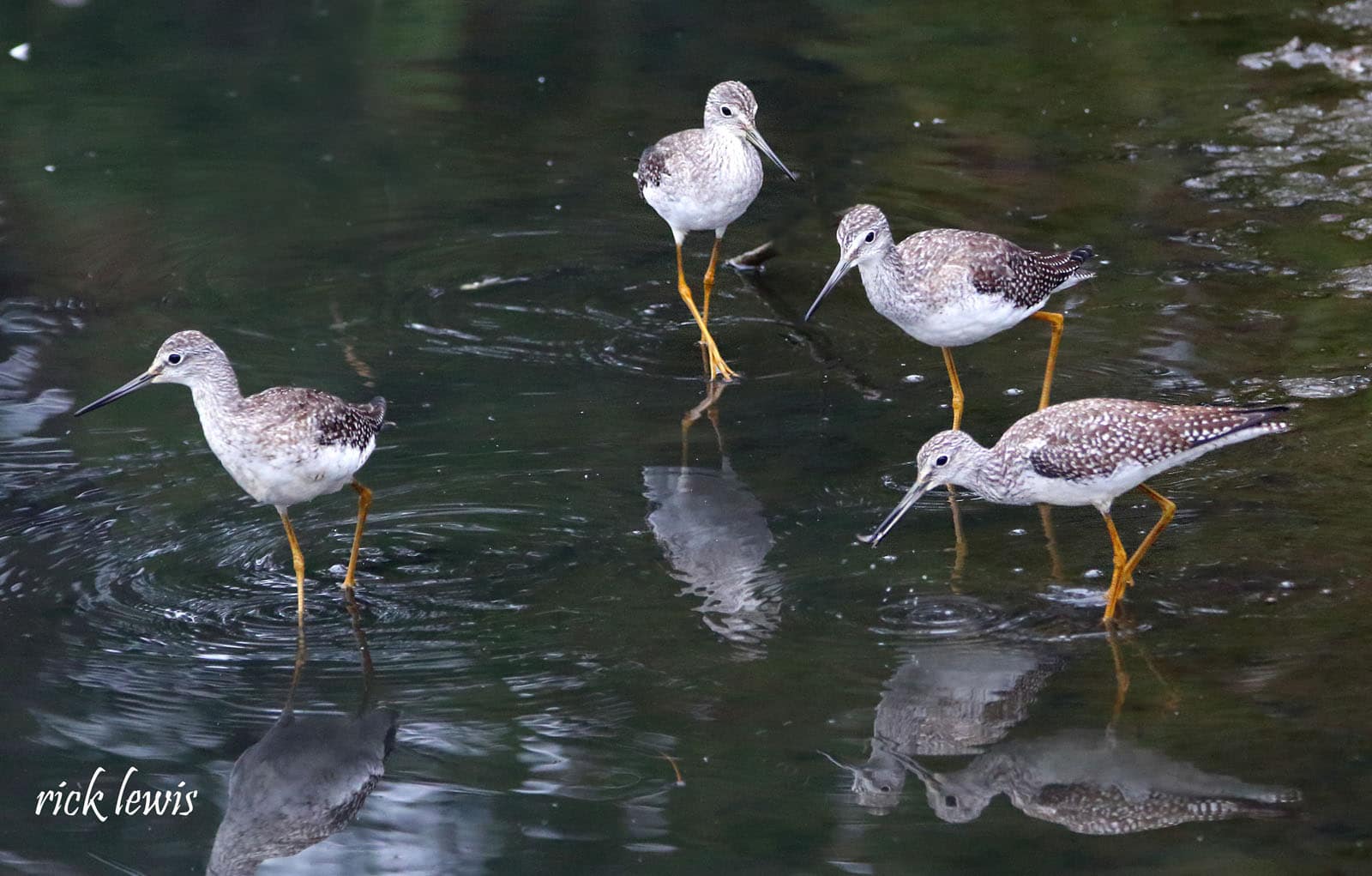
The greater yellowlegs is quite a handsome bird. It is slender, with a small head and long bright yellow legs. In winter, it has a black and white checkerboard of speckling on its back and fine black streaking on its head and neck. It’s between 11.5 and 13 inches long. The greater yellowlegs tends to wade in deeper water than do other sandpipers, leading to its sometimes being called a “marshpiper.” It breeds in swamps and bog in southern Alaska and central Canada.
Another yellowlegs, the lesser yellowlegs (Tringa flavipes), also appears in Alameda. It looks very similar to the greater, but is about 9 to 10.5 inches long, about 20% smaller overall than the greater. According to the community bird listing tool eBird, the greater yellowlegs are seen more often at Elsie Roemer Bird Sanctuary than are the lesser. Despite their similar appearance, greater and lesser yellowlegs are not each other’s closest relatives. The lesser is more closely related to our next bird, the willet.
Willet (Tringa semipalmata)
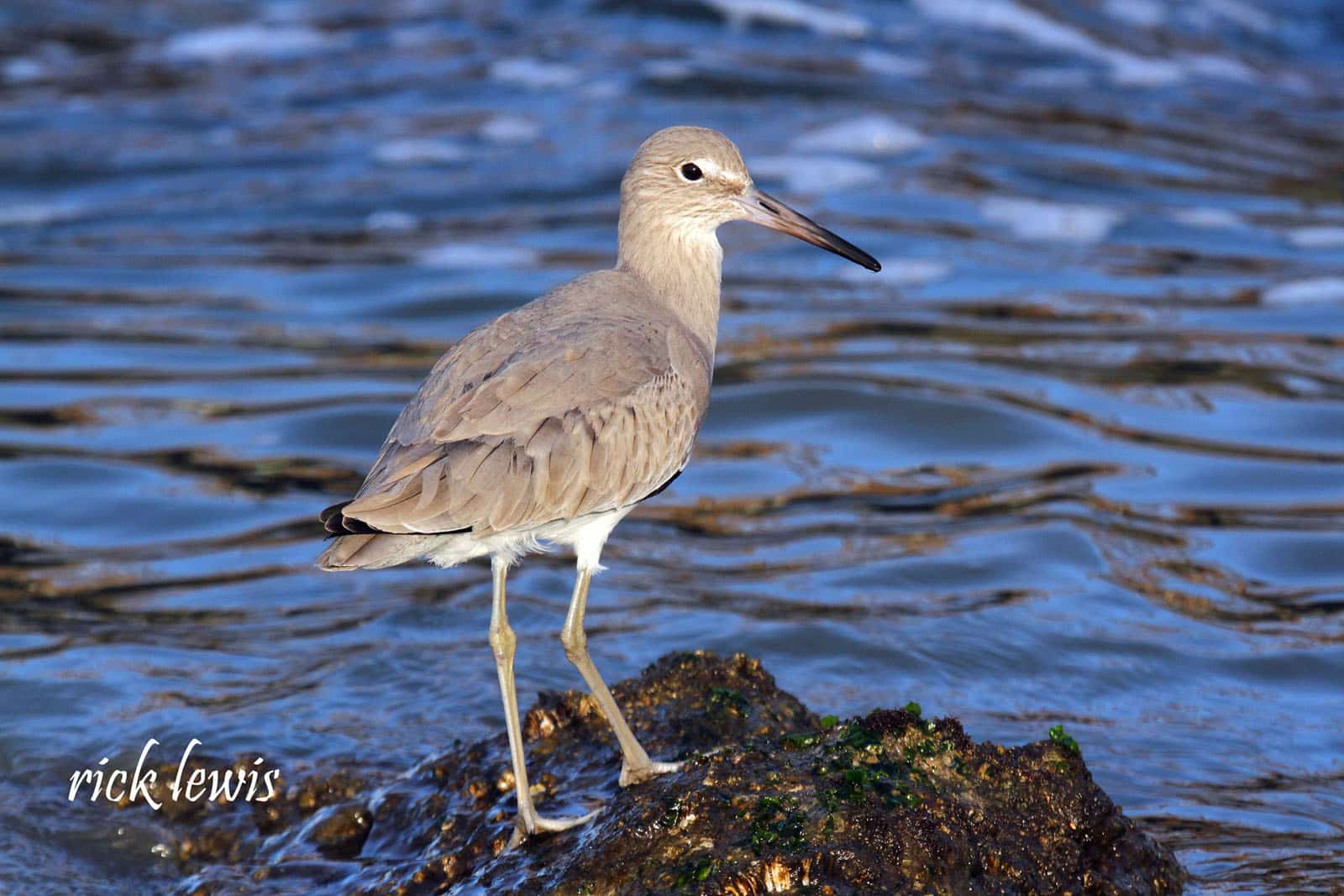
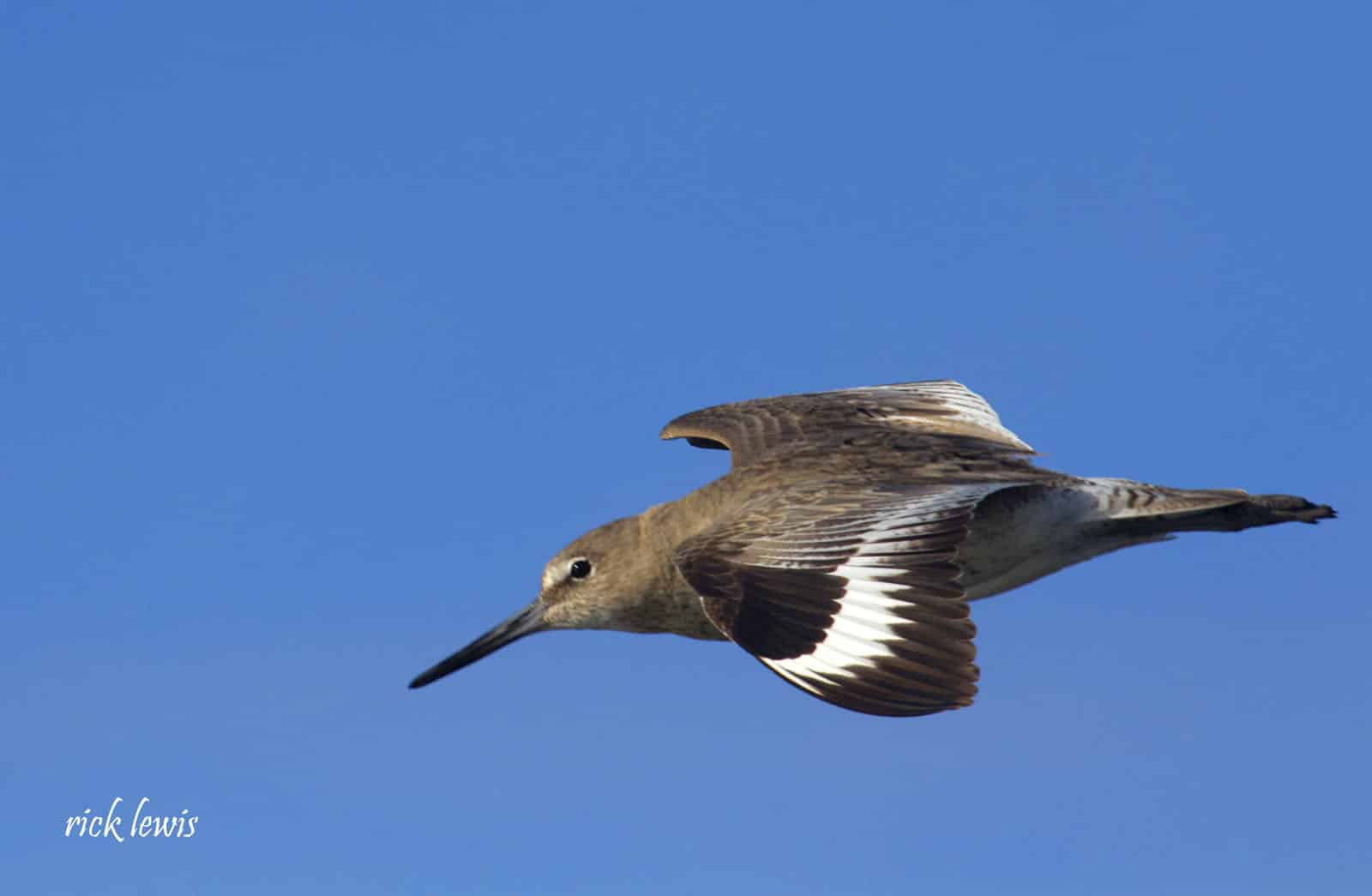
Willets in winter are distinguished by being plain, until they open their wings. Standing near the Bayshore, it’s a stocky brownish gray bird about 13 to 16 inches long, with a long thick black bill, gray legs and few distinguishing marks. Then it launches into the air and displays a stunning pattern of black and white on its wings, demonstrating that it’s a willet. Western willets breed inland, in the north central United States and lower Canada, nesting near marshes and other wetlands. In winter, Western willets feed both during the day and at night, eating mostly invertebrates, including small crabs, worms, and clams, and the occasional small fish. They forage using both their sensitive bills and visual sighting.
All these birds feed largely on aquatic invertebrates – insects, worms, snails, clams, crabs, and the like. If they can catch them, many will eat small fish, frogs and toads. Spotted sandpipers forage both by probing with their bills into sand and mud and visually sighting prey and lunging at it in the air or picking it off surfaces. Long-billed dowitchers feed by touch, probing deeply below wet, muddy or sandy surfaces. Because they see well at night, in fall and winter, they often feed during hours of darkness. Greater yellowlegs capture their prey in shallow water by swift stabs. Willets also feed during the day and at night. They take most of their prey from the surface, but also probe for crustaceans and occasionally paddle into the shallows to chase down prey.
Beginners to shorebird identification may find these medium-sized birds easier to tell apart than the peeps. They have more distinctive behaviors and more variation in color and pattern. And, of course, they’re bigger! Stay tuned for the final installment in Common Sandpipers of Alameda—the big ones—later this fall or winter.
Linda Carloni is a member of Friends of the Alameda Wildlife Reserve.
This article is part of a series written by Friends of the Alameda Wildlife Reserve (FAWR) members, FAWR is a Conservation Committee of Golden Gate Bird Alliance (formerly Audubon). To find out more about birds and GGBA’s free guided trips see www.goldengatebirdalliance.org
