On November 10, the Planning Board reviewed proposed updates to the City’s Inclusionary Housing Ordinance, which focus on creating a more flexible and balanced framework for affordable housing production that responds to current market realities. The proposed update maintains the City’s 15% affordable housing requirement for projects of five or more units. However, it offers developers several compliance options—on-site construction, off-site clustered units, or payment of in-lieu fees—aiming to ensure affordability goals are met without stifling development.
Board members broadly supported the direction of the update. However, they emphasized the need for economic feasibility and developer flexibility, urging that inclusionary goals not inadvertently suppress housing development.
Overview and background
Planning Manager Steve Buckley presented proposed updates to Alameda’s Inclusionary Housing Ordinance. The ordinance currently requires residential projects of five or more units to provide 15% affordable housing for very low- (4%), low- (4%), and moderate-income (7%) households. Options for developers to provide affordable housing include on-site units, off-site clustered units, and paying in-lieu fees (developers can pay the fees in lieu of including affordable housing units on-site).
Earlier discussions established broad agreement that Alameda faces an acute need for housing across income levels, with distinct considerations for rental versus ownership projects.
Key takeaways from prior meetings in January and May included:
- Recognition that on-site units should be incentivized, but that off-site cluster housing can also play a vital role.
- A desire to distribute affordable units across neighborhoods rather than concentrate them, while still allowing clustering for efficiency and funding competitiveness.
- Interest in exploring local preference systems to prioritize affordable housing for residents, local workers, and school employees.
- Support for ensuring that in-lieu fees genuinely cover the cost of producing affordable units.
- A commitment to ensuring buyer transparency in Below Market Rate (BMR) homeownership programs, i.e., buyers must understand equity limitations and resale restrictions.
Buckley cautioned that construction, labor, and financing costs remain unusually high, so policy adjustments should avoid inadvertently halting new housing.
Income levels and affordability targets
The ordinance operates within the framework of Alameda County Area Median Income (AMI) thresholds, where the 2025 AMI for a family of four is $159,800. Income tiers define who qualifies for very-low, low-, or moderate-income housing, and determine the rent or sale-price restrictions on inclusionary units.
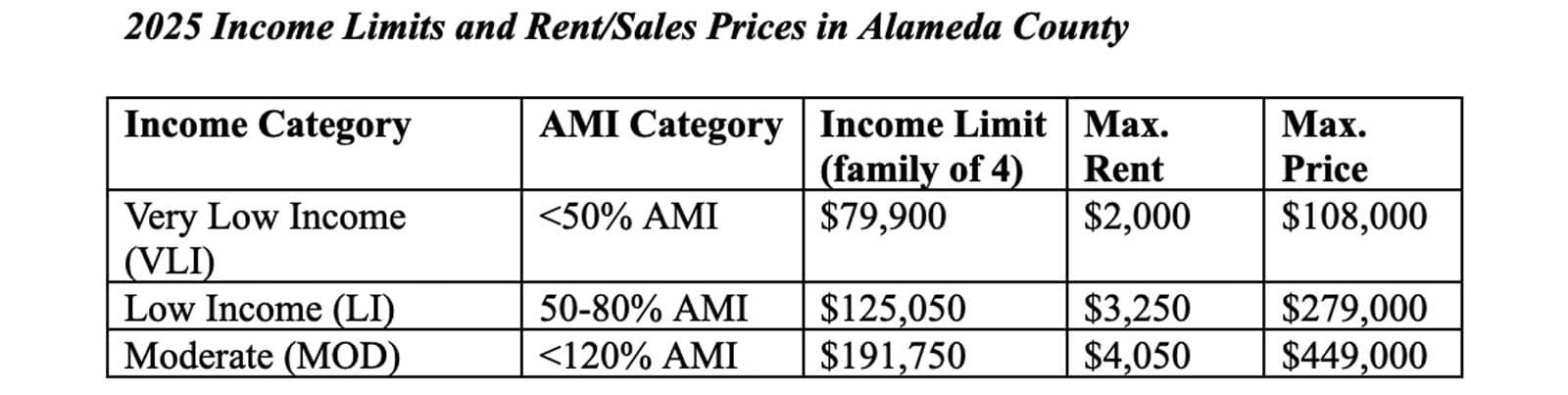
Buckley highlighted how maximum affordable rents and home purchase prices are calculated using regional affordability standards—typically, that no more than 30% of household income should be spent on housing costs. For example, a median-income family of four earning about $160,000 annually could afford a three-bedroom rental at roughly $3,600 per month.
Sale prices, by contrast, reveal much steeper gaps between what income-qualified households can afford and actual market values in Alameda. As a result, ownership units require substantially higher subsidies per unit than rental housing.
This difference underscores why the City treats rental and ownership inclusionary targets differently—and why moderate-income ownership units are often the hardest to produce without steep subsidies.
Inclusionary options under consideration
For rental housing, Low-Income rental units are a priority, since Very-Low-Income units are usually developed by the Alameda Housing Authority and nonprofit partners, and Moderate-Income units are generally priced close to market rents and don’t fill a critical affordability need. Buckley presented three options:
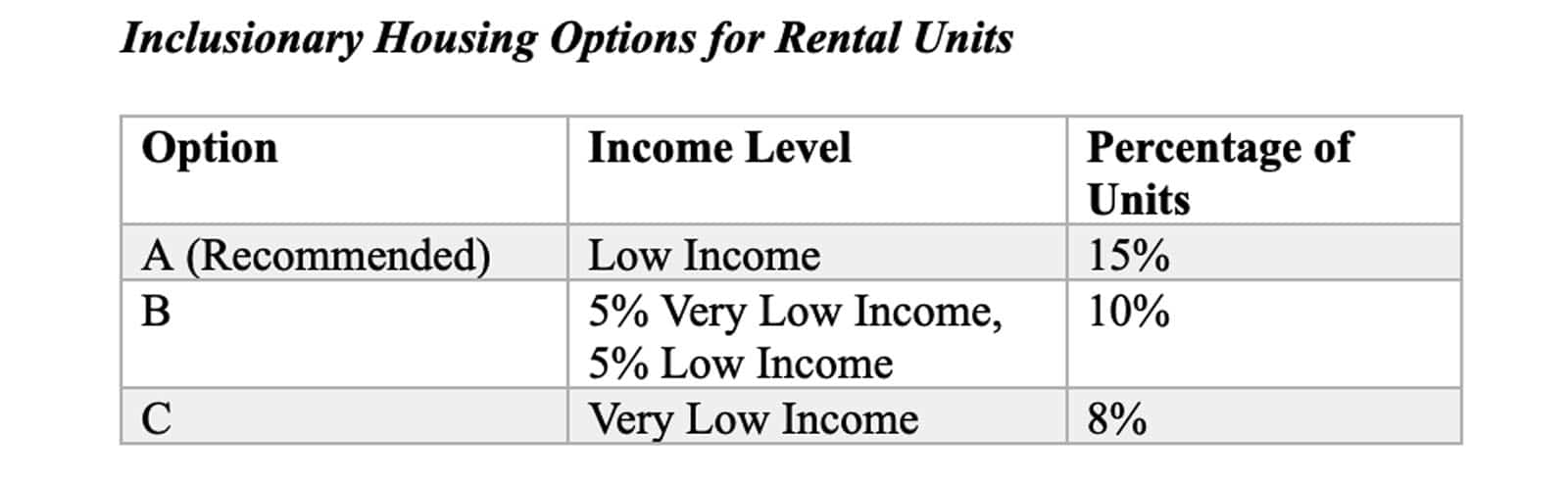
Each option results in similar developer costs, averaging around $18 per square foot. This aligns with regional norms and keeps projects financially viable.
While rental projects spread affordability obligations over time through reduced operating income, ownership projects absorb the affordability cost entirely at the time of sale. Consequently, the City must carefully calibrate inclusionary percentages and fees to ensure that for-sale housing remains financially feasible while still contributing to affordability goals.
Buckley explained that the City’s current inclusionary program, developed years ago when construction costs were lower, has become very expensive to meet for ownership projects under current conditions. Thus, the new update seeks to reduce the cost burden while maintaining equivalent affordability outcomes. Buckley presented four options for ownership units.


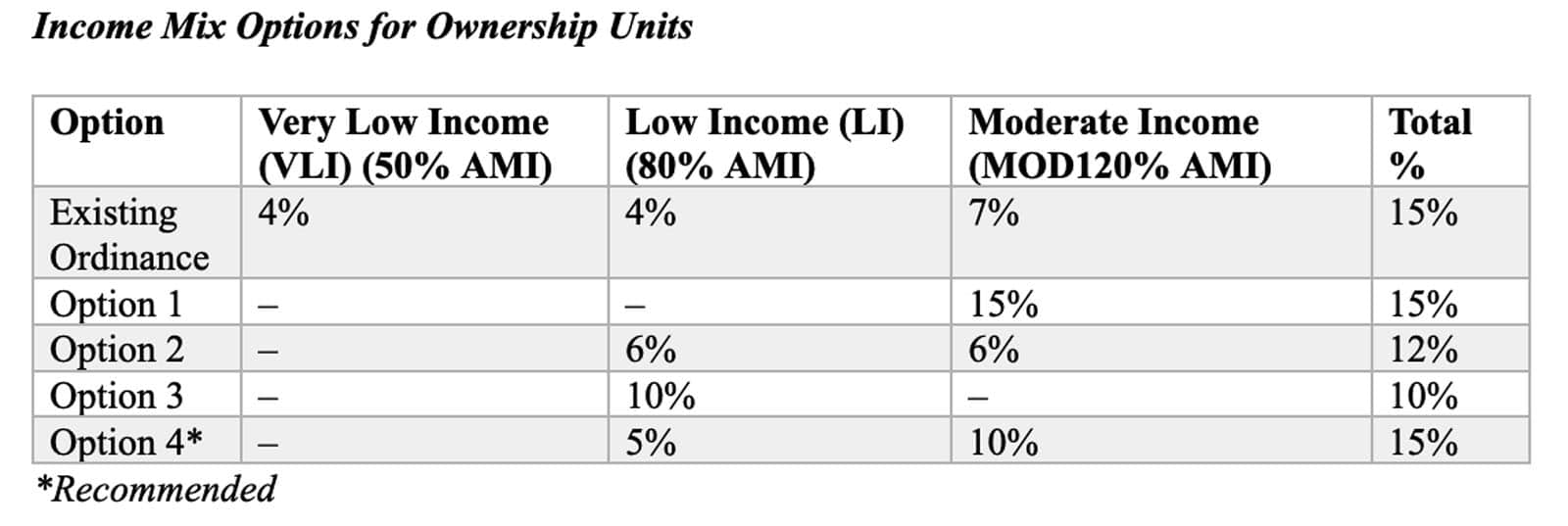
Buckley proposed that ownership inclusionary options be structured under a menu-based compliance system where developers can select among on-site units, clustered projects, or in-lieu fees, with the City retaining authority to approve equivalent-value proposals based on feasibility. The proposed update would also extend the affordability term from 59 to 99 years.
Alameda aims to mirror regional best practices (e.g., Berkeley, Emeryville, and San Leandro), where flexible yet enforceable inclusionary ownership frameworks have sustained production through changing market cycles.
Board comments
Board members generally praised staff’s work on the inclusionary housing update, with the overall sentiment that Alameda’s ordinance is moving in the right direction, particularly by differentiating between rental and ownership requirements and expanding compliance options. Nonetheless, they raised concerns about feasibility, economic challenges, and the balance between policy idealism and market realities.
Board member Hanson Hom underscored that current barriers to development stem from construction, financing, labor, and land costs, not inclusionary mandates, noting that lowering fees alone won’t make projects viable since “even if you eliminated all inclusionary housing requirements, most projects would still not be feasible.”
Still, he strongly supported eliminating moderate-income rentals from inclusionary housing, as they mirror or exceed market rents, and instead focusing on low and very-low-income units. For inclusionary ownership housing, he supported focusing on moderate and low-income tiers since very-low-income ownership is “onerous” given HOA and utility costs.
Board member Andy Wang also focused on the economic feasibility of housing production and the importance of honest framing. He supported proposed structural improvements to the ordinance, but stressed that the update does not address project feasibility. He proposed a temporary, parallel measure—such as 24-month fee relief—to encourage immediate construction, saying “15% of zero is still zero,” meaning strong inclusionary mandates are meaningless if no projects are built.
Wang supported the current direction as a long-term framework, but urged short-term flexibility to spur housing during the current market downturn. He also cautioned against overemphasizing on-site units when in-lieu funds can enable construction of affordable projects during economic downturns.
Board Member Asheshh Saheba also emphasized that increasing total housing supply remains essential to achieving affordability. He supported letting developers choose between in-lieu fees and on-site inclusionary units, depending on project economics. Still, he took issue with the proposed flat-fee, per-square-foot structure for in-lieu fees, suggesting it unfairly penalizes smaller or more costly sites (e.g., waterfront or remediation zones). He advocated for ensuring cost predictability for developers. His overarching concern was that the policy, while well-intentioned, might not promote the ultimate goal—new housing.
Board Vice President Diana Ariza aligned with Hom and Saheba, suggesting there should be a mechanism to account for differences in site costs and economic conditions and ensuring that inclusionary obligations remain achievable across varying project types and markets.
Finally, Board President Xiomara Cisneros repeatedly underscored that “flexibility is key,” praising the concept of providing multiple compliance options. She endorsed the 99-year affordability term and advocated for also using inclusionary resources for preservation and rehabilitation projects. She urged the City to tie policy decisions to current construction cost indices and broader market cycles, suggesting adjustments over time as needed. She expressed concern that overly high fees might discourage small infill developers and called for “right-sizing” rates to keep small-scale projects viable.
Staff response and next steps
Planning Services Manager Buckley acknowledged the comments, emphasizing that it’s impossible to accommodate every project nuance in a citywide ordinance, and that Development Agreements will remain the primary mechanism for addressing case-specific feasibility issues.
Staff will present the Board’s feedback to the City Council at the November 17 meeting for policy direction before drafting the updated ordinance.
Contributing writer Karin K. Jensen covers boards and commissions for the Alameda Post. Contact her via [email protected]. Her writing is collected at https://linktr.ee/karinkjensen and https://alamedapost.com/Karin-K-Jensen.
