
Autumn is well underway and it will be winter soon enough. Now at the right tide levels, we can see crowds of sandpipers on parts of the Alameda bayshore, feeding and resting to recuperate from their migration. This final article about Alameda sandpipers concerns the three largest that we commonly see.
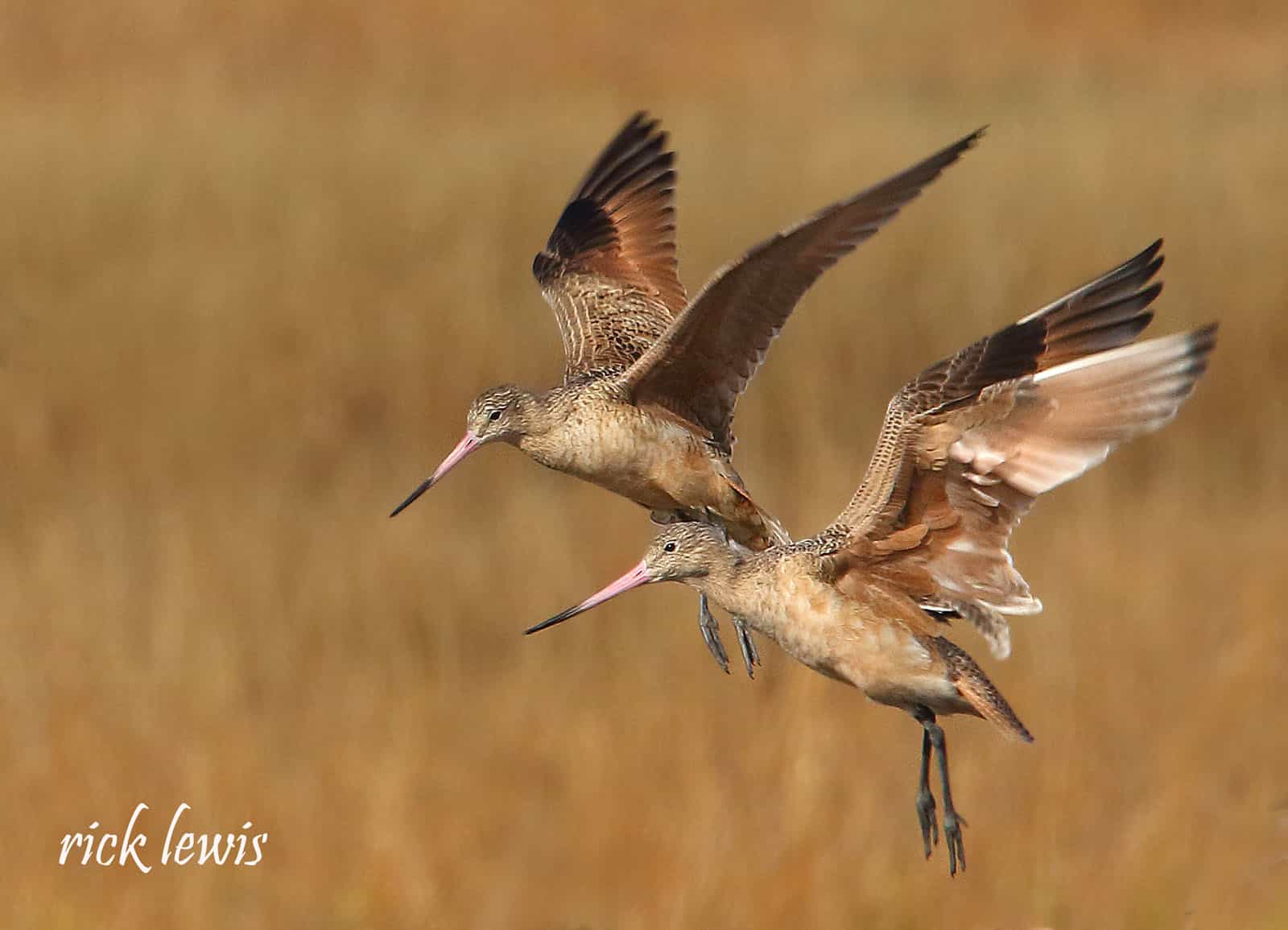
Marbled godwit (Limosa fedora)
The marbled godwit and long-billed curlew are found only in the Americas. Marbled godwits breed primarily in grasslands on the northern prairie at sites near water, with small, isolated populations breeding along James Bay in Canada and in Alaska. In winter, marbled godwits are found on most coasts of North America, extending slightly into Central America on its western coast.
The marbled godwit is a tawny buff color. Its upperparts are darkly speckled and barred; in winter, its underparts are mostly unmarked and have a cinnamony tinge. Underwings are cinnamon-colored all year. The marbled godwit is 16 to 19 inches long and has a sword-shaped bill with a slight upward turn and (in winter) a bright pink bottom half.
Food varies by season. In winter and on the coast, marbled godwits feed on aquatic invertebrates. On the interior breeding grounds, they eat insects, especially grasshoppers, as well as plant tubers and small fish. During migration, marbled godwits eat plant tubers almost exclusively, using their upturned bill to clip them off.
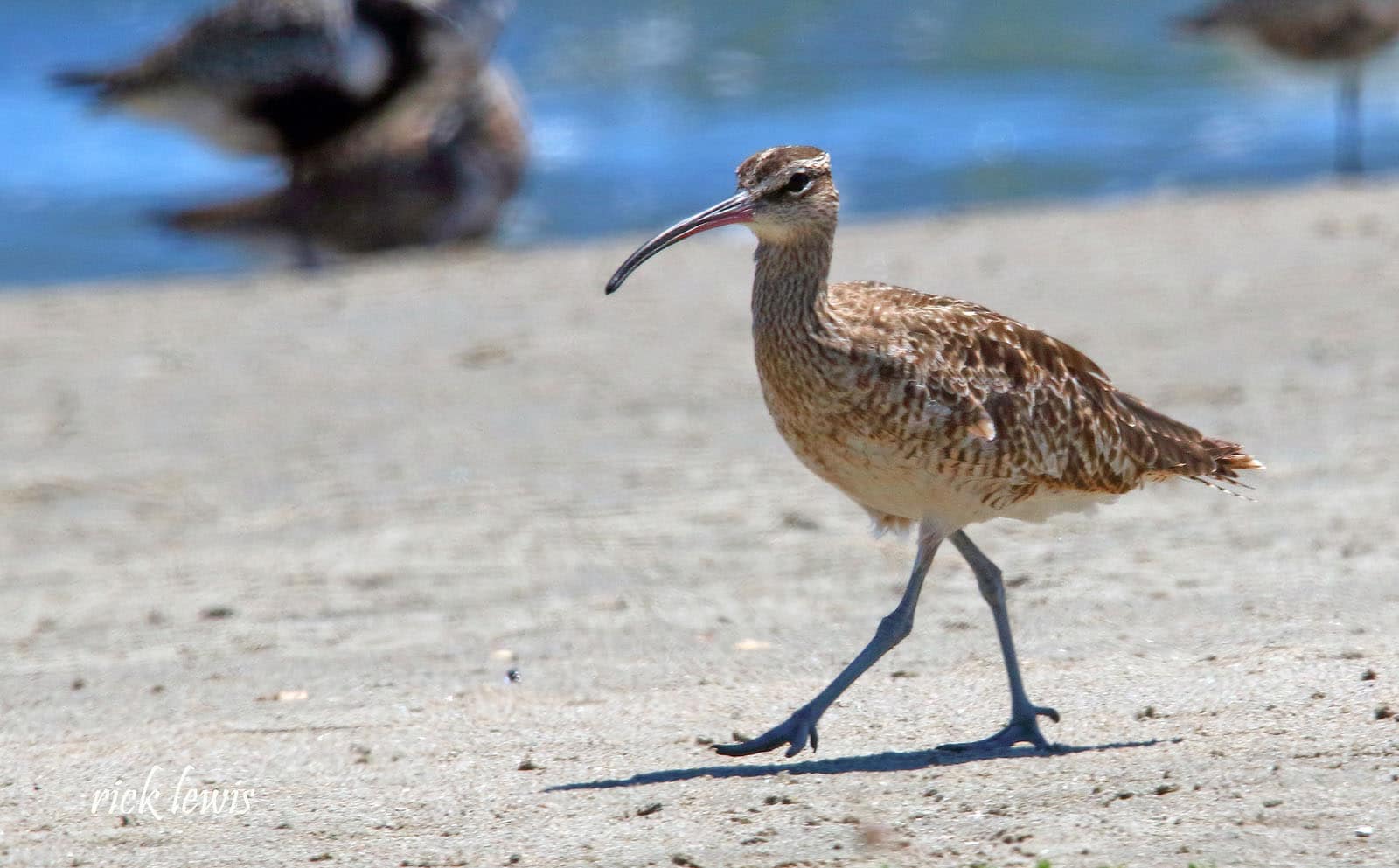
Whimbrel (Numenius phaeopus)
Unlike the marbled godwit and the long-billed curlew, the whimbrel is found in both the Eastern and Western hemispheres, breeding in the north (boreal, subarctic and low arctic areas) and wintering mostly on shores around the world. This results in some long migrations—nonstop flights of almost 2,500 miles have been recorded along the Atlantic coast from New England or southern Canada to South America.
The whimbrel is a large brownish shorebird. It is between 17 and 18 inches long; its upper parts are a dark brown marked with pale buff, and underparts a plainer paler buff. Its most distinctive features are a very dark crown (containing a pale stripe that can be difficult to see) and a long (2.9 to 4 inches) down-curved bill. This genus was named Numenius because its long down-curved bill was thought to resemble the new moon, evoking the Greek word meaning “of the new moon.” Most whimbrels also have a narrow dark line through the middle of the eye.
The whimbrel’s diet is varied and changes with the seasons. When the whimbrel first arrives in its breeding areas, it eats berries left from the prior summer, lichens and mosses, and intertidal animals when it can find them. As the environment thaws, whimbrels move into tundra, eating lichens and other plants as well as insects, other invertebrates, and fish when available. On the wintering grounds, whimbrels eat mainly marine invertebrates, including crustaceans and worms, as well as fish. In many wintering areas, whimbrels primarily eat fiddler crabs; the curve of the whimbrel’s bill fits the shape of these crabs’ burrows well.

Long-billed curlew (Numenius americanus)
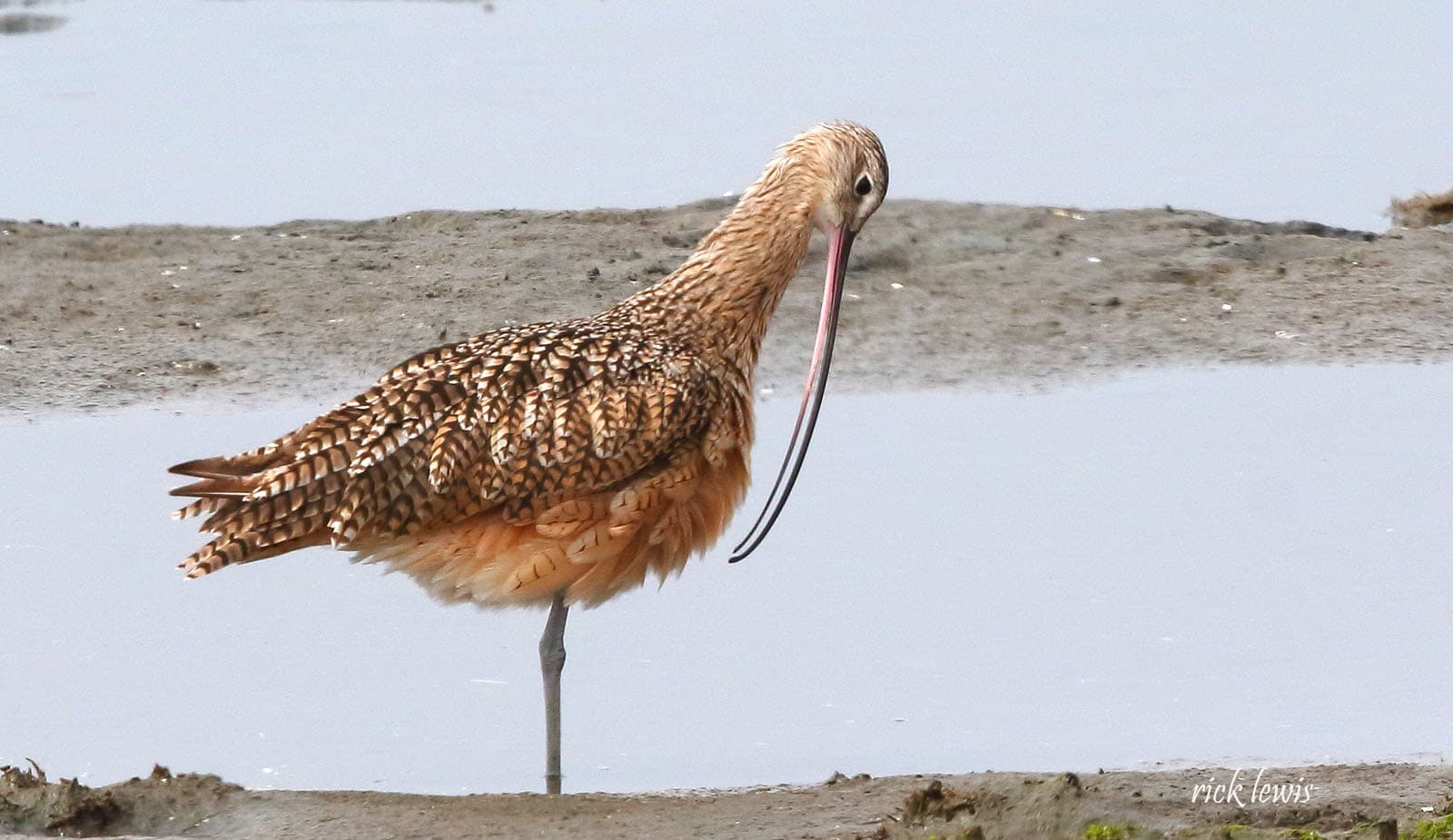
This is the largest shorebird that visits Alameda. In fact, it’s the largest shorebird in North America. Its length is between 19.5 and 25.5 inches and its weight ranges from 17.5 to 33.5 ounces. Its bill is very long, measuring up to 8.6 inches. Females average larger than males, and have a longer bill.
Like other members of its Numenius genus (the first name in the scientific name), its bill is downwardly curved, referred to as decurved. The bird’s shape reminds some of a football and its legs are quite long. Overall, the long-billed curlew is cinnamon-colored with dark markings on the wings, head, and breast, and a plain belly.
Of all four species of the Numenius genus in North America, the long-billed curlew breeds the furthest south and winters the furthest north, resulting in a short to medium length migration. It breeds in the grasslands of the Great Plains and Great Basin, and winters in central and coastal California, along the Gulf and east coasts, in Mexico, and along Central American coasts.
Long-billed curlews are carnivorous, feeding on insects, crustaceans and some other invertebrates. In winter, they forage mostly by probing; in summer both pecking and probing are used and grasshoppers and beetles are a frequent food. Its bill is particularly well adapted for capturing crabs and shrimp in burrows of tidal mudflats or burrowing earthworms in pastures.
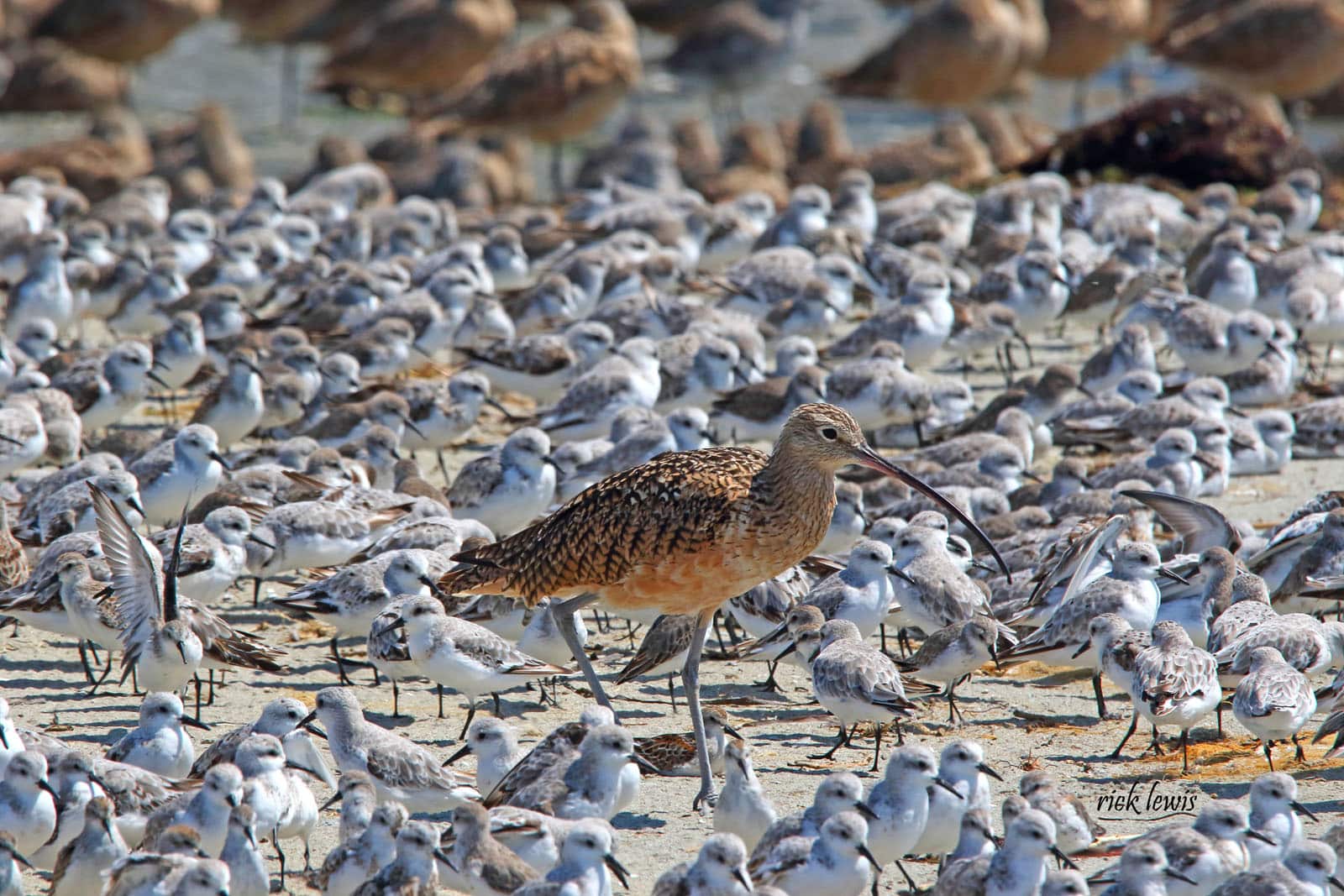
This series has explored both the similarities and the differences among the sandpipers that share Alameda’s bay shore in the fall and winter. Our sandpipers have long bodies and legs, and are mostly shades of brown or gray on their upper parts, frequently with lighter under parts. Their bills are narrow and tend to be long relative to the birds’ size. They live mostly on the shore, in sand or mud. They feed from the ground and eat a lot of insects, worms, and crustaceans. But they are also diverse, arriving here from different breeding locations with different behaviors—the spotted sandpiper’s bobbing rear is distinctive! Their patterning is diverse as are their sizes, with lengths ranging from 5 to 25 inches.
Now’s the time to visit them and see if you can distinguish one from the other!
Linda Carloni is a long-time member of the Golden Gate Bird Alliance and its Alameda Conservation Committee, Friends of the Alameda Wildlife Reserve.
This article is part of a series written by Friends of the Alameda Wildlife Reserve (FAWR) members. To find out more about birds and Golden Gate Bird Alliance’s free guided field trips see www.goldengatebirdalliance.org
