When we last left off in Part 2 of this series, we had learned about the family connections between the first owners of 1724 Santa Clara Avenue, the Greenleafs, and the second owners of the property, the Martins. After Minnie Gertrude Martin purchased the property from the widow Helen Greenleaf in 1904, the house remained a rental property for decades, occupied by a series of long-term tenants.
Timeline
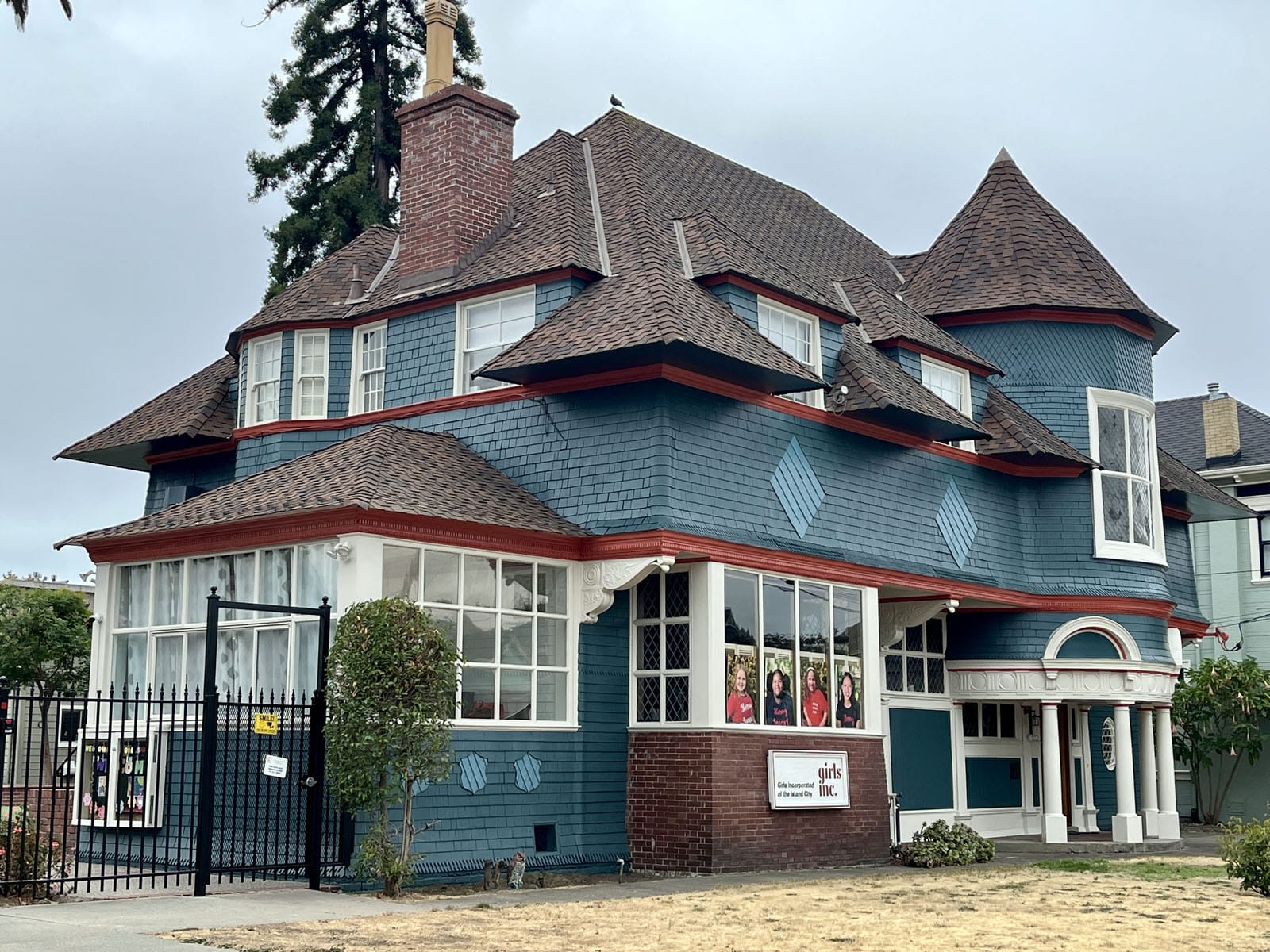
Fortunately for us, this storied house has generated significant interest from historians over the years, and so we have a continuous, unbroken timeline of residents stretching all the way from its beginning in 1891 up to the present day.
As we learned in Part 1, the Greenleaf family was the very first owner in 1891, having had the unique home designed for them by noteworthy British-born architect Ernest Coxhead. After the death of her husband David Greenleaf in 1893, and then the tragic death of her son David Greenleaf Jr. in 1903, Helen Greenleaf sold the house to M. G. Martin in 1904 for $10,000.
Meet the renters
Between 1904 and 1915, the house was rented by the Poorman family. The 1904 Husted’s City Directory lists attorney Samuel Poorman living at 1724 Santa Clara Avenue, along with Alice Poorman, student Edward Poorman, and Samuel Poorman Jr., attorney in San Francisco. By 1911 only Samuel Poorman and his son Samuel Jr. were listed as residents, and by 1914, Samuel Jr. was listed as Alameda City Attorney.
By 1916, the Poormans were out and the home was being rented by clerk Leonard D. Smith, and by 1917 Smith was listed as a structural engineer. No Husted Directories were published in 1919 and 1920, and by the time we pick up the trail again in 1922, contractor Henry W. Hazzard and his wife Lona are listed as occupants of the house. But the Hazzards weren’t just renting the house for themselves.
Hazzard School
An announcement in the Alameda Times Star, dated June 21, 1922, is the first hint of a new era for the building that had been used only as a residence during the first 31 years of its existence. The announcement reported the City Council’s approval of a request “…that the property situated at 1724 Santa Clara Avenue be changed and reclassified from a Class I Single Family Dwelling District, to a Class IV, Kindergarten District. Ordinance No. 213 adopted and passed by the Council of the City of Alameda this 20th day of June, 1922. – Frank Otis.” Otis was Alameda’s mayor from 1919 to 1925.
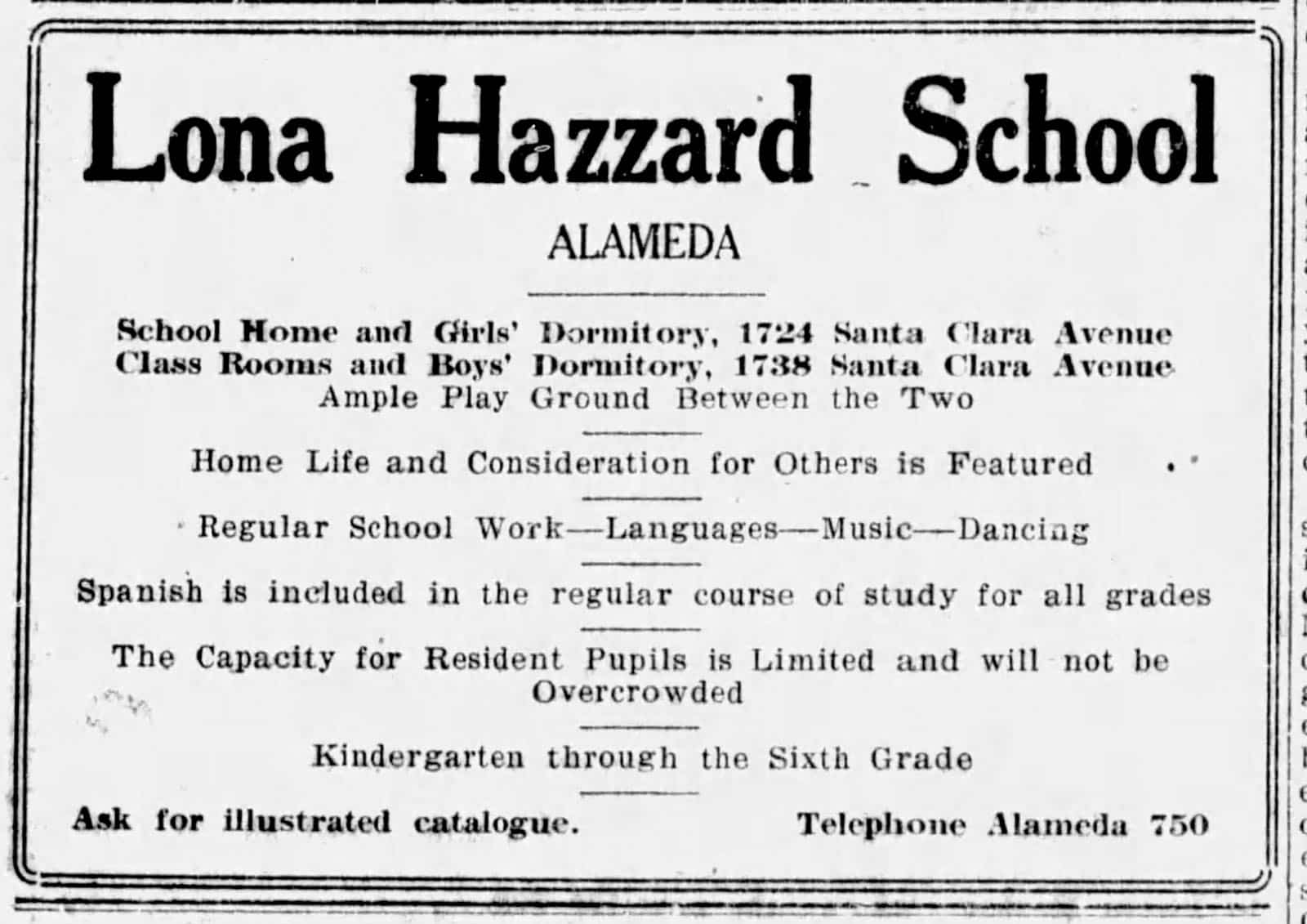
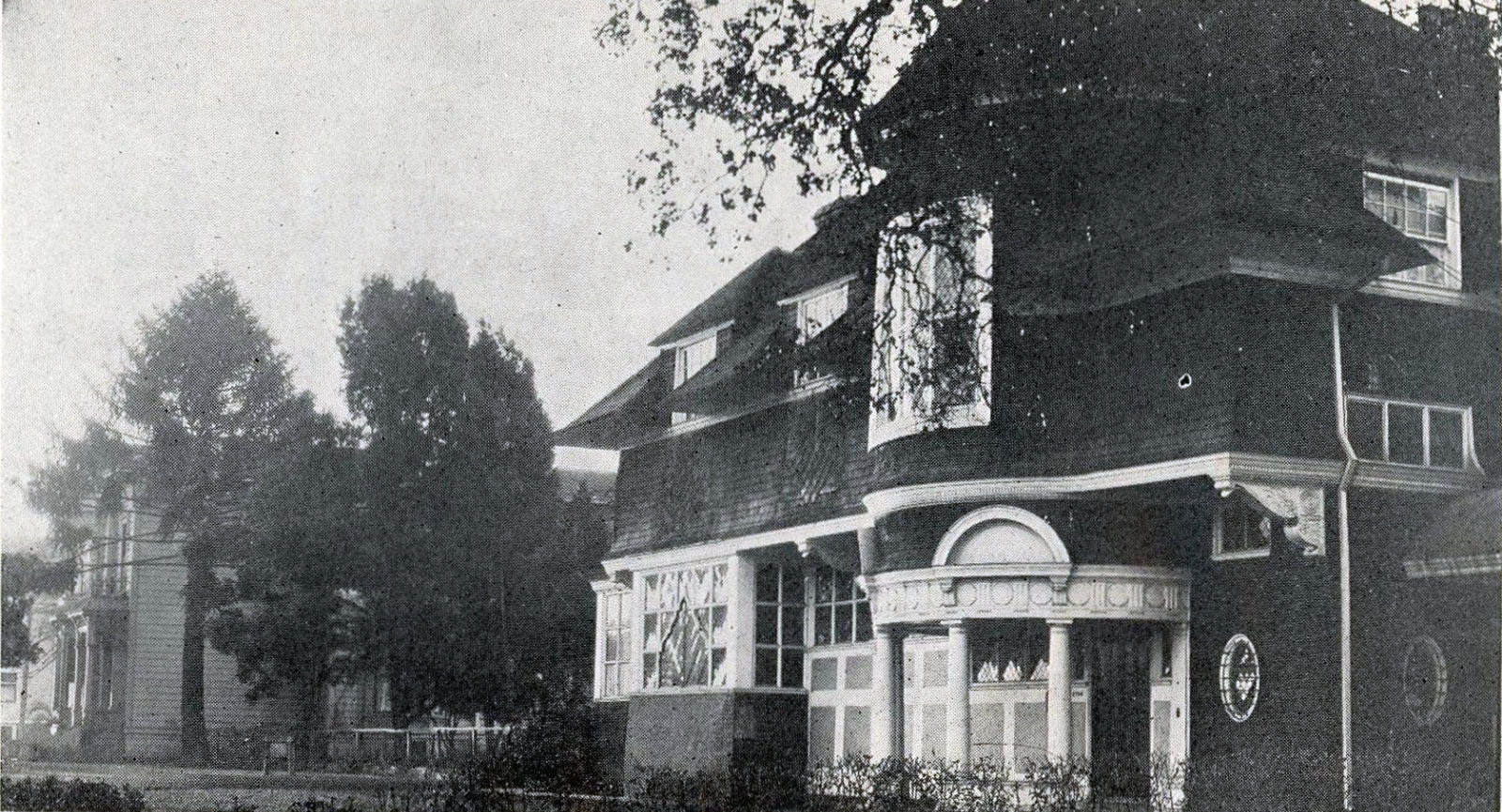
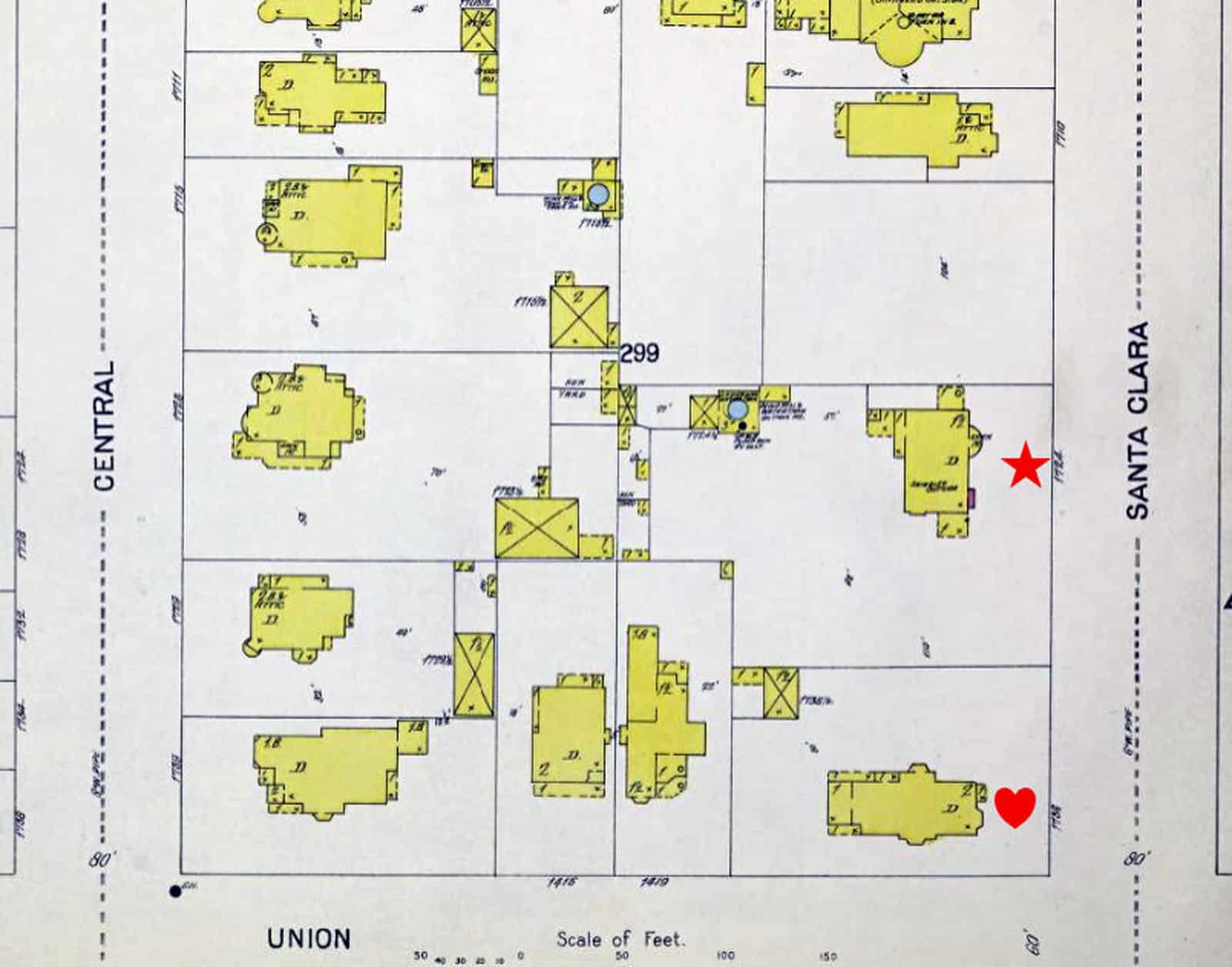
The Lona Hazzard School occupied the house and grounds from 1922 to 1932. The property was still owned by M. G. Martin, but the Martin family continued to rent out the building during this period. An ad in the Alameda Times Star on October 12, 1922 describes the facility as an “Ideal day and boarding school, with spacious grounds, kindergarten and 1st grade work from 9 to 12, hot lunch, rest period, and supervised play to 5 p.m.” By 1924 the Lona Hazzard School was advertising that they offered a “school home and girls dormitory at 1724 Santa Clara Avenue,” and “classrooms and boys dormitory at 1738 Santa Clara Avenue.” The 1738 address refers to a neighboring building to the east that is no longer part of the property and no longer carries the number 1738. It was replaced with a different building in 1940 and today is an orthodontist office. But at the time, the Hazzard School used two different neighboring buildings for their girls and boys programs, including a boarding school. Both buildings may have been part of the Martin property, which was even larger than the property owned by Girls, Inc. today, and extended all the way to Union Street.
Why a private school?
Mrs. Lona Hazzard was interviewed by the Alameda Times Star in December of 1925, and gave reasons why she felt a private school could be “auxiliary and complementary” to the public schools. Mrs. Hazzard explained that a private school, with the option for boarding, could be of benefit for a number of reasons. Among those were: “Busy Mothers—when conditions take them from home and keep their minds occupied in matters foreign to their children’s infantile interests. Nervous or Sick Mothers—Sick mothers are bound to be irritable at times. Such irritability is inevitably transferred to their children, and by them right back to their mother. Traveling Parents—Sometimes it is necessary for parents to travel. Gentleness and refinement are almost impossible for children coming in contact with conditions as are found in hotels, trains, and steamships, while school studies are out of the question. Motherless Homes—The best substitute for mother is a well selected private school.”



Mrs. Hazzard went on to explain that these adverse conditions should not be the only reason for selecting a private school. Among other benefits offered by her school, she cited smaller class sizes, less exposure to children’s diseases, dancing and music instruction, a large enclosed playground under constant supervision, and three hot meals a day.
A Martin finally moves in
The Lona Hazzard School seemed to closed, at least at that location, by 1932. By 1933, Husted’s City Directory shows bookkeeper David G. Martin and his wife Ruth occupying the house. As you will recall from Part 2, David Greenleaf Martin was the grandson of David Greenleaf Sr. His father had married Greenleaf’s daughter, Marianne, in 1883. A relative of his, M. G. Martin, had purchased the property back in 1904, and now, decades later, members of the Greenleaf/Martin family were once again living in the home. They enjoyed living there for about 10 years before putting the home up for sale in 1943, when it was purchased by Floyd and Edwina Larkin. Ruth Martin died in May of 1954, and her husband David G. Martin died just a year and a half later in December of 1955. They had been living in the city of Santa Clara at the time of their deaths, and were buried at Oakland’s Mountain View Cemetery. Floyd and Edwina Larkin would end up holding the record for the shortest ownership of 1724 Santa Clara Avenue at just under six years.
The Boy Scouts move in
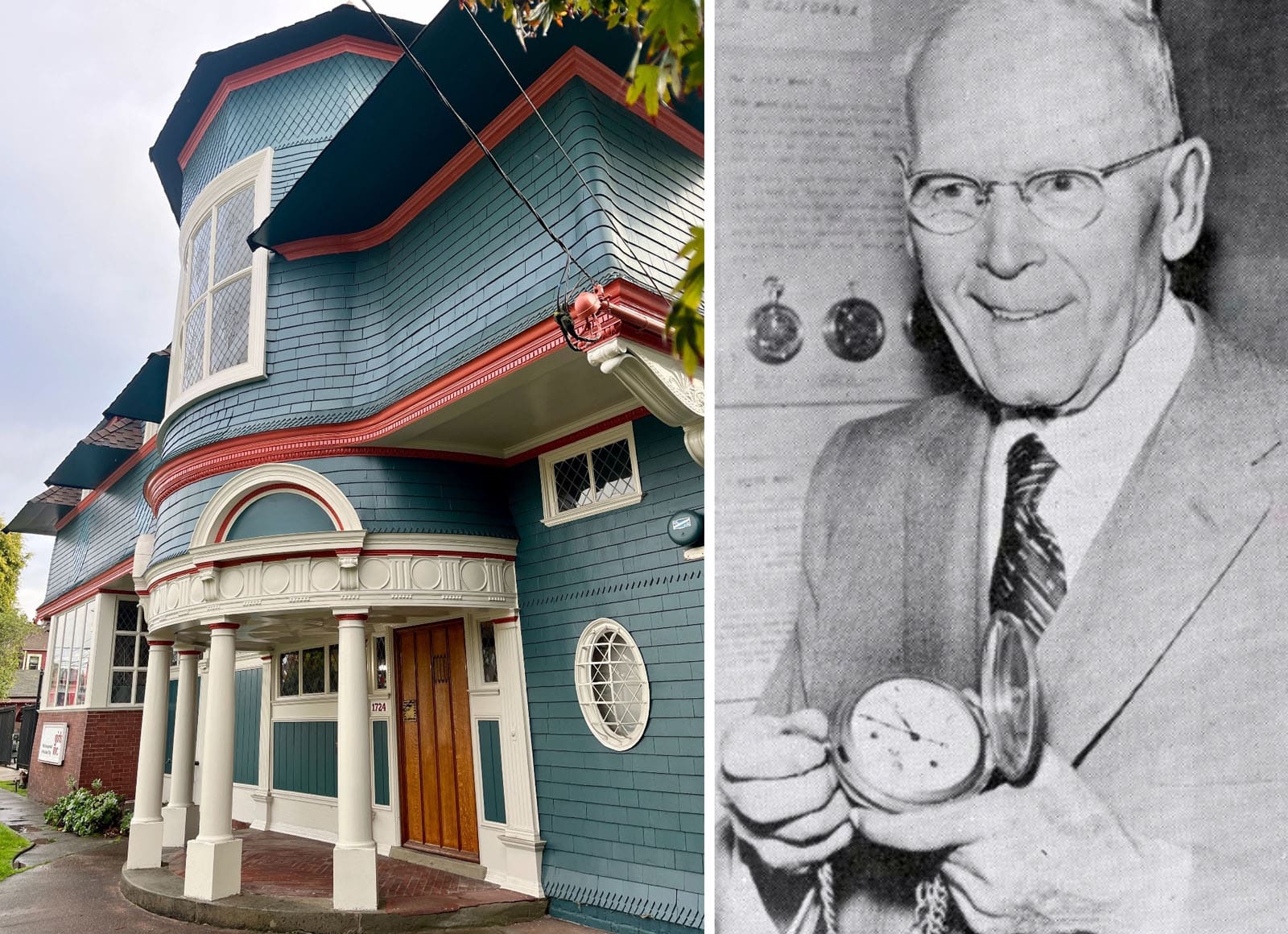
Dr. William Barclay Stephens (1869-1962) founded the Alameda Boy Scouts Council in 1916. Dr. Stephens was born in Paris, Kentucky, and after completing medical school at Columbia in 1893, he opened an eye, ear, nose, and throat practice in San Francisco. After a year there, he moved his practice to Alameda, where he focused on eye research. He was instrumental in founding the Alameda Sanitarium (today known as Alameda Hospital) and even had a wing named for him. Dr. Stephens had many interests, and was a long-time member of the California Academy of Sciences, where he eventually donated his vast collection of clocks, watches, and other types of timepieces. Stephens also had a philosophy that every person should have a hobby, and his was horology—the art and science of measuring time.
In 1949, after presiding over the Boy Scouts chapter in Alameda for 14 years, Dr. Stephens donated $20,000 for the purchase of a building of their own. That building turned out to be 1724 Santa Clara Avenue, and they named it the Stephens Center in his honor. The Scouts also named their camp after him, along with a 65-foot Sea Scout Ship, the Barclay Stephens.
Scouts make changes
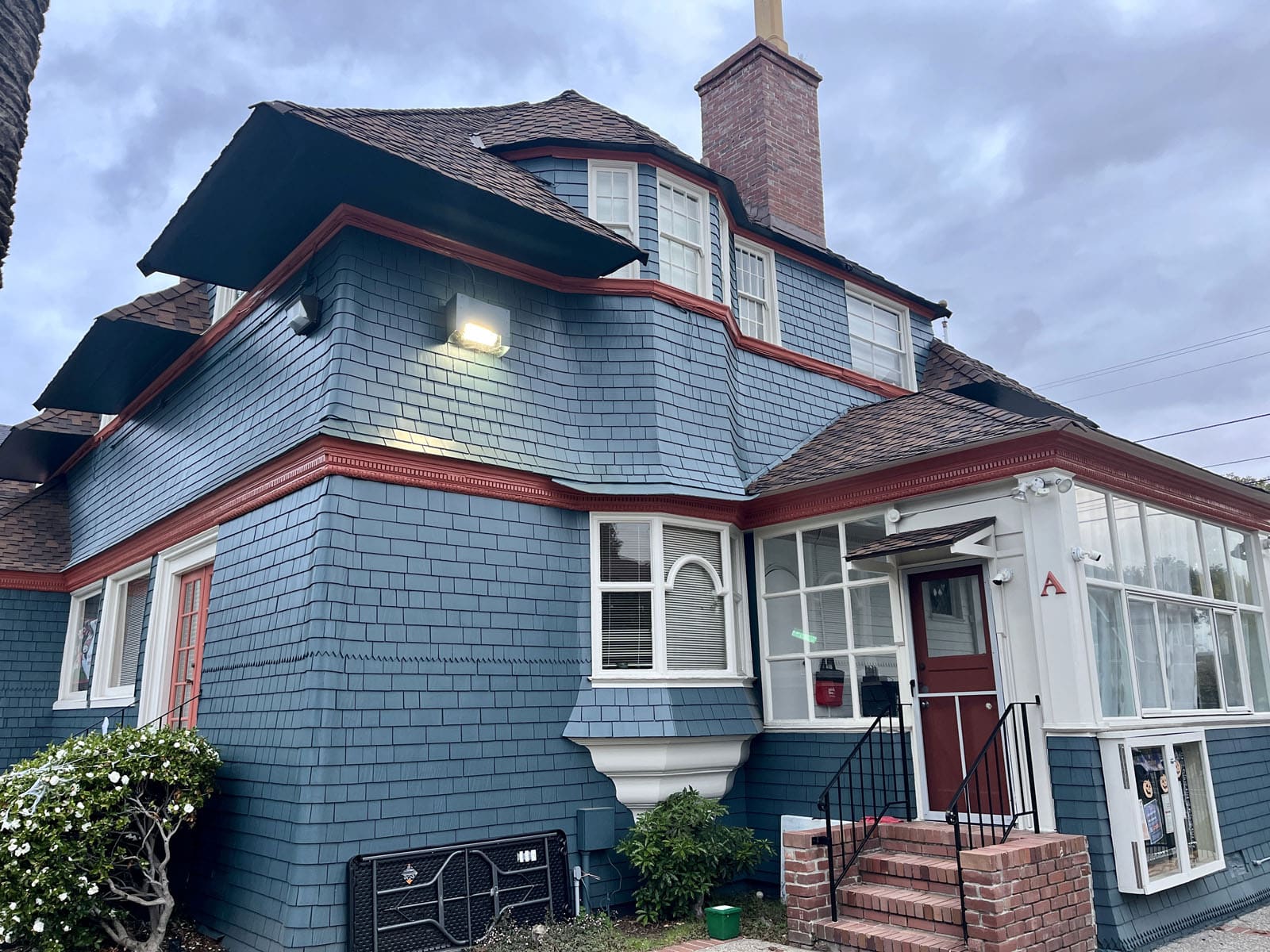
When the Scouts moved into 1724 Santa Clara Avenue in 1950, the almost 60-year-old building had, over the years, been used as a home for multiple families, as well as a classroom and boarding school. As the Scouts adapted it for their own use, they were careful, as all previous owners and tenants had been, to respect the historic heritage of the main building. They did build a recreation center building over a former concrete swimming pool, and put up a warehouse in the area of the former tennis courts.
Between 1976 and 1982, Xanthos House (name later changed to Alameda Family Services) rented out the house, and as their time at this storied property came to a close, another group was waiting in the wings to enter at stage right, where they had been hiding in plain sight all along.
Up next
When our story of the Greenleaf House continues, we’ll learn why the Alameda Girls Club was the obvious choice to be the next owner and caretaker of this property, and how they had been standing close by for years, within sight, waiting for their moment to step up and continue the tradition of stewardship, learning, and growth at this historic spot in Alameda. We’ll also learn when and why the Girls Club changed its name to Girls, Inc., what they do today, and how they serve both boys and girls throughout Alameda—with a focus on girls, of course. All that, and more, when our story continues.
Contributing writer Steve Gorman has been a resident of Alameda since 2000, when he fell in love with the history and architecture of this unique town. Contact him via [email protected]. His writing is collected at AlamedaPost.com/Steve-Gorman.
